
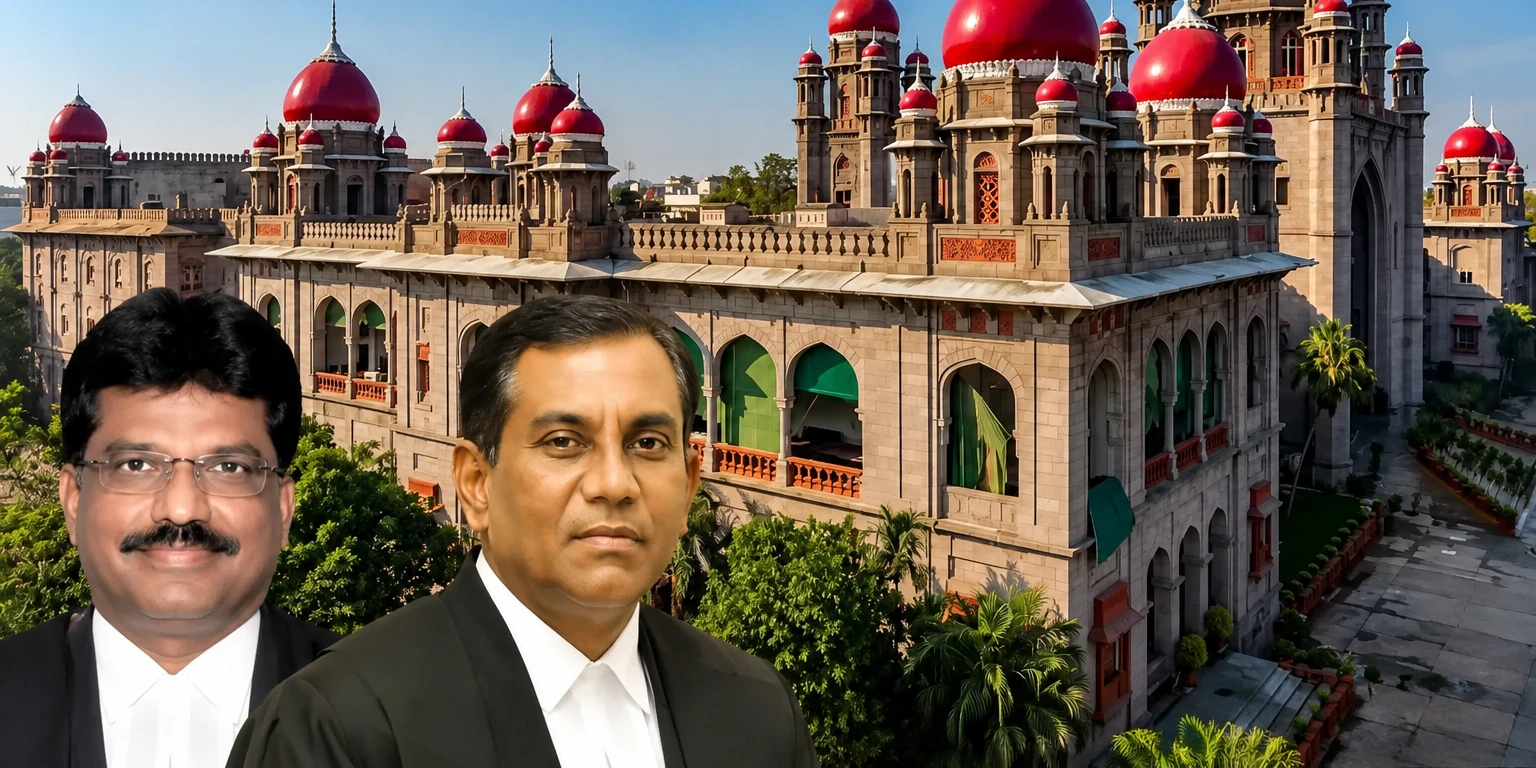
The Telangana High Court has held that permanent alimony under Section 25 of the Hindu Marriage Act, 1955 cannot be awarded unless the party seeking such relief files a specific application before the competent court. The Court clarified that permanent alimony is not an automatic consequence of divorce proceedings and that courts cannot grant such relief in the absence of a formal plea.
A Division Bench comprising Justice K. Lakshman and Justice B.R. Madhusudhan Rao made the observation while deciding a family court appeal filed by a wife challenging the dismissal of her petition seeking annulment of marriage on the ground of alleged fraud and misrepresentation by her husband.
The appellant-wife had approached the Family Court under Section 12(1)(c) of the Hindu Marriage Act seeking a decree of nullity of marriage. According to her, the marriage had been arranged through an online matrimonial platform where the respondent-husband represented his date of birth as February 9, 1981.
The wife alleged that after the marriage she discovered that the husband's actual date of birth was February 9, 1974. She contended that horoscope matching had been conducted on the basis of the incorrect date of birth and that her consent to the marriage had been obtained through misrepresentation and fraud.
Claiming that she became aware of the true date of birth only during the process of marriage registration before the Sub-Registrar, she sought annulment of the marriage.
However, the Family Court dismissed her petition, prompting her to file the present appeal before the High Court.
During the pendency of the appeal, both parties filed affidavits before the High Court stating that they were no longer interested in continuing the marital relationship.
The wife expressed her willingness to withdraw pending criminal and domestic violence proceedings subject to a fair financial settlement and return of her gold ornaments. The husband, in turn, indicated that he would not oppose the appeal if those proceedings were withdrawn.
Taking note of the parties' stand, the High Court observed that there was no possibility of reconciliation and that the marriage had effectively broken down.
The Bench observed that disputes relating to the return of gold ornaments, financial settlement, and withdrawal of pending criminal proceedings had arisen during the pendency of the appeal and had not been pleaded or adjudicated before the Family Court.
Holding that these involved disputed questions of fact, the Court declined to examine them in appellate proceedings.
The Court observed that such claims would have to be pursued before the appropriate forum in accordance with law.
One of the principal issues before the Court was whether permanent alimony could be awarded in the appeal despite the absence of a separate application under Section 25 of the Hindu Marriage Act.
Rejecting the contention advanced on behalf of the wife, the Court held that the statutory language of Section 25 clearly requires an independent application seeking permanent alimony.
The Bench observed:
"A bare reading of Section 25 clearly indicates that a separate application is required to be made for seeking permanent alimony."
The Court further held:
"In the present case, in the absence of a specific application, we cannot award permanent alimony to the appellant/wife."
According to the Court, merely raising the issue during arguments or through affidavits filed in appeal cannot substitute the statutory requirement of filing an application under Section 25.
The High Court relied upon a decision of the Madhya Pradesh High Court, which had similarly held that permanent alimony cannot be granted unless a specific application seeking such relief is filed.
The Bench reiterated that compliance with the statutory procedure is mandatory and that courts cannot bypass the requirement by awarding permanent alimony in the absence of a formal claim.
Allowing the appeal, the High Court set aside the Family Court's order and dissolved the marriage by granting a decree of divorce.
However, the Court declined to grant permanent alimony due to the absence of an application under Section 25 of the Hindu Marriage Act.
The Bench clarified that the wife remains free to pursue appropriate legal remedies for permanent alimony and recovery of her gold ornaments before the competent forum, including in the domestic violence proceedings already pending between the parties.
The ruling reinforces the procedural requirement under Section 25 of the Hindu Marriage Act and clarifies that permanent alimony is not an automatic relief that can be granted merely because matrimonial proceedings culminate in divorce. The judgment underscores that a specific application is a statutory precondition for consideration of any claim for permanent alimony.
Website designed, developed and maintained by webexy