
In a significant development in the Raja Raghuvanshi honeymoon murder case, the Supreme Court on Thursday set aside the bail granted to Sonam Raghuvanshi, the prime accused in the alleged murder of her husband during their honeymoon in Meghalaya. The Court directed her to surrender before the authorities within three weeks.
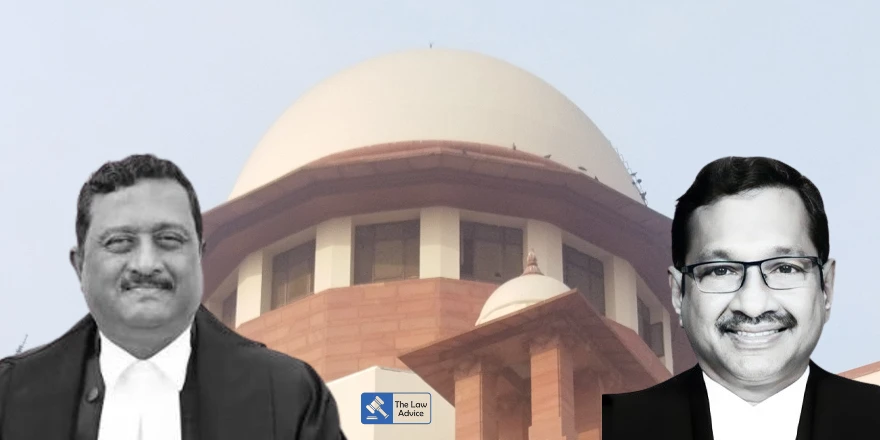
A Bench comprising Justices MM Sundresh and PB Varale allowed the Meghalaya government's appeal against the High Court's decision that had upheld the trial court's order granting bail.
The Supreme Court observed that the courts below had granted bail on the ground that the investigating agency had failed to properly communicate the grounds of arrest to the accused. However, the Bench clarified that there is a crucial distinction between complete non-service of the grounds of arrest and inadequacy in the reasons supplied.
The Court held that while complete non-service of the grounds of arrest may render an arrest illegal, a case involving alleged inadequacy requires the court to examine whether any actual prejudice has been caused to the accused.
The Bench observed:
"On facts we find that respondent is not entitled to bail. It is not as if the respondent was not served with the grounds of arrest. There is a difference between non-service and giving adequate reasons. While the first category might vitiate the arrest, in the second one has to see the prejudice."
The Supreme Court emphasized that although "bail is the rule and jail is the exception," Sonam Raghuvanshi had already been denied bail on three earlier occasions, and those orders had attained finality.
The Bench further noted that the criminal trial has already commenced and allowing the accused to remain on bail at this stage could adversely affect the ongoing proceedings.
Accordingly, the Court cancelled the bail granted by the lower courts and directed Sonam Raghuvanshi to surrender within three weeks.
However, the Bench granted her liberty to file a fresh bail application if the trial is not concluded within six months.
The Court also clarified an important legal principle concerning arrest procedure.
It held that even if there is non-compliance regarding the service of the grounds of arrest, such a defect does not prevent the investigating agency from re-arresting the accused during the course of investigation.
The Bench observed:
"A non-compliance of the service of grounds of arrest will not act as a fetter to re-arrest for the purpose of investigation."
During the hearing, the Bench also made broader observations on changing social trends.
The Court remarked that while today's generation possesses greater access to information, it is often more vulnerable when dealing with pressure and emotional challenges.
When Solicitor General Tushar Mehta remarked that young people today have "more information but less knowledge," Justice PB Varale added:
"Whatever is being shared on WhatsApp is being treated as knowledge."
Sonam Raghuvanshi is accused of conspiring to murder her husband, Raja Raghuvanshi, during their honeymoon in Meghalaya's East Khasi Hills district in May 2025.
She was arrested in June 2025 and later charge-sheeted for offences including murder. The trial is presently underway.
In April 2026, the District and Sessions Court at East Khasi Hills granted her bail, holding that the investigating agency had failed to effectively communicate the grounds of her arrest as required under law.
The Meghalaya government challenged that order before the High Court, but on June 29, 2026, the High Court upheld the bail, observing that the "grounds of arrest" had been prepared mechanically and contained irrelevant entries.
The State thereafter approached the Supreme Court seeking cancellation of the bail.
Appearing for Sonam Raghuvanshi, Advocate Ardhendumauli Prasad submitted that the prosecution had cited 94 witnesses and only four witnesses had been examined so far.
He argued that the arrest memo itself demonstrated that Sonam had been arrested from Gazipur in Uttar Pradesh and had not voluntarily surrendered before the Meghalaya Police. He further contended that the documents supplied as grounds of arrest were defective, incomplete and contained incorrect references to offences.
On the other hand, Solicitor General Tushar Mehta, appearing for the Meghalaya government, argued that Sonam had surrendered before the investigating agency and that the legal precedents relating to supply of grounds of arrest did not apply in the same manner where an accused voluntarily surrenders.
The Supreme Court, however, questioned whether the issue regarding the grounds of arrest could be raised after the accused had already unsuccessfully sought bail on merits three times.
Finding no merit in the defence submissions, the Bench allowed the State's appeal and cancelled Sonam Raghuvanshi's bail.
While directing her surrender, the Court observed that if the trial does not progress adequately within six months, she would be free to approach the court again seeking regular bail.
Website designed, developed and maintained by webexy