
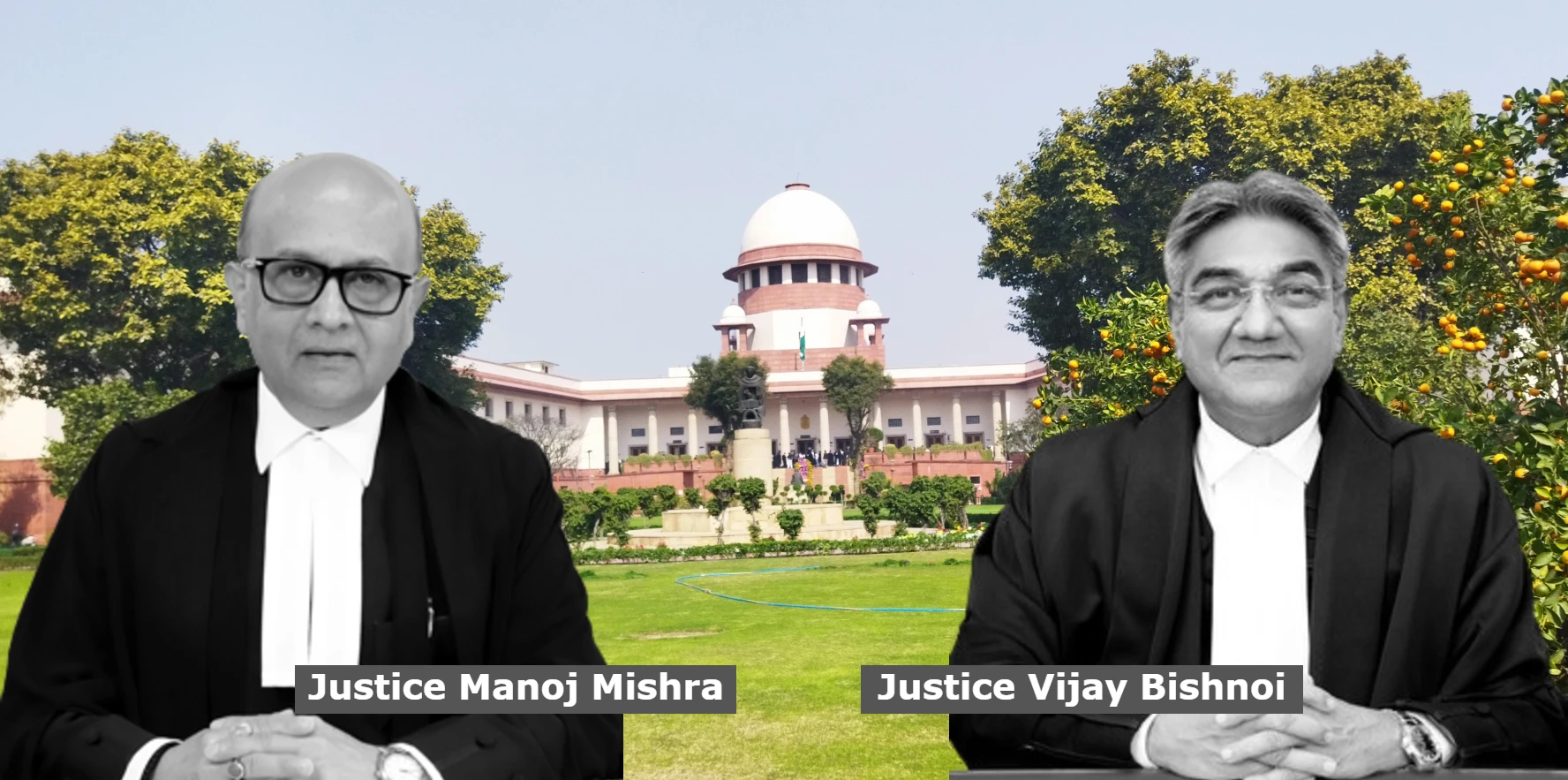
The Supreme Court has set aside the enhancement of sentence imposed by the Madras High Court on Gopi @ Sahaya Puruna, holding that a High Court cannot enhance a convict’s sentence in exercise of revisional jurisdiction when there is no appeal for enhancement filed by the State, victim or complainant.
A Bench of Justice Manoj Misra and Justice Vijay Bishnoi pronounced the judgment in Gopi @ Sahaya Puruna v. State, Rep. by the Inspector of Police on August 18, 2026.
The case arose from a gruesome 2007 incident in Kanyakumari District in which Dr. A. Malik Mohammed and his watchman Gnanaprakasam were killed, while Dr. Mohammed’s wife, Katheeja Bibi, was abducted and later burnt alive. Gopi and co-accused Ambarasu were prosecuted in connection with the offences.
The Trial Court had convicted Gopi under several provisions of the IPC, including Sections 449, 302, 392, 364 and 201, and imposed multiple sentences of life imprisonment along with fixed-term imprisonment. The sentences were directed to run consecutively.
The Madras High Court subsequently set aside his conviction under Section 120-B IPC but maintained the remaining convictions. It enhanced his life imprisonment to imprisonment for the remainder of his natural life and affirmed the direction that the sentences would run consecutively.
The Supreme Court held that such enhancement was impermissible. Relying on its earlier decision in Nagarajan v. State of Tamil Nadu, the Court reiterated that when an accused challenges conviction and sentence, the appellate court cannot make the accused worse off by enhancing the sentence unless there is an appeal or revision seeking enhancement by the State, victim or complainant.
The Court therefore set aside the High Court’s enhancement of Gopi’s sentence from life imprisonment to imprisonment for the remainder of his natural life.
The Supreme Court also examined whether multiple sentences, including life imprisonment, could be directed to run consecutively.
Referring to the Constitution Bench decision in Muthuramalingam v. State, the Court held that the legal position is settled: a sentence of life imprisonment cannot be directed to run consecutively either with another life sentence or with a fixed-term sentence.
In Gopi’s case, the Trial Court had awarded five life sentences—including sentences under Sections 449, 302 and 364 IPC—and a seven-year rigorous imprisonment sentence under Section 201 IPC, all of which had been directed to run consecutively. The Supreme Court held that this was contrary to the settled law.
Accordingly, the Court modified the sentence arrangement and directed that all the sentences shall run concurrently. It concluded that the High Court had wrongly exercised its suo motu revisional jurisdiction to enhance the sentence and had also erred in directing consecutive sentences.

Representation:-
For Petitioner(s) :Ms. Payoshi Roy Adv., Mr. S. Prabu Ramasubramanian Adv., Ms. V. Swetha Adv., Mr. P Ashok Adv., Mr. Chandra Kiran K Adv., Mr. Vairawan A.S AOR
For Respondent(s) :Ms. Vrinda Bhandari AOR, Ms. Vanshita Gupta Adv
Website designed, developed and maintained by webexy