
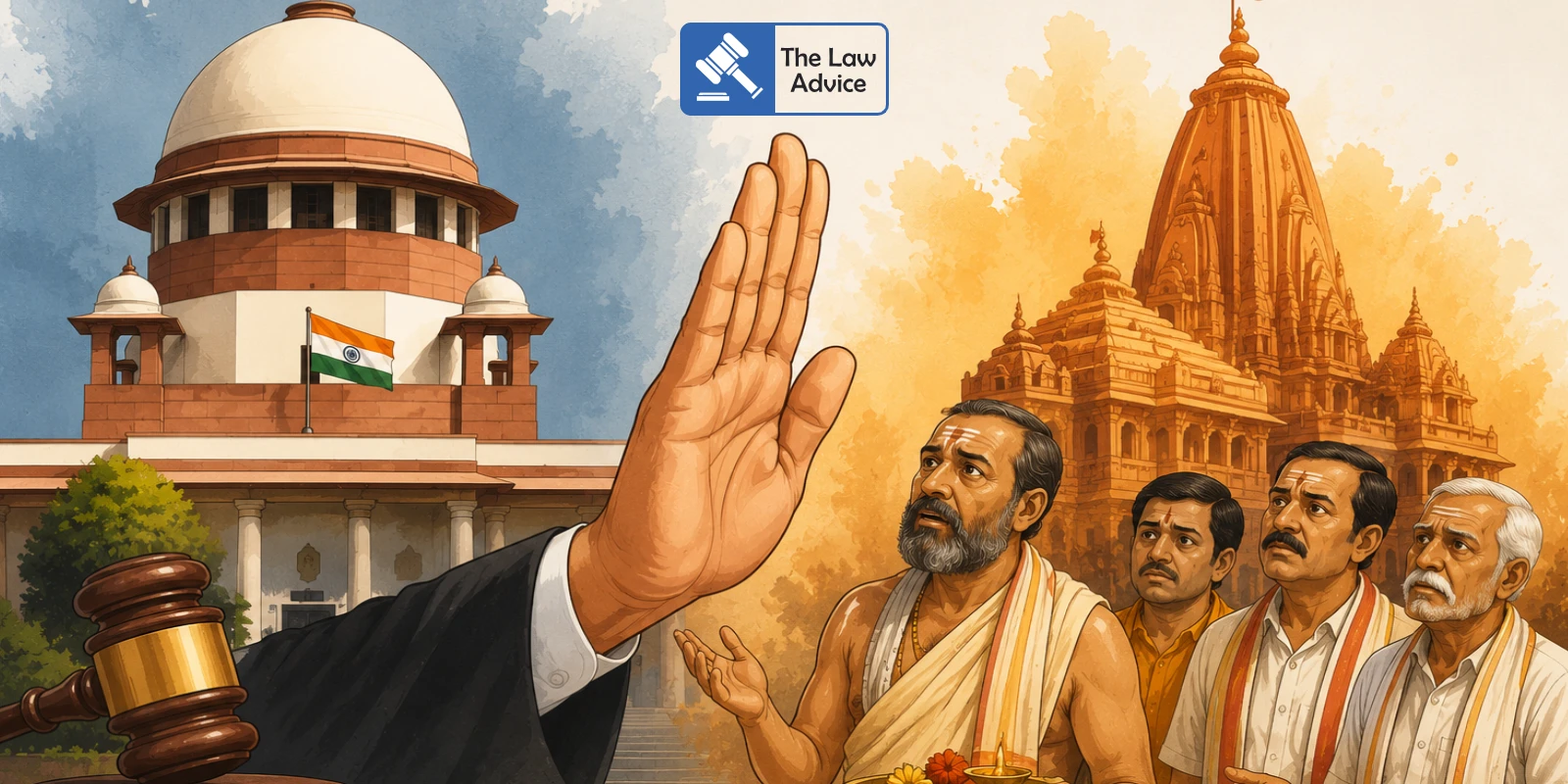
The Supreme Court on Monday issued notice to the Union government and the governments of Madhya Pradesh, Uttar Pradesh and Rajasthan on a writ petition filed by 237 hereditary pujaris and owners of private temples, alleging that temple properties built on private land are being auctioned by the authorities.
A Bench of Justice Aravind Kumar and Justice Alok Aradhe sought responses from the Centre and the concerned States on the plea.
The petitioners contend that the temples were established by their ancestors on private land and have always remained private temples. However, they allege that executive circulars, including one issued in 1974, resulted in District Collectors being recorded as managers of these temples, paving the way for government control and proposed auctions of temple properties.
During the hearing, Justice Aravind Kumar questioned why the petitioners had not challenged the revenue entries for nearly six decades if the Collectors' names had been entered pursuant to the 1974 circular.
In response, counsel for the petitioners submitted that although the entries were made long ago, the authorities are only now attempting to auction the temple lands.
Justice Kumar observed that several disputes involving temple properties have come before the Court and remarked that in many instances, temple properties are allegedly mismanaged. He also noted that, in law, temple properties vest in the deity.
The Bench initially expressed reluctance to entertain the petition, observing that the appropriate remedy may be a civil suit. Justice Kumar also referred to his visits to Mathura, saying that the temple area had significantly improved after government intervention, compared to its condition over two decades ago.
Through the petition, the pujaris have sought the constitution of an independent authority or tribunal to determine whether the temples are private or public. They have also challenged the validity of the executive circulars, particularly the April 12, 1974 circular, and sought the quashing of revenue entries showing District Collectors as temple managers.
Additionally, the petitioners have sought restoration of their names, along with the deity, in the revenue records as owners and hereditary pujaris. They have also requested interim protection against any coercive action, including the auction, demolition or interference with the temple properties.
Case: Purandas v. Union of India, W.P. (C) No. 828/2026.
Website designed, developed and maintained by webexy