
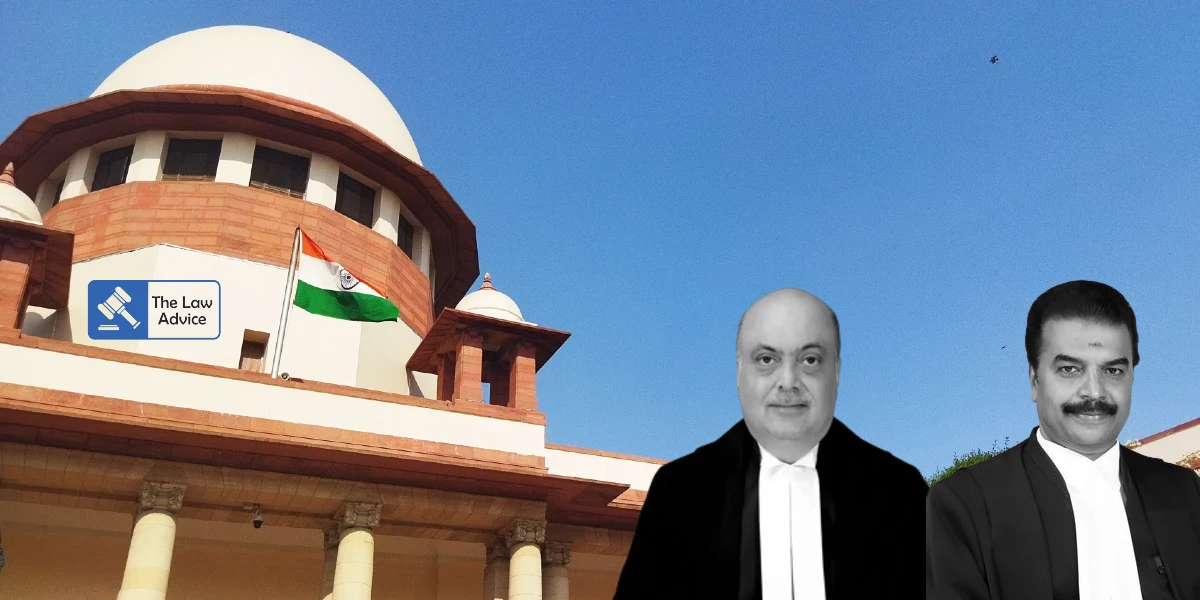
The Supreme Court has held that a surplus employee can be absorbed only against the post from which he was declared surplus, or an equivalent or lower post, and cannot claim direct absorption to a higher post merely because he subsequently satisfies the eligibility criteria for that position.
A Bench comprising Justice Ahsanuddin Amanullah and Justice R. Mahadevan set aside a Bombay High Court order which had directed the absorption of a former Lecturer to the post of Head of Department (Civil Engineering) at the Institute of Civil and Rural Engineering, Gargoti, District Kolhapur.
The judgment was delivered in The State of Maharashtra & Ors. v. Sudhakar Shivaram Teke & Ors. on August 11, 2026.
Employee Was Declared Surplus as Lecturer
The dispute arose after Sudhakar Shivaram Teke was declared surplus and disengaged from service pursuant to the Maharashtra Government Resolution dated September 10, 2001.
Under the State's surplus employee absorption policy, such employees were liable to be absorbed against an equivalent post available in another institution or college of the same category.
Teke was holding the post of Lecturer when he was declared surplus. He was subsequently absorbed as a Lecturer and eventually superannuated in 2024.
His grievance, however, was that he should have been directly absorbed as Head of Department (Civil Engineering) because the pay scales attached to the posts of Lecturer and Head of Department were equivalent.
The Institute rejected his claim on February 18, 2011, following which he approached the Bombay High Court.
Bombay High Court Had Allowed His Claim
The Bombay High Court allowed Teke's writ petition, primarily relying upon the provisions of the Maharashtra Employees of Private Schools (Conditions of Service) Regulation Act, 1977 (MEPS Act).
The High Court proceeded on the basis that the post of Head of Department was required to be filled by the senior-most Lecturer and that Teke satisfied the required criterion.
The State challenged this reasoning before the Supreme Court, arguing that the statutory method of filling the post of Head of Department could not be equated with the separate question of absorption of a surplus employee.
Supreme Court Finds Fundamental Error in High Court Order
The Supreme Court held that the High Court had committed a fundamental error by treating eligibility for appointment as Head of Department as sufficient to establish a right to absorption against that post.
The Court observed that the State's absorption policy governed the post against which a surplus employee could be absorbed. Since Teke was holding the post of Lecturer when he was declared surplus, his entitlement under the policy was confined to absorption as a Lecturer, or against an equivalent or lower post, depending upon availability.
The Court made it clear that the absorption policy could not be used to confer upon a surplus employee a post higher than the post held at the time of being declared surplus.
Pay Scale Equivalence Does Not Create Right to Higher Post
The Supreme Court rejected the argument that the equivalent pay scales of Lecturer and Head of Department entitled Teke to direct absorption as Head of Department.
It held that equivalence of pay scales, by itself, cannot alter the nature of the post against which an employee is to be absorbed under a surplus employee policy.
The Court also rejected the argument based on the availability of a vacancy, observing that the existence of a vacant higher post could not confer a right to direct absorption against that post.
Appointment or Promotion to Higher Post Is a Separate Claim
The Bench drew a clear distinction between absorption and subsequent appointment, promotion or elevation.
The Court held that once Teke was absorbed against the post of Lecturer, any subsequent claim for appointment or promotion to the post of Head of Department would constitute a separate cause of action.
Such a claim, if legally available, would have to be considered independently under the statutory rules and procedure governing appointment to the higher post.
The Court also took note of the fact that Teke had conceded that he was holding the post of Lecturer and not Head of Department when he was declared surplus.
Supreme Court Sets Aside Bombay High Court Order
The Supreme Court accordingly allowed the State's appeal and set aside the Bombay High Court's order dated September 27, 2019, passed in Writ Petition No. 1841 of 2013 along with Civil Application No. 395 of 2019.
The Court held that Teke was entitled to absorption as a Lecturer under the applicable policy.
However, the Bench clarified that it was expressing no opinion on any independent claim that Teke might have had concerning any subsequent appointment, promotion or other benefit relating to the post of Head of Department. Since he had already retired, any such claim, if raised, would have to be considered by the appropriate forum in accordance with law.
Key Legal Principle
A surplus employee cannot claim absorption to a higher post than the post held when declared surplus. Equivalence of pay scales or the existence of a vacancy in a higher post does not create a right to direct absorption. Any subsequent claim for promotion or appointment to the higher post must be considered separately under the applicable statutory rules.
Case Details

Representation:-
For Petitioner(s) Mr. Aniruddha Deshmukh Adv., Mr. Siddharth Dharmadhikari Adv., Mr. Aaditya Aniruddha Pande AOR, Mr. Shrirang B. Varma Adv.
For Respondent(s) Ms. Pranjal Chapalgaonkar Adv., Mr. Vatsalya Vigya AOR
Website designed, developed and maintained by webexy