
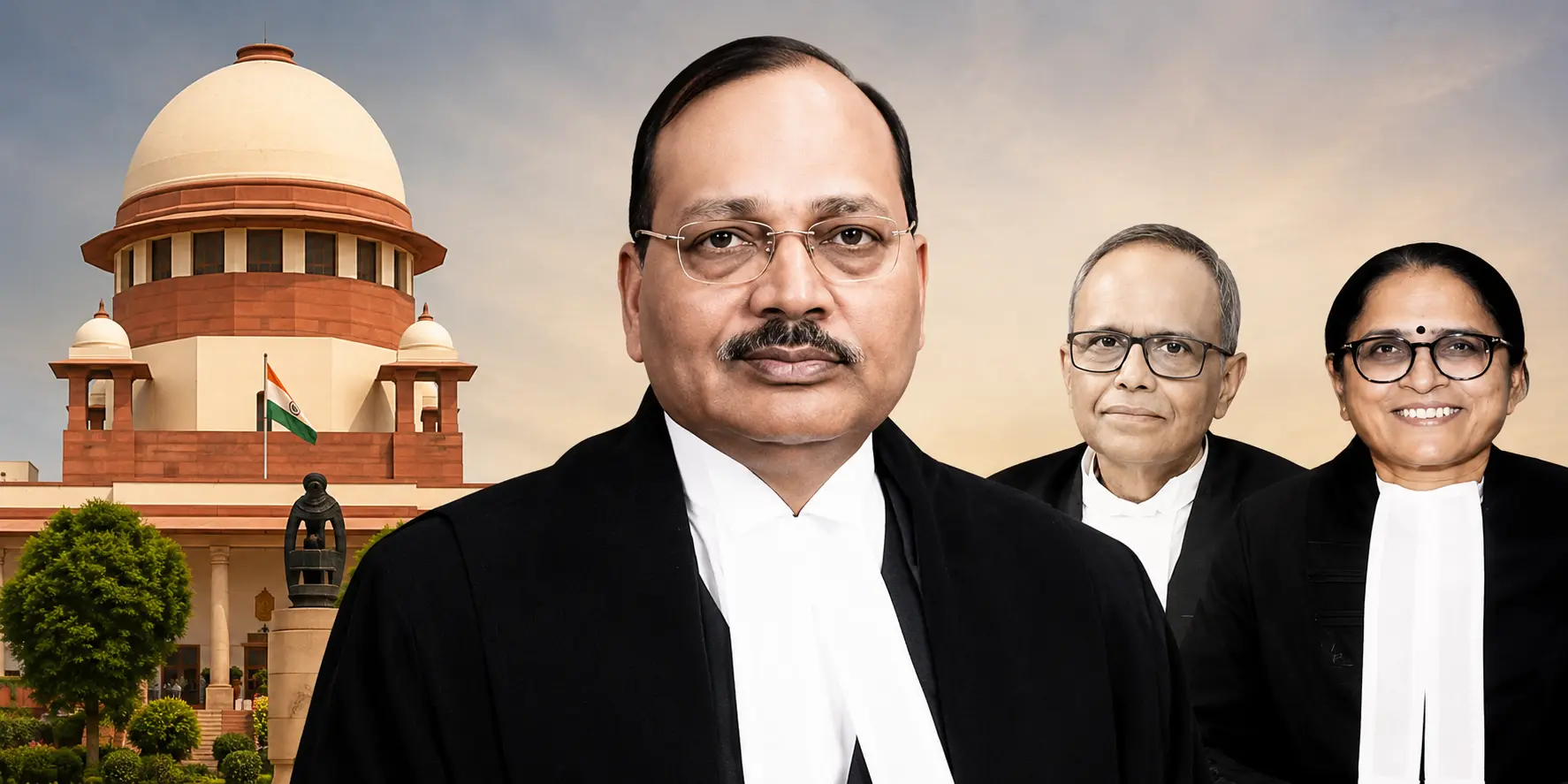
The Supreme Court on Tuesday took up for further consideration the issue of enhancing the retirement age of judicial officers from 60 to 62 years, after the State Governments and High Courts submitted their respective status reports pursuant to the Court’s earlier directions.
The matter is being considered by a Bench comprising Chief Justice of India Surya Kant, Justice Joymalya Bagchi and Justice V. Mohana in the long-running All India Judges Association v. Union of India proceedings.
The larger issue before the Court concerns enhancement of the age of superannuation of judicial officers on an all-India basis.
States and High Courts asked to submit reports
In its order dated 05 August 2026, the Supreme Court had asked all State Governments and High Courts to take a time-bound decision on the issue and apprise the Court of their respective positions.
The Court had specifically directed the State Governments, through their Advocates General, and the High Courts, through their Registrars General, to submit status reports by 2 PM on 31 August 2026, with an advance copy to the learned Amicus Curiae.
The matter has now come up pursuant to that exercise, with the reports before the Court.
Several States considering enhancement
During the proceedings, the Court was apprised that four to five States are considering increasing the retirement age of judicial officers to 62 years.
Some States have already taken steps in this direction. The August 5 order recorded that Telangana and Andhra Pradesh had already enhanced the retirement age to 61 years, while Madhya Pradesh had indicated that, taking into account the recommendation of the Full Court of its High Court, it was willing to consider increasing the age, although a final decision was then pending. Assam and the NCT of Delhi had sought further time.
States had raised parity and financial concerns
Most States had earlier opposed enhancement of the retirement age, principally citing two grounds: the disparity between the retirement age of judicial officers and employees of other State Government departments, and the anticipated additional financial burden on the State exchequer.
The issue of parity with other government employees has also featured prominently in the arguments before the Court. The State side had expressed concern that an increase in the retirement age of judicial officers could lead employees in other State services to demand similar treatment.
However, the Supreme Court had indicated on August 5 that judicial officers constitute a distinct class and that their service conditions cannot necessarily be equated with those of the administrative executive. The Court relied upon its earlier judgment in All India Judges Association v. Union of India, which had emphasised the constitutional and functional distinction between the judiciary and other State services.
Sr. Advocate Vikas Singh, Ashish Giri, Vijay Hansaria appeared for few of the judicial officers from various states.
Sr. Advocate Ashish Giri appearing for the Judicial Officers of the State of Rajasthan argued that that the cut off date for enghancement of the age of the Judicial Officer shal be fixed as per the judgment of Hon’ble Apex Court passed in (1993) 4 SCC 288 whereby it was held “the State Governments should take appropriate steps to raise the retirement age of judicial officers by 31st December, 1992. It meant that those who were to retire on or before 31st December, 1992 would not get the benefit of the enhanced age of retirement. In the present case, the writ petitioner was admittedly to retire on 31st December, 1992 according to the superannuation age prevalent till that time, viz., 58 years. He would not, therefore, be entitled to the benefit of the enhanced retirement age which is to come into force from 1st January, 1993. The writ petition is accordingly, dismissed. I.A. No. 1 of 1993 which is for ad-interim relief will also stand dismissed.”
While Sr. Advocate Vikas Singh submitted that the Court shall do it, whatever the date it is.
The Advocate Generals of most of the states were virtually present before the bench, and all of them unanimously supported this.
Supreme Court had rejected financial burden as a sufficient ground
The August 5 order also recorded the submissions that enhancement of the retirement age could actually reduce the financial burden on States by postponing pension payments and avoiding the immediate need for recruitment and training of new judicial officers.
The Court noted that the benefits of retaining experienced judicial officers could outweigh the additional expenditure involved.
On a prima facie consideration, the Bench had observed that neither of the reasons advanced by the State Governments for declining enhancement appeared tenable. Nevertheless, the Court said that the issue should preferably be resolved through consensus and asked States to revisit their decisions regarding enhancement from 60 to 62 years.
The Court had also clarified that State Governments were not required to reject enhancement merely because their respective High Courts had expressed reservations. The views of the High Courts would be considered by the Supreme Court while taking the final decision.
Final decision yet to come
The submission of the status reports by the States and High Courts marks the next stage in the Supreme Court's consideration of whether the retirement age of judicial officers should be uniformly enhanced.
The Court is now expected to examine the respective positions taken by the States and High Courts before taking a final decision on the issue.
Case: All India Judges Association & Ors. v. Union of India & Ors.
W.P. (C) No. 1022/1989
Website designed, developed and maintained by webexy