
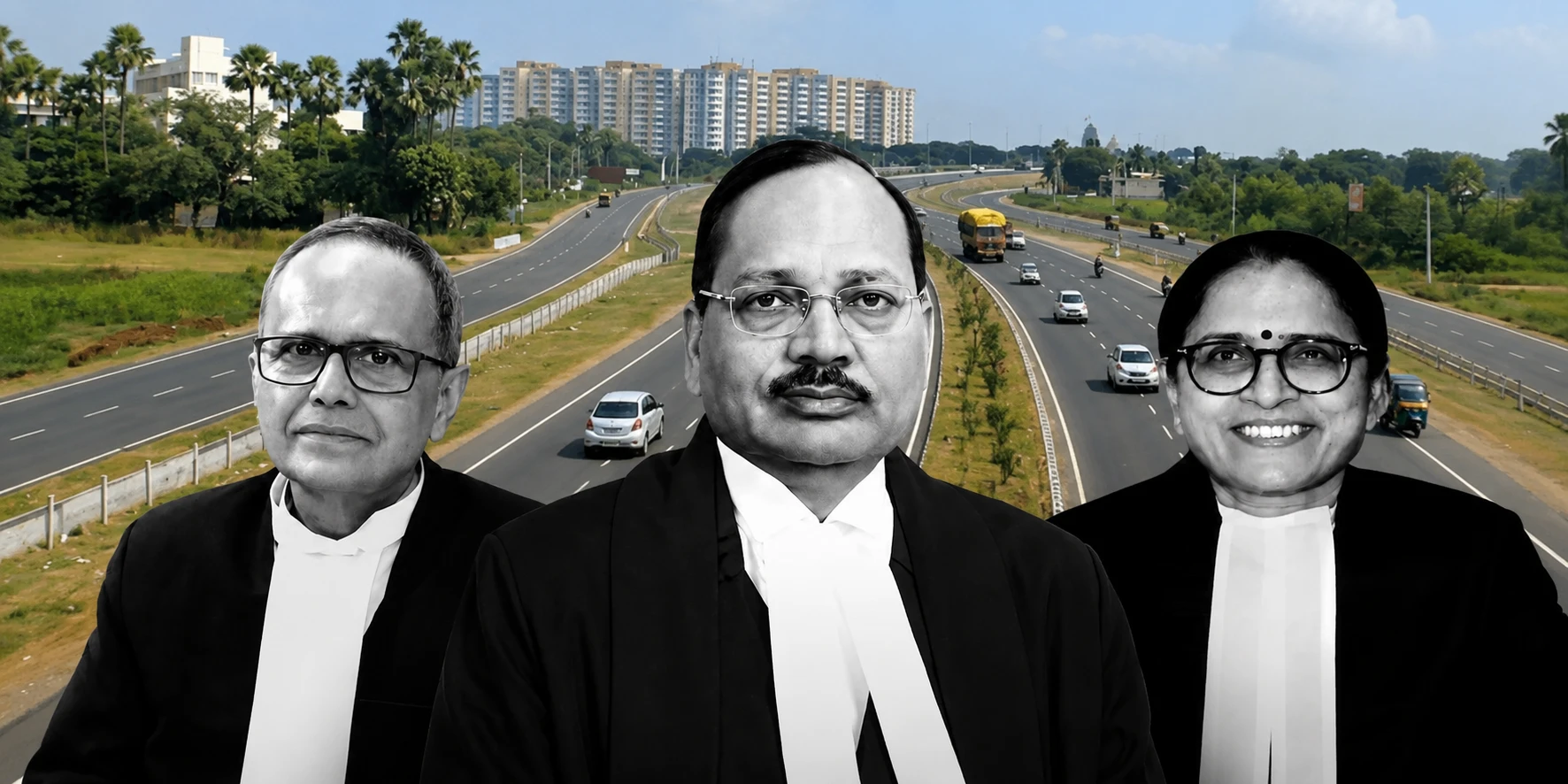
The Supreme Court on Thursday urged the Union Government to amend the National Highways Act, 1956, observing that disputes relating to land acquisition compensation should be adjudicated by judicially trained authorities rather than bureaucrats.
A Bench comprising Chief Justice of India Surya Kant, Justice Joymalya Bagchi, and Justice V. Mohana was hearing a batch of Special Leave Petitions challenging the Punjab and Haryana High Court's judgment declaring Sections 3G and 3J of the National Highways Act unconstitutional.
The Bench expressed serious concern over the existing statutory framework under the National Highways Act, where disputes over compensation are decided by government-appointed arbitrators such as Collectors or Commissioners instead of judicial courts.
According to the Court, determination of compensation is essentially a judicial exercise involving assessment of market value, appreciation of evidence, and adjudication of legal rights—functions that should ordinarily be performed by judicially trained persons.
Chief Justice Surya Kant remarked:
"Every such Act dealing with land acquisition provides that determination of compensation, which is purely a judicial exercise, is done by judicially trained minds. This is the only Act where an exception has been carved out and bureaucrats have been entrusted with this. That is prima facie not acceptable to us."
He added that the issue requires immediate correction, either through legislative intervention by Parliament or judicial directions from the Court.
Attorney General R. Venkataramani informed the Court that the Union Government is actively considering amendments to the National Highways Act.
He assured the Bench that if the proposed amendments are enacted, they would also address the pending compensation disputes.
Recording this assurance, the Supreme Court directed that the ongoing arbitration proceedings under the Act may continue, subject to the final outcome of the present proceedings.
The Court highlighted a significant disparity between landowners whose properties are acquired under the National Highways Act and those whose lands are acquired under other land acquisition statutes.
Under both the Land Acquisition Act, 1894 and the Right to Fair Compensation and Transparency in Land Acquisition, Rehabilitation and Resettlement Act, 2013, disputes regarding compensation are decided by judicial courts, ensuring independent adjudication and broader appellate remedies.
However, under the National Highways Act, compensation disputes are referred to statutory arbitration before government officers, raising concerns about independence and fairness.
The Bench observed that this unequal treatment may affect the constitutional protection of property rights guaranteed under Article 300A of the Constitution.
Solicitor General Tushar Mehta, appearing for the National Highways Authority of India (NHAI), submitted that the National Highways Act incorporates the Arbitration and Conciliation Act, 1996, and that statutory arbitration exists under several other enactments as well.
Justice Joymalya Bagchi, however, sought detailed arguments on whether the unilateral appointment of arbitrators under the National Highways Act is compatible with the Arbitration Act.
The Court questioned whether there exists a conflict between the special provisions of the National Highways Act and the safeguards contained in the Arbitration Act, particularly concerning the independence of arbitrators.
Before concluding the hearing, Chief Justice Surya Kant also expressed concern over the continued denial of solatium and interest to several landowners despite earlier Supreme Court rulings.
Recalling the Supreme Court's decision in Union of India v. Tarsem Singh, the Chief Justice observed that farmers had already suffered injustice when the statutory benefits of solatium and interest were denied under the National Highways Act.
He remarked that while land acquired for national highways often appreciates in value due to infrastructure development, affected landowners continue to face procedural hurdles in obtaining fair compensation.
One of the counsels informed the Court that despite the Tarsem Singh judgment, many landowners are still compelled to litigate for payment of solatium and interest.
Pending final adjudication, the Supreme Court directed that all arbitrators handling compensation disputes under the National Highways Act shall continue with the pending proceedings, subject to the outcome of the present case.
The matter is expected to have far-reaching implications for thousands of land acquisition disputes across the country and may lead to significant reforms in the compensation mechanism under the National Highways Act.
Case Title: M/s Riar Builders Pvt. Ltd. & Anr. v. Union of India & Ors. (with connected matters)
Website designed, developed and maintained by webexy