
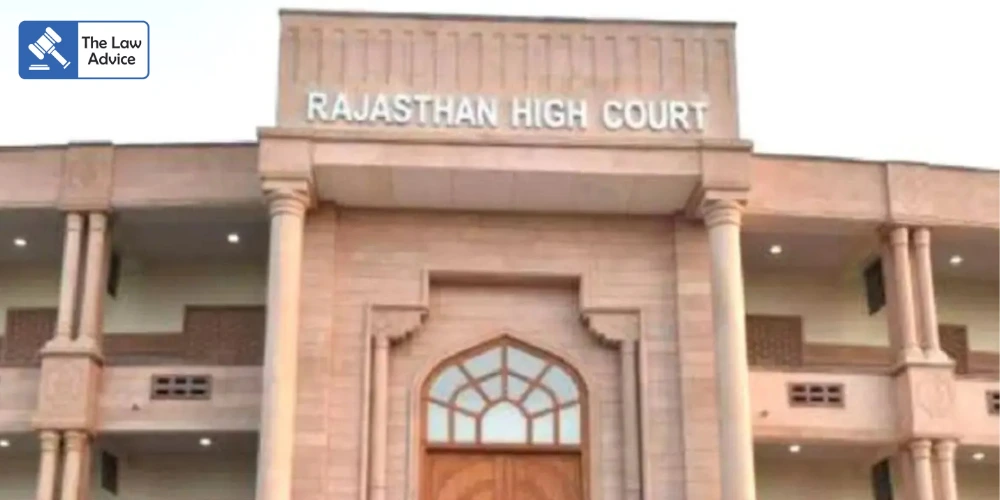
The Rajasthan High Court has affirmed a single-judge bench order dismissing the challenge to the appointment of Advocate Padmesh Mishra as Additional Advocate General (AAG) for the State of Rajasthan before the Supreme Court.
Mishra, son of Supreme Court Judge Justice P.K. Mishra, was accused of lacking the requisite 10 years of practice mandated under the Rajasthan State Litigation Policy, 2018. The petitioner argued that despite falling short of the stipulated experience requirement, he was appointed due to his familial connection.
A Division Bench comprising Acting Chief Justice Sanjeev Prakash Sharma and Justice Baljinder Singh Sandhu ruled that the Litigation Policy serves only as a guiding framework and does not have statutory force. As such, a writ of quo warranto could not be issued to question the appointment.
The Court noted that decisions regarding who should represent the State in court fall solely within the domain of the Government, and judicial interference in such professional selections is limited. It emphasized that the court cannot dictate the State’s choice of counsel, describing such matters as issues of suitability and confidence rather than legal eligibility.
Endorsing the State’s stance, the Bench observed that policies like the 2018 Litigation Policy are advisory in nature. Previous circulars governing the appointment of government counsel remained operative even after the policy’s introduction—indicating that it was never meant to rigidly restrict appointments.
Significantly, the Court highlighted:
“The craft of presenting a case and the skill of advocacy cannot be judged merely by counting years in the profession. A person with extensive legal knowledge—such as a law professor—may not necessarily be capable of effectively arguing in court. Hence, rigid criteria for positions like Advocate General or Additional Advocate General cannot be imposed. It must remain the prerogative of the litigant, i.e., the State.”
The Bench also turned down the argument that publishing amendments to Clause 14.8 of the policy in the Gazette made it legally enforceable, clarifying that the amendment was only a notification within the policy framework—not a modification of statutory rules. Hence, it could not trigger writ jurisdiction.
Additionally, the Court drew a distinction between the constitutional post of Advocate General under Article 165, which is a public office, and supporting positions such as Additional Advocate General or Government Counsel. It noted that AAGs are assigned departments on a rotational basis, serve without fixed tenure, and act purely based on briefs received, functioning essentially as aides to the Advocate General.
Special Public Prosecutors and Government Advocates appointed under different rules and mechanisms in Rajasthan further illustrate the flexible and case-specific nature of such appointments, the Bench added.
Finding no legal infirmity in Mishra’s appointment, the Division Bench dismissed the appeal.
Case Title: Sunil Samdaria v. State of Rajasthan & Anr.
Website designed, developed and maintained by webexy