
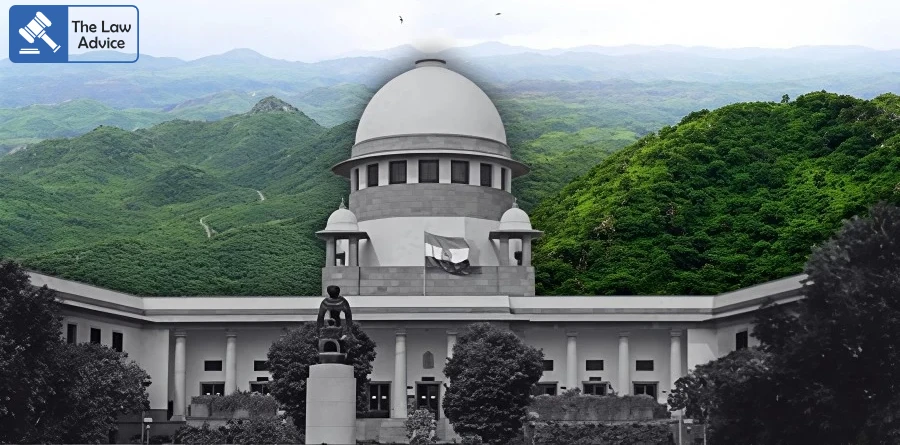
The Supreme Court of India on Thursday made it clear that it would not permit any activity affecting the Aravalli range, declining to entertain any request linked to the proposed Aravalli Zoo Safari project in Haryana at this stage.
A Bench headed by Chief Justice of India Surya Kant, along with Justices Joymalya Bagchi and Vipul M Pancholi, said no permission would be granted until the court takes a comprehensive view in the main matter concerning the definition and extent of the Aravalli range.
The court was hearing a plea by the Haryana government seeking permission to place a revised detailed project report (DPR) for the proposed jungle safari in Gurugram and Nuh districts before the court-appointed Central Empowered Committee. The state submitted that the project area had been reduced from nearly 10,000 acres to around 3,300 acres and urged the court to allow the revised DPR to be examined.
Rejecting the request, the Chief Justice said the court was “absolutely firm” and would not allow “even a single inch” of the Aravalli range to be touched unless a holistic and scientific assessment by an impartial expert body satisfied the court. He added that an expert committee would be constituted based on suggestions from the Union of India, stressing that the court itself was not equipped to assess such technical issues.
The Bench said the safari project could be considered only after the expert panel submits its opinion in the larger matter.
The observations were made in the backdrop of the court’s December 29, 2025 order keeping in abeyance its earlier November 20, 2025 judgment that had accepted a 100-metre height-based definition of Aravalli hills, pending a fresh expert evaluation.
That definition had drawn criticism from environmental activists, who cautioned that hills falling below the 100-metre threshold could become vulnerable to mining. On Thursday, Haryana’s counsel argued that the issue of defining the Aravalli range was linked to mining and had no bearing on the safari project. The Bench, however, disagreed, noting that no project could be allowed until the definitional issue was conclusively settled.
The court also declined the state’s request to allow the CEC to examine the revised DPR, with Justice Bagchi observing that preparing and seeking consideration of a DPR itself amounted to a step towards establishing the safari.
Emphasising a broader perspective, the Chief Justice noted that the Aravalli range spans multiple states and cannot be viewed in isolation. “Aravalli neither starts nor ends in Haryana, nor in Rajasthan. It is a composite range, and we have to take a holistic view,” he said.
The matter arises from a petition filed by five retired Indian Forest Service officers and the NGO People for Aravalis, who have warned that the proposed safari would cause irreversible damage to the ecologically fragile Aravalli ecosystem. In October 2025, the top court had already directed the Haryana government not to proceed with the project.
Website designed, developed and maintained by webexy