
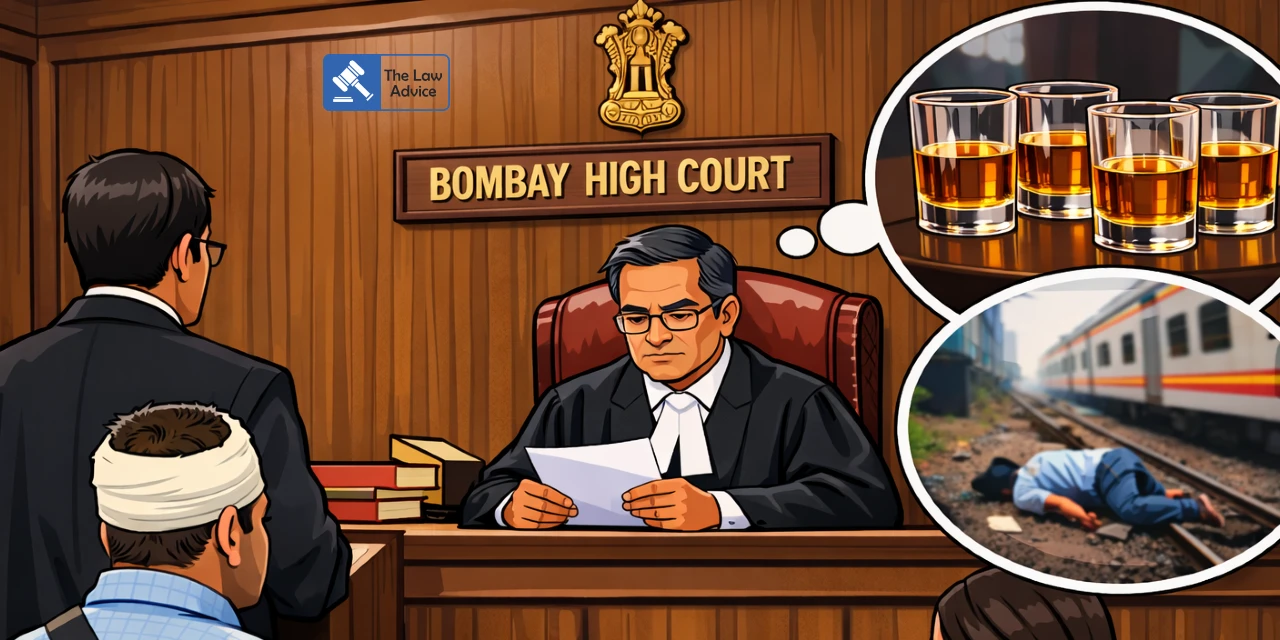
The Bombay High Court on Wednesday denied railway accident compensation to an injured passenger, holding that he had consumed four large pegs of alcohol before the incident.
The passenger stood at the edge of the platform and was knocked down by a passing train.
In the matter, the Bombay High Court held that passengers injured while under the influence of alcohol are not entitled to railway accident compensation, even if the incident would otherwise qualify as an untoward railway accident under the law.
The Court observed that intoxication impairs judgment and can lead to risky and dangerous conduct. While delivering the verdict, Justice Jitendra Jain also reflected on the wider societal consequences of alcohol consumption.
Emphasising the harmful impact of alcohol, the Bombay High Court observed that alcohol “ruins everything,” affecting physical and mental health, damaging relationships, leading to family breakdown, social dysfunction, career disruption, and causing severe long-term lifestyle consequences.
''First you take a drink, then the drink takes a drink, then the drink takes you’," the Court said.
The appeal arose from order of the Railway Claims Tribunal, Mumbai, which rejected the passenger’s claim for compensation under the Railways Act, 1989.
The injured passenger had approached the tribunal seeking damages for injuries sustained in a railway incident that occurred in the early hours of March 10, 2001. Court records showed that he was waiting on the platform around midnight for a train to Borivali when an approaching train hit him, causing serious injuries.
Railway staff first took him to a government hospital and later shifted him to Bombay Hospital for further treatment. Medical records from Bombay Hospital revealed that the passenger had consumed four large pegs of alcohol before dinner.
Relying on this medical report, the Bombay High Court noted that the entry was based on the patient’s own statement at the time of treatment and that he never disputed it during the course of the proceedings.
However, the Bombay High Court disagreed, noting that the passenger was not crossing the railway tracks but was standing close to the edge of the platform when the train arrived. The Court said such a situation could otherwise qualify as an accidental railway incident.
Despite this, the Court examined the proviso to Section 124A of the Railways Act, 1989, which denies compensation if an injury is caused by actions taken while a person is intoxicated. It held that consuming a large quantity of alcohol amounted to intoxication, and standing near the platform edge in that condition was risky behaviour directly linked to the injury.
The passenger’s lawyer relied on earlier cases where courts had granted compensation even though intoxication was mentioned. The High Court clarified that those cases were different because there was no clear medical proof. In the present case, hospital records clearly showed alcohol consumption.
As a result, the Court held that although the incident could be treated as an untoward railway accident, the legal bar on compensation due to intoxication applied, and the appeal was dismissed.
Advocate Sainand Chougule appeared for the injured passenger. The Western Railways were represented by advocates Chetan C Agrawal and Rushikesh Bhorania for the Union of India.