
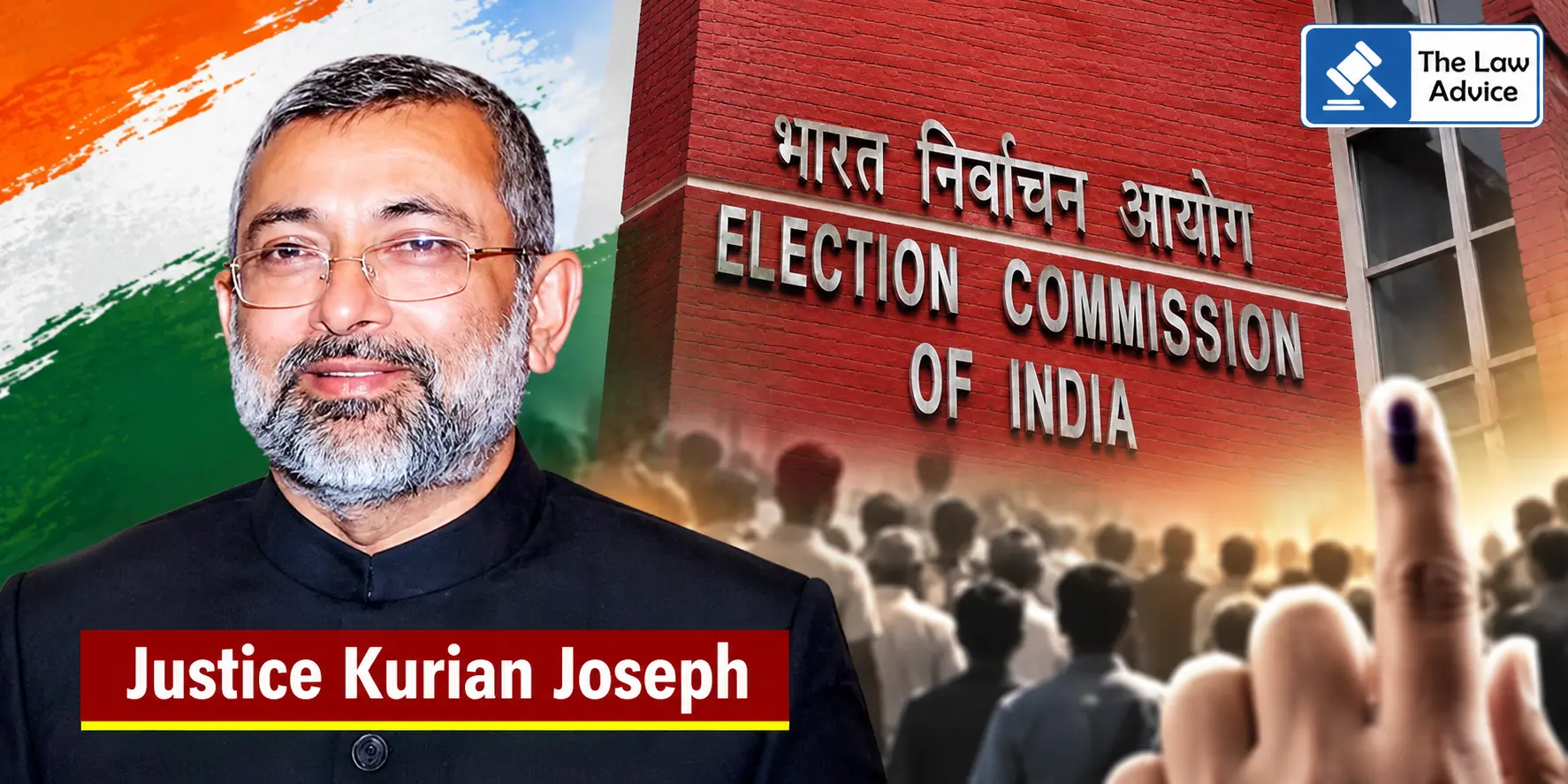
Former Supreme Court judge Justice Kurian Joseph has called for stronger constitutional safeguards to ensure the independence and integrity of the Election Commission of India (ECI), warning that democracy is threatened when the integrity of those entrusted with conducting elections cannot be trusted.
Speaking at the inaugural session of a seminar titled “Independence of Election Commission of India: Compromised?”, organised by the Indian Association of Lawyers, Keralam, on October 13, Justice Joseph referred to concerns raised during the Constituent Assembly debates regarding the appointment and independence of Election Commissioners.
He recalled the warning of Constituent Assembly member Hriday Nath Kunzru that defective electoral machinery and officials whose integrity could not be relied upon would “poison democracy at the source”.
Justice Joseph questioned whether the concerns expressed during the framing of the Constitution had become relevant in the present circumstances. He emphasised that the independence and integrity of the Election Commission must be protected through safeguards incorporated into the Constitution itself.
Appointment of Election Commissioners Should Be Governed by Constitutional Safeguards
Justice Joseph said that the Constitution should prescribe the appointment process and service conditions of the Chief Election Commissioner (CEC) and other Election Commissioners, rather than leaving these matters entirely to parliamentary legislation.
Referring to Article 324 of the Constitution, which vests the Election Commission with the superintendence, direction and control of electoral rolls and the conduct of elections, he observed that adequate safeguards were necessary to protect the institution from potential executive influence.
He also recalled Dr. B.R. Ambedkar’s concerns during the Constituent Assembly debates about the possibility of appointing an unsuitable person, or someone susceptible to executive influence, to the office of Chief Election Commissioner or Election Commissioner.
Justice Joseph further referred to the proposal made by Constituent Assembly member Sibban Lal Saxena, who had suggested that appointments to the Election Commission be ratified by a two-thirds majority of both Houses of Parliament in a joint sitting. The proposal reflected concerns that the government of the day might appoint a political loyalist to secure electoral advantage.
All Election Commissioners Should Have the Same Removal Protection as Supreme Court Judges
Justice Joseph also questioned the distinction between the safeguards governing the removal of the Chief Election Commissioner and those applicable to other Election Commissioners.
Under Article 324(5) of the Constitution, the Chief Election Commissioner can be removed in the same manner and on the same grounds as a Supreme Court judge. Other Election Commissioners, however, can be removed only on the recommendation of the Chief Election Commissioner.
Justice Joseph said that all Election Commissioners should enjoy the same protection against removal as Supreme Court judges. According to him, if the Chief Election Commissioner and other Election Commissioners are to function as members of the same constitutional institution, they should be placed on an equal footing in this respect.
He also stressed that the Chief Election Commissioner should not enjoy any special privilege over other members of the Commission, describing the CEC as “first among equals”.
Justice Joseph emphasised that constitutional powers belong to institutions and are not personal privileges of the individuals occupying high constitutional offices. He cautioned against the perception that such powers are concentrated in the person holding the office, instead of being exercised institutionally and in accordance with constitutional responsibilities.
Appointment Law and Supreme Court Judgment
The Supreme Court, in its 2023 judgment in Anoop Baranwal v. Union of India, prescribed an interim selection committee comprising the Prime Minister, the Leader of Opposition in the Lok Sabha and the Chief Justice of India for appointing Election Commissioners, until Parliament enacted a law on the subject.
Parliament subsequently enacted the Chief Election Commissioner and Other Election Commissioners Act, 2023, replacing the Chief Justice of India on the selection committee with a Union Cabinet Minister nominated by the Prime Minister.
The validity of the new appointment framework is under challenge before the Supreme Court. Justice Joseph did not elaborate on the pending challenge but stressed that safeguards for the independence and integrity of constitutional institutions should operate from the appointment stage itself.
Questions Concentration of Electoral Powers in the Election Commission
Justice Joseph also questioned whether the Election Commission should necessarily exercise superintendence and control over all state-level elections. Referring to electoral arrangements in countries such as the United States, Switzerland and the United Kingdom, he raised the question of whether extensive electoral powers should remain concentrated in a single central authority.
Invoking the principle that “power corrupts and absolute power corrupts absolutely”, he cautioned that unchecked and unguided powers could lead institutions away from their constitutional responsibilities.
He identified public vigilance as an important safeguard against the misuse of power, emphasising that constitutional institutions must remain accountable to the constitutional framework within which they operate.
Justice Joseph’s address placed the independence of the Election Commission, the appointment and removal safeguards for Election Commissioners, and the distribution of electoral powers at the centre of the discussion on protecting democratic institutions.
Website designed, developed and maintained by webexy