
CJI Surya Kant Highlights Mediation’s High Compliance Rate, Says Parties Are More Likely to Honour Settlements They Help Create
New Delhi, August 8, 2026: Chief Justice of India Surya Kant on Friday highlighted the growing importance of mediation in dispute resolution, observing that parties are more likely to comply with settlements when they have actively participated in negotiating and framing the terms.
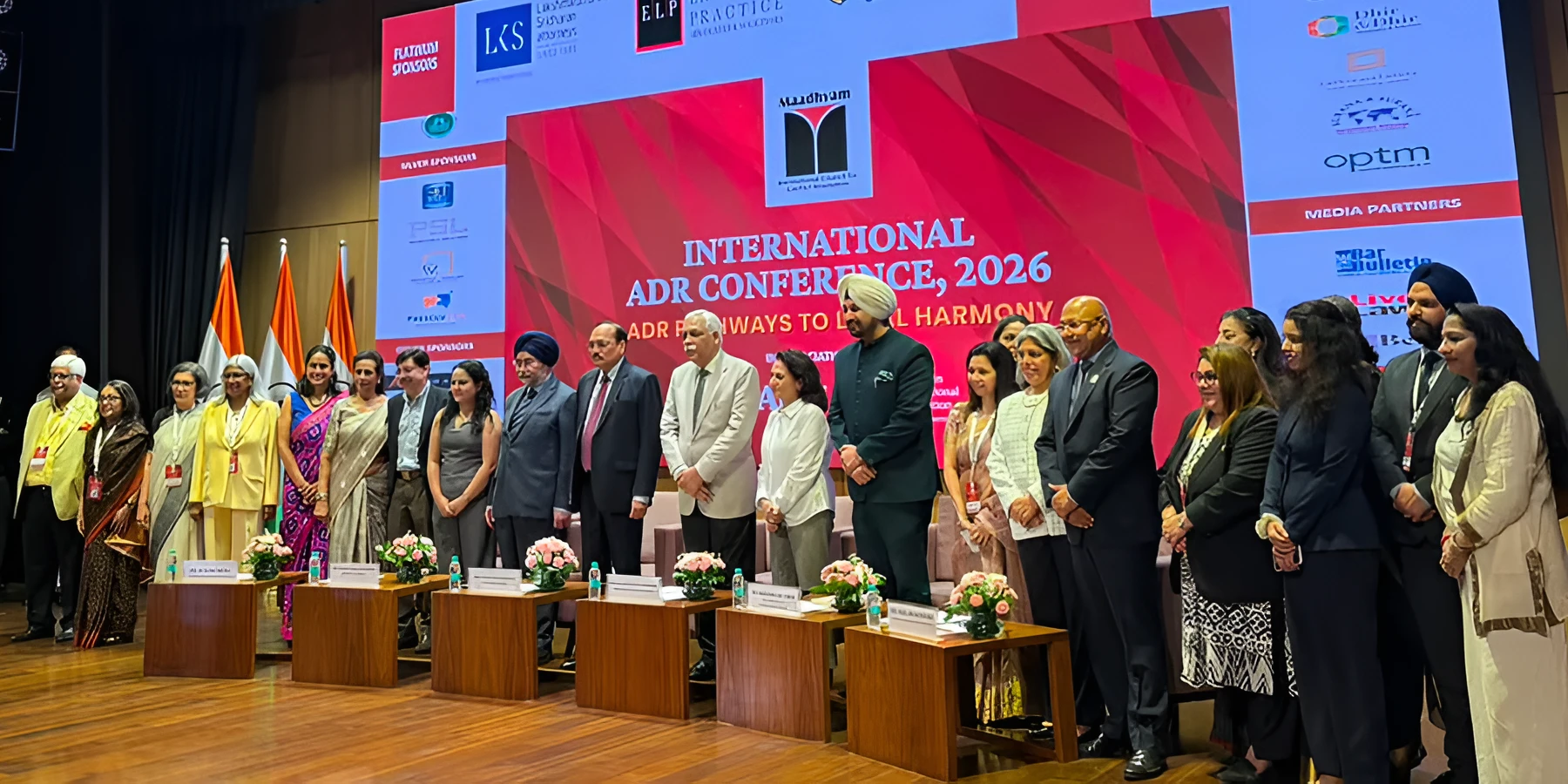
Speaking at the International ADR Conference 2026, organised by the Madhyam International Council for Conflict Resolution, the CJI referred to studies suggesting that voluntary compliance with agreements reached through mediation can be as high as 90 per cent.
‘Parties Honour What They Help Create’
CJI Surya Kant said the principal strength of mediation lies in giving disputing parties an opportunity to participate in developing the solution themselves.
He observed that a party which has genuinely contributed to drafting the terms of a settlement is less likely to subsequently abandon it.
By contrast, he said, a party receiving a judicial verdict may continue to challenge it through appeals, delays and enforcement proceedings.
The CJI explained the distinction between various dispute-resolution mechanisms by observing that litigation and arbitration determine who is right and what the law requires, whereas mediation focuses on what the parties can themselves accept and build upon.
CJI Says Arbitration Has Earned Its Place
While highlighting the advantages of mediation, CJI Kant clarified that this did not mean one dispute-resolution mechanism was inherently superior to another.
He specifically acknowledged the importance of arbitration in modern commercial activity.
“Arbitration, in my opinion, has earned its place in the architecture of modern commerce,” he said, particularly in disputes involving engineering, valuation and cross-border contractual matters.
However, the CJI cautioned that an arbitral award may not necessarily bring a dispute to an end in practice, as parties may continue litigation at the stage of challenging or enforcing the award.
He summed up the distinction by observing:
“Finality on paper and finality in fact are not always the same inheritance.”
Mediation Has Transformed
The CJI also spoke about the transformation of mediation in India.
According to him, mediation has moved beyond the perception of being conducted in traditional, uncomfortable settings with reluctant compromises. It has increasingly developed into a professional dispute-resolution mechanism supported by institutional mediation centres, trained mediators, digital case management and online dispute resolution.
He said India should aspire to establish itself as a global centre for mediation, particularly by developing state-of-the-art infrastructure capable of keeping pace with the country's economic expansion.
Delhi HC Chief Justice Says Mediation Could Replace Arbitration
Delhi High Court Chief Justice Devendra Kumar Upadhyaya, who addressed the conference after CJI Kant, also emphasised the potential of mediation.
He suggested that mediation could eventually assume an even greater role than arbitration.
“We might see a day when mediation may replace arbitration. I don't know.”
Justice Upadhyaya acknowledged the importance of arbitration in the context of India's economic growth and increasing globalisation. However, he noted that arbitration had also developed certain adversarial characteristics traditionally associated with litigation.
Justice Upadhyaya Recalls Initial Scepticism
The Delhi High Court Chief Justice also shared his own experience with mediation.
He recalled that, as a lawyer, he had initially been sceptical about the effectiveness of mediation when court-annexed mediation centres were introduced.
His perspective changed after he became a judge and began working with mediation committees and the mediation centre at Lucknow.
“I could not realise at that time the potential of mediation,” he said, adding that India has still not fully realised the potential of the mechanism.
International ADR Conference Brings Global Practitioners Together
The inaugural session also featured Senior Advocate Amarjit Singh Chandhiok, President of Madhyam, who spoke about the organisation's work in promoting mediation.
International mediator Judge Daniel Weinstein joined the event virtually and discussed the growth of mediation across jurisdictions, while emphasising the importance of understanding cultural differences during negotiations.
The International ADR Conference 2026, themed “ADR: Pathways to Legal Harmony,” brought together judges, lawyers, mediators and other alternative dispute resolution practitioners from India and abroad.
Website designed, developed and maintained by webexy