
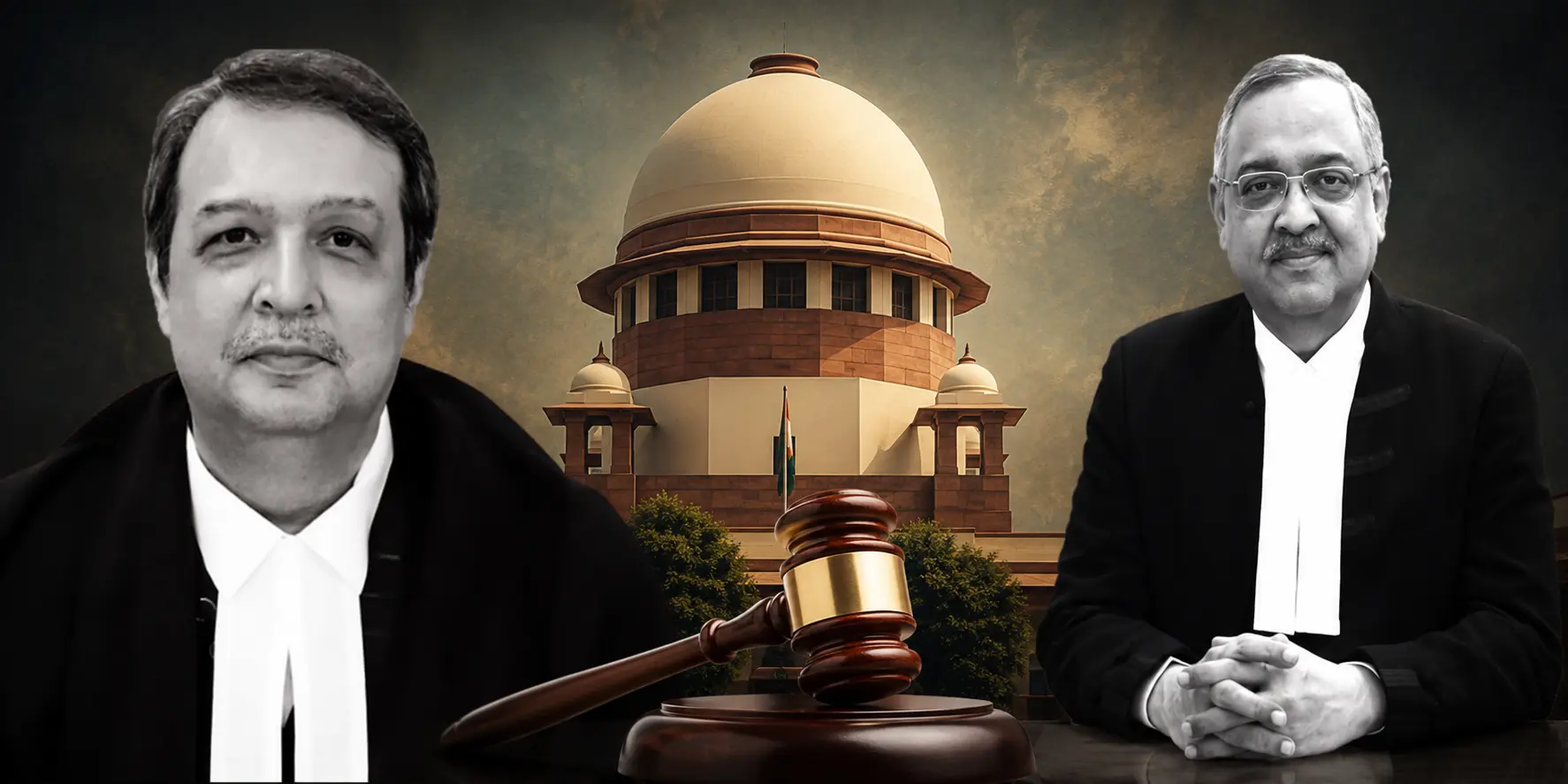
Supreme Court Sets Aside Murder Conviction After 22 Years, Slams Failure to Properly Examine Evidence
The Supreme Court has set aside the murder conviction of Arjun Jani @ Tuntun, who had spent nearly 22 years in incarceration, holding that the prosecution evidence suffered from serious inconsistencies and that the conviction based solely on a shaky eyewitness account could not be sustained.
A Bench comprising Justice J. B. Pardiwala and Justice K. Vinod Chandran expressed deep concern over the manner in which the appellant's appeal was dealt with, particularly the rejection of a 3,157-day delay condonation application in an appeal against his conviction under Section 302 IPC. The Court noted that by the time the matter was considered, the appellant had already undergone about 22 years of imprisonment.
The judgment, delivered on August 4, 2026, emphasised that courts must adopt a proactive and liberal approach in condoning delay in criminal appeals filed by incarcerated and marginalised persons, especially where the consequence is deprivation of personal liberty.
Convict Had Spent 22 Years Behind Bars
The appellant's appeal was ultimately taken up with the assistance of legal services after he had spent approximately 22 years in prison. The Supreme Court noted that a Coordinate Bench had earlier described the High Court's refusal to condone the delay as “very disturbing”, observing that the fact that the appellant was undergoing a sentence and that the appeal was filed through jail ought to have prompted a practical and sympathetic approach.
The jail authorities had also issued a conduct certificate recording that the appellant's conduct during incarceration was satisfactory, that he maintained good relations with fellow prisoners and that he had never been punished for a jail offence.
Supreme Court Questions Remission Rejections
The Court also examined the appellant's repeated applications for remission. His application had been rejected six times, with the latest rejection dated September 19, 2025.
The Court noted that after 22 years of actual imprisonment, the appellant was 45 years old and that both the 2000 and 2022 remission policies were stated to be beneficial to him. The Court criticised the reliance on apprehensions regarding the local law-and-order situation as a reason for refusing remission, observing that such considerations could not substitute the judicious exercise of the power of remission.
Prosecution Case Involved Three Women
The case arose from the alleged murders of three women—Kamala, Sonbari and Ratanai. The prosecution alleged that the women were killed with stones by smashing their heads on a public road.
The Supreme Court examined the evidence in detail and found several serious inconsistencies in the prosecution's case.
The principal eyewitness, PW3, claimed to have witnessed the appellant assaulting Ratanai but fled after being threatened. However, the Court found discrepancies regarding when and to whom she disclosed the incident. The testimony of other witnesses regarding how they came to know about the alleged occurrence also differed materially.
Eyewitness Account Found “Shaky” and “Highly Improbable”
The Court was particularly concerned by the circumstances surrounding the alleged eyewitness account.
PW3 stated that she had witnessed the assault at around 1 a.m. by looking through a gap in her door. Yet, despite allegedly fleeing past the house of one of the deceased, she did not notice the bodies of the other two women lying nearby.
The Court also noted that PW3 allegedly witnessed only one murder, while another witness subsequently spoke of her having disclosed that three murders had occurred.
The Court further noted that none of the relatives or co-inhabitants of the deceased were examined, and there was no satisfactory explanation as to why the three victims had come outside their houses in the middle of the night.
Police Investigation Also Came Under Scrutiny
The Supreme Court found serious deficiencies in the investigation.
The Investigating Officer had not prepared a sketch of the scene despite three bodies having been recovered. The officer also failed to explain how he reached the accused and arrested him.
More significantly, the Court noted that the alleged confession made after arrest could not be relied upon as it was inadmissible under Section 25 of the Indian Evidence Act, 1872. The Court also referred to evidence that police officers had beaten the accused to extract the confession.
The alleged recovery of stones and a brick was also found unreliable. The trial court had rejected the recovery, noting the absence of any material connecting the recovered objects to the murders. No blood stains were found either visually or through forensic examination.
“Eyewitness Testimony Alone” Cannot Sustain Conviction Where It Is Unreliable
The Supreme Court reiterated that an accused can legally be convicted solely on the basis of eyewitness testimony. However, such testimony must be believable, credible, consistent with the surrounding circumstances and capable of inspiring the confidence of the Court.
Where serious discrepancies create reasonable doubt about whether the witness actually saw the incident, such testimony cannot safely form the sole basis of conviction.
After examining the evidence, the Bench concluded that the eyewitness testimony was “shaky and highly improbable” and did not establish beyond doubt that the appellant had murdered the three women. The Court consequently set aside the trial court's judgment and acquitted the appellant.
Supreme Court: 22 Years “Erased” Without Reliable Evidence
In a strong concluding observation, the Court highlighted the cumulative failure of the justice system.
The Bench noted that three women had lost their lives, while a person was taken into custody on suspicion, an inadmissible confession was extracted through third-degree methods, the trial court failed to properly evaluate the evidence and the High Court remained a “moot spectator” while adding to its disposal tally.
The cumulative result, the Court observed, was that 22 years of the appellant's life were erased without reliable evidence supporting his conviction.
The Court also directed the District Legal Services Authority, Koraput, with assistance from the District Administration headed by the District Collector, to undertake efforts for the appellant's rehabilitation or resettlement.
Case Details
Arjun Jani @ Tuntun v. State of Orissa
2026 INSC 802
Criminal Appeal @ SLP (Crl.) No. 7128 of 2026
Judgment dated: August 4, 2026
Coram: Justice J. B. Pardiwala and Justice K. Vinod Chandran

Representation:-
For Petitioner(s) :- Ms. Pragati Neekhra, AOR, Mr. Aryan Vaibhav Srivastava, Adv., Mr. Kartikay Aggarwal, Adv.
For Respondent(s) :- Mr. Hitendra Nath Rath, AOR, Ms. Laxmi, Adv.
Website designed, developed and maintained by webexy