
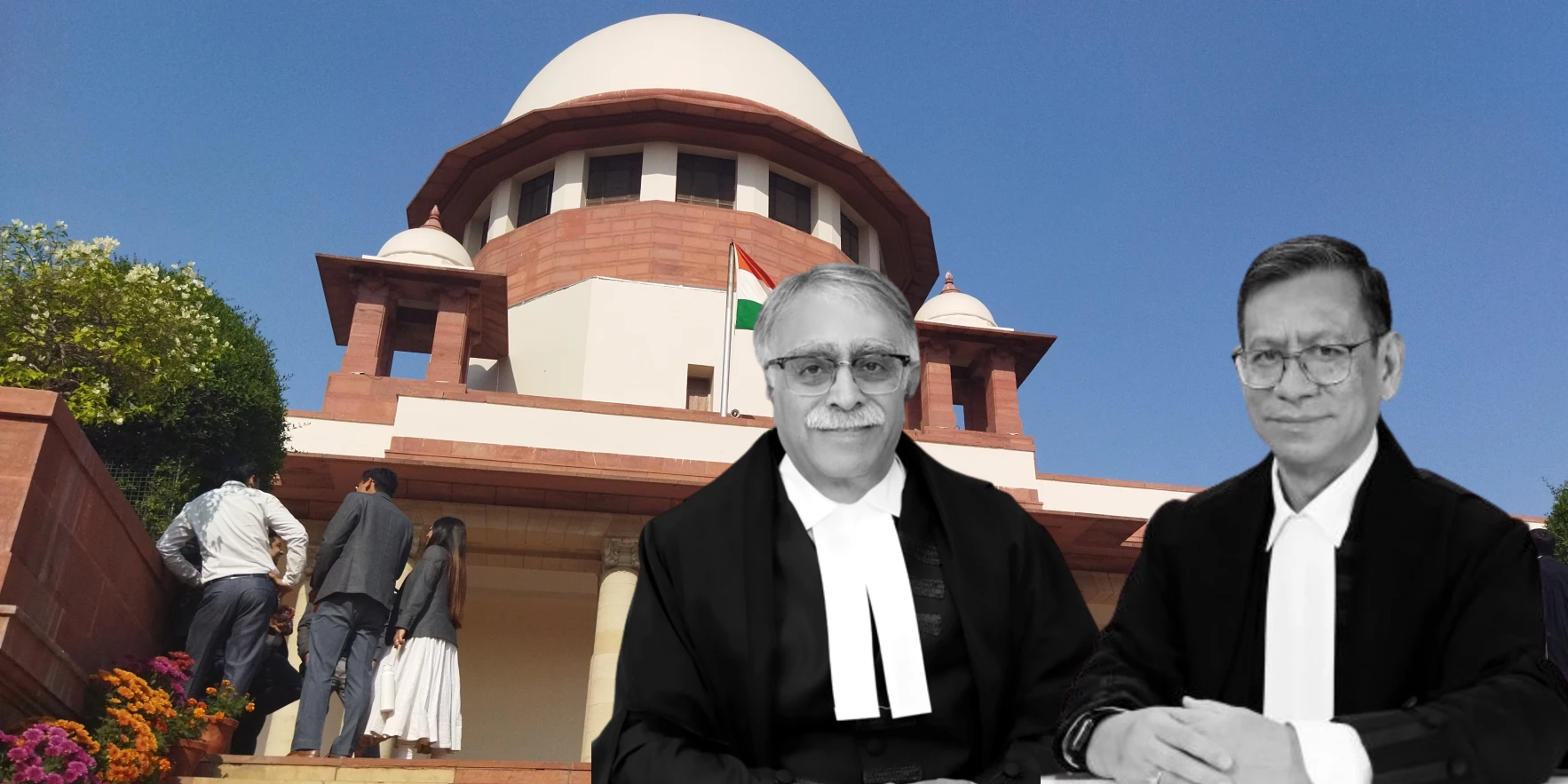
The Supreme Court has dismissed an appeal arising from testamentary proceedings before the Madras High Court, holding that mere marking of a document as an exhibit does not amount to proof of its contents.
A Bench comprising Justice Sanjay Karol and Justice Nongmeikapam Kotiswar Singh upheld the Madras High Court's order which had refused to exclude documents and averments contained in a proof affidavit at the threshold.
The Court clarified that while documents may be marked or exhibited during the course of proceedings, their contents must still be proved in accordance with law.
Dispute Over Proof Affidavit in Will Proceedings
The case arose from testamentary proceedings concerning the Will of late C. Shyamalavalli. The respondent had instituted proceedings before the Madras High Court seeking probate of the Will, which were subsequently converted into T.O.S. No. 12 of 2021.
The appellants, who were defendants in the proceedings, filed a written statement and later objected to the plaintiff's proof affidavit.
They sought exclusion of the affidavit, its averments and the documents exhibited therein, contending that certain material was irrelevant to the testamentary proceedings.
The Single Judge rejected the application, while observing that some documents could not be marked because only xerox copies had been produced without explaining the absence of the originals.
The remaining documents, however, were permitted to be received in evidence for purposes including determining title and rival claims concerning the Will.
The Division Bench subsequently dismissed the appeal and imposed costs of Rs. 10,000 on the appellants.
Supreme Court Refuses to Exclude Documents at Threshold
The Supreme Court agreed with the reasoning of the High Court.
Referring to Order XIII Rule 3 of the Code of Civil Procedure, 1908, the Bench noted that a court may reject a document at any stage if it considers the document irrelevant or otherwise inadmissible, while recording reasons for doing so.
However, the Court found that the objections raised against the documents, other than the xerox copies for which no explanation regarding non-production of originals had been given, did not establish that the material was prima facie inadmissible or irrelevant.
The Court therefore held that there was no justification to exercise the power under Order XIII Rule 3 CPC to exclude the documents at that stage.
Evidence Should Not Be Shut Out Prematurely
The Bench also considered documents and averments relating to the pendency of other suits and transfer of properties within the same family structure.
The Supreme Court held that such material could not be rejected at the threshold.
Relying upon the Constitution Bench-era principle discussed by a three-Judge Bench in Bipin Shantilal Panchal v. State of Gujarat, the Court reiterated that objections to admissibility ordinarily should not unnecessarily interrupt the progress of a trial.
The Court referred to the practice whereby an objected document can be tentatively marked as an exhibit subject to the objection, with the admissibility issue being considered at the final stage.
The purpose of such an approach is to avoid a situation where evidence excluded during trial later becomes necessary at the appellate stage, requiring the matter to be remanded and thereby prolonging litigation.
“Mere Marking of a Document as an Exhibit Is Not Proof”
At the same time, the Supreme Court drew an important distinction between admission/marking of a document and proof of its contents.
The Court reiterated the settled legal position that:
“Mere marking of a document as an exhibit, is not a proof of the contents thereof.”
Referring to its earlier decision in LIC v. Ram Pal Singh Bisen, the Court observed that mere admission of a document into evidence does not dispense with the requirement of proving it in accordance with law.
The Bench also referred to Sait Tarajee Khimchand v. Yelamarti Satyam, Narbada Devi Gupta v. Birendra Kumar Jaiswal and Vijay v. Union of India in reaffirming the principle.
Thus, even though a document has been marked or exhibited, the contents of the document must subsequently be proved through legally admissible evidence.
Xerox Documents Properly Excluded
The Supreme Court specifically agreed with the Single Judge's decision to exclude documents for which only xerox copies had been filed without any explanation for non-availability of the originals.
However, the Court found no reason to exclude the other documents at the preliminary stage.
It held that the contents of those documents would ultimately have to be proved in accordance with law.
Appeal Dismissed; Testamentary Proceedings to Continue
The Supreme Court accordingly dismissed the appeal and upheld the Madras High Court's order dated August 21, 2024.
The Court made it clear that its observations should not influence the final adjudication of the testamentary dispute.
It directed that the proceedings in T.O.S. No. 12 of 2021 should continue uninfluenced by the observations made in the judgment.
The stay granted by the Supreme Court on November 11, 2024, was also vacated.
Key Takeaway
The judgment reinforces an important evidence-law distinction:
Marking a document as an exhibit ≠ proving the contents of the document.
At the same time, courts should ordinarily avoid shutting out potentially relevant evidence at the threshold where its admissibility can appropriately be considered during the course of the trial or at the final stage.
Case Details
Case: S. Sangeetha & Ors. v. Tmt. P. Ponni
2026 INSC 813
Civil Appeal @ SLP (C) No. 26326 of 2024
Date: August 7, 2026
Bench: Justice Sanjay Karol and Justice Nongmeikapam Kotiswar Singh
Court: Supreme Court of India
Website designed, developed and maintained by webexy