
The Supreme Court has acquitted Paramjit Singh Bedi, setting aside his conviction and 10-year sentence for rape under Section 376 of the IPC, holding that the prosecution version could not be accepted for the rape charge after the trial court had disbelieved the same version while dealing with the charge of kidnapping/abduction.
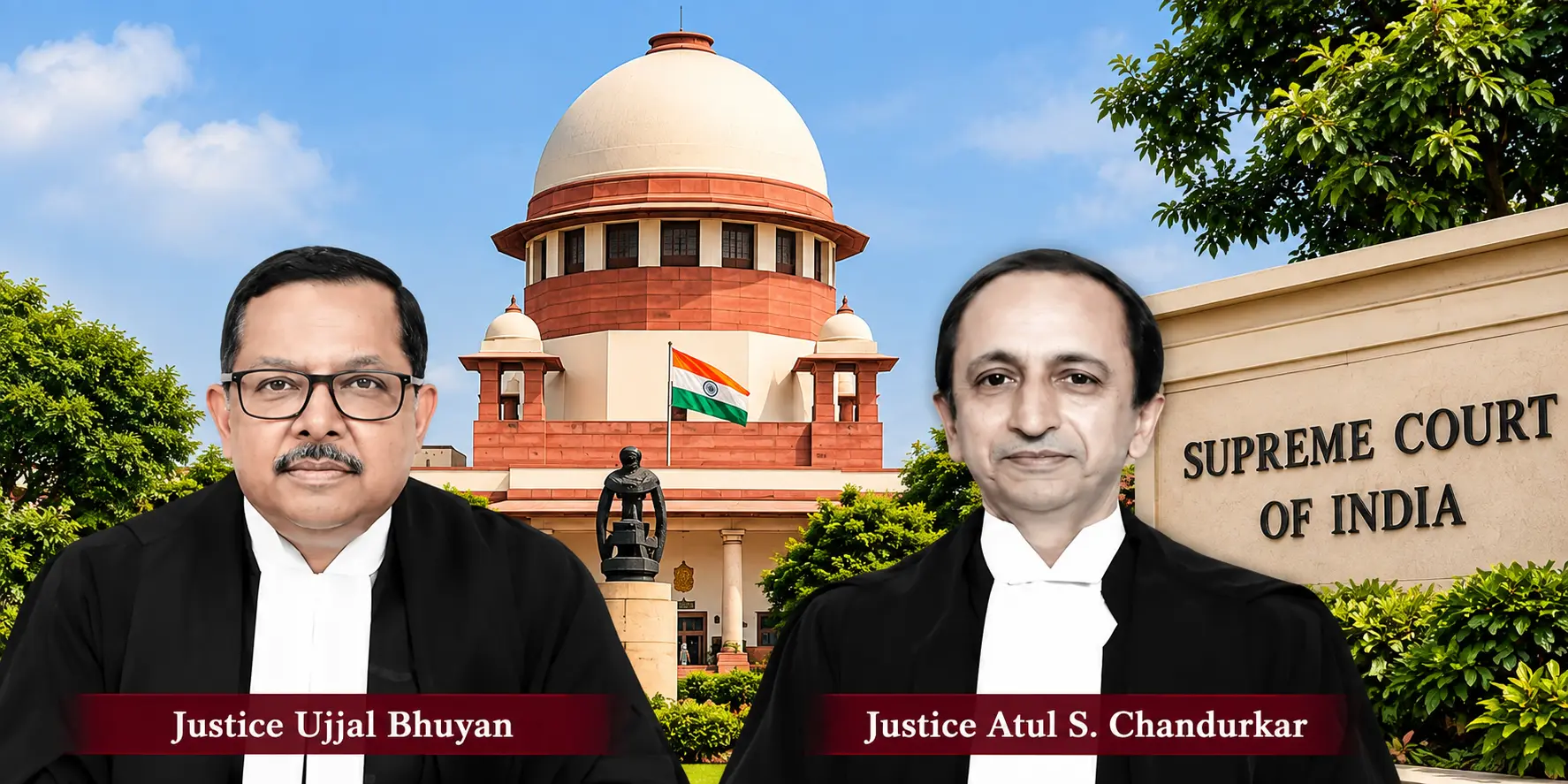
A Bench comprising Justice Ujjwal Bhuyan and Justice Atul S. Chandurkar allowed the appeal and set aside the judgments of the Sessions Court, Ludhiana and the Punjab and Haryana High Court.
The prosecution case arose from an incident of June 2009 involving a girl who was studying in Class VIII. The prosecution alleged that the appellant took her first to a flat in Ludhiana and subsequently to an abandoned factory in Malerkotla, where he allegedly had sexual intercourse with her against her will.
The Sessions Court, however, acquitted the appellant of the charge under Section 366 IPC, holding that the prosecution had failed to establish that the prosecutrix was below 18 years of age at the relevant time and also expressing doubt regarding whether she had been taken away without her consent.
Despite this, the Sessions Court convicted him under Section 376 IPC and sentenced him to 10 years' rigorous imprisonment and a fine of ₹5,000. The High Court subsequently affirmed the conviction.
The Supreme Court examined the testimony of the prosecutrix in detail and noted several contradictions concerning the manner in which she travelled with the appellant and their return journey from Malerkotla to Ludhiana.
The Court noted that according to her cross-examination, she travelled with the appellant through crowded and brightly lit areas but did not raise an alarm or attempt to get down from the scooter. Her account regarding the return journey also differed between her examination-in-chief and cross-examination.
The Court held that her testimony, viewed as a whole, did not inspire confidence and that the presence of spermatozoa in the vaginal swab, by itself, could not establish rape in the circumstances of the case.
One of the key observations of the Supreme Court was that the testimony of the prosecutrix could not be partly rejected for one charge and partly accepted for another.
The Court observed that where the testimony of a prosecutrix is of unimpeachable character, it must be accepted in its entirety. Conversely, the prosecution could not rely upon the same version to convict the accused under Section 376 IPC after that version had been disbelieved in relation to Section 366 IPC.
The Bench further held:
“Immorality of an act sans credible evidence cannot justify a conviction.”
The Court held that although the conduct attributed to the appellant might be viewed as immoral or unethical, that alone could not sustain a conviction for rape.
The charge under Section 376 IPC, the Court said, had to be established through hard and credible evidence, rather than surmises, conjectures or value judgments.
Consequently, the Supreme Court set aside the Sessions Court and High Court judgments and cleared Paramjit Singh Bedi of the charge under Section 376 IPC. The criminal appeal was allowed.
Case: Paramjit Singh Bedi v. State of Punjab
Citation: 2026 INSC 1054
Judgment Date: September 25, 2026
Bench: Justice Ujjwal Bhuyan and Justice Atul S. Chandurkar.

Website designed, developed and maintained by webexy