
The Supreme Court has upheld the punishment imposed on an advocate for professional misconduct after he disclosed confidential communications with his former client during television interviews and publicly described her complaint as a false rape case.
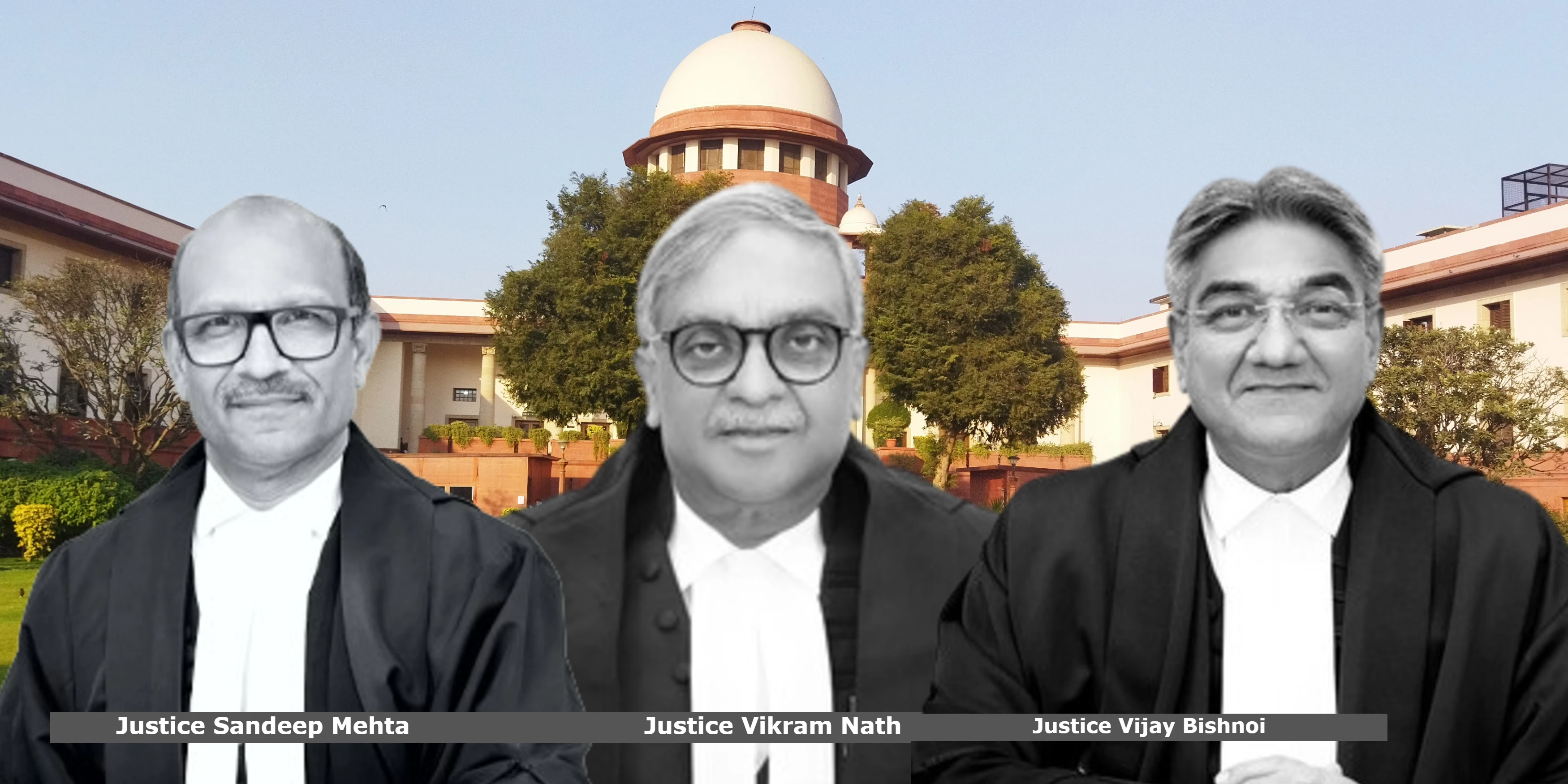
A Bench comprising Justice Vikram Nath, Justice Sandeep Mehta and Justice Vijay Bishnoi dismissed cross appeals arising from disciplinary proceedings against advocate Rizwan Siddique, holding that an advocate cannot use information received in confidence from a client against that client, even after the professional relationship has ended.
The judgment was delivered in Rehana Khan v. Rizwan Siddiquee, 2026 INSC 907, arising from Civil Appeal No. 12256 of 2025 and connected matters.
The case arose from a professional relationship between the appellant, Rehana Khan, and the respondent advocate, which existed during 2013 and 2014.
The appellant had approached the advocate in connection with allegations against a senior police official and had shared confidential details of her personal life and material relating to her allegations with him.
A dispute subsequently arose regarding a legal notice sent to the police official. The appellant later lodged an FIR on July 24, 2014, in which the advocate was also named as a person allegedly acting under the influence of the police official.
On August 5, 2014, the advocate gave interviews that were broadcast on Aaj Tak and Zee News. During the broadcasts, conversations between the advocate and his former client, along with messaging exchanges, were also aired.
The Supreme Court noted that the advocate did not deny giving the interview but sought to justify it on the ground that he was responding to accusations against him and was no longer representing the appellant.
Rejecting the justification, the Court held that an advocate's professional duty is not conditional upon the client's continued conduct towards the advocate.
The Court made it clear that an advocate cannot use information received in confidence against a client, and the fact that the client has subsequently become an adversary does not alter that obligation.
The Court observed that an advocate who believes he has been falsely accused has legal remedies, including placing his version before the investigating agency or pursuing a defamation action. However, he cannot take his grievance to a television channel and disclose privileged communications, play recorded conversations with a former client or publicly characterise the client's complaint as a false rape case.
The Bench therefore found the finding of professional misconduct on this count to be “unassailable” and sufficient to sustain the punishment imposed by the Bar Council of India.
The disciplinary proceedings were initiated after the appellant filed a complaint under Section 35 of the Advocates Act, 1961 before the Bar Council of Maharashtra and Goa in February 2015.
The matter was subsequently taken up by the Disciplinary Committee of the Bar Council of India as B.C.I. Tr. Case No. 177 of 2018.
By its order dated August 11, 2025, the BCI Disciplinary Committee held that the advocate's unauthorised issuance of a legal notice, disclosure of confidential information resulting in the complainant's identification in the media, and derogatory public remarks constituted professional misconduct under Section 35 of the Advocates Act.
The Committee directed that his name be removed from the roll of advocates maintained by the Bar Council of Maharashtra and Goa for two years. During that period, he was restrained from appearing before any court, tribunal or authority in India or holding himself out as an advocate.
It also imposed a Rs. 3 lakh fine payable to the appellant and directed him to deposit a further Rs. 2 lakh in the Bar Council of India's Welfare Fund.
The appellant had approached the Supreme Court seeking enhancement of the punishment, including permanent removal of the advocate's name from the rolls and Rs. 2 crore compensation for the trauma allegedly suffered by her.
The Supreme Court, however, refused to enhance the punishment.
The Bench held that a person seeking enhanced relief must approach the Court with clean hands. It found that the appellant herself had not fully disclosed material circumstances, including exchanges showing discussions between her and the advocate concerning means by which the police official might be trapped.
The Court also noted that she had voluntarily appeared before the electronic media on July 28, 2014, and spoken about her case, despite later complaining that her case had been made public. Further, the discharge of the police official by the Trial Court on December 4, 2015 had not been challenged and had attained finality.
The Supreme Court expressed strong disapproval of the conduct of both parties, observing that the dispute had occupied the time of the Bar Council of India, a High Court and the Supreme Court for 11 years.
The Court ultimately upheld the BCI Disciplinary Committee's order and dismissed Civil Appeal No. 12256 of 2025, Civil Appeal No. 7959 of 2026 and Transferred Case (Civil) No. 30 of 2026.
In view of the conduct of both parties, the Supreme Court imposed costs of Rs. 5 lakh each on the appellant and the respondent.
Both were directed to deposit the amount with the Supreme Court Legal Services Committee within four weeks, failing which the amount would be recovered in accordance with law.
Case: Rehana Khan v. Rizwan Siddiquee
Citation: 2026 INSC 907
Judgment Date: August 21, 2026
Bench: Justice Vikram Nath, Justice Sandeep Mehta and Justice Vijay Bishnoi.
Website designed, developed and maintained by webexy