
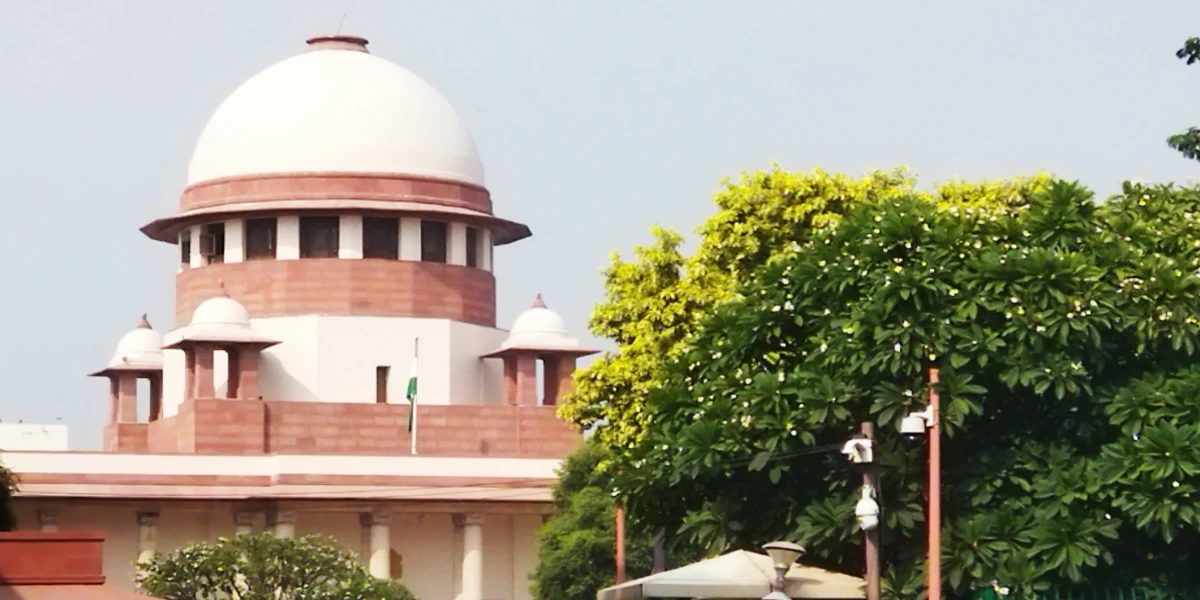
Today, the Supreme Court put hold on its earlier directions on the revised definition of the Aravalli Hills in a suo motu matter, after flagging concerns that the expert report and the Court’s remarks were being misconstrued.
''Noting that the expert committee’s report and the Court’s own observations were being misinterpreted.''
Hearing a suo motu matter, a bench led by Chief Justice of India Surya Kant, along with Justices JK Maheshwari and AG Masih, said the issue needed further clarity before any changes could be acted upon.
The next date of hearing is on 21st Jan, 2025.
“We consider it necessary that the committee’s recommendations and this Court’s directions remain in abeyance,” the bench said, adding that the stay will continue till a fresh committee is constituted.
The Court had taken up the matter on its own after concerns were raised that the revised definition of the Aravalli Hills could allow unregulated mining and cause serious environmental damage.
The bench noted that before implementing any definition, an independent and unbiased expert assessment was required. It said the Court needed to examine whether the revised definition had unintentionally widened the scope of non-Aravalli areas, thereby enabling mining activity to continue.
Several specific concerns were flagged during the hearing. The Court said it must be examined whether mining would be allowed in the 500-metre gaps between hills and, if so, how ecological continuity would be protected. It also questioned claims that only 1,048 out of 12,081 hills meet the 100-metre elevation requirement, saying the accuracy of this data and the need for a geological study would have to be assessed.
CJI Surya Kant said the Court was considering setting up a high-powered expert committee to take a holistic look at the report and the issues arising from it. This would include identifying areas excluded from the Aravalli region and assessing whether such exclusions could weaken the ecological integrity of the range.
The Court sought the assistance of Attorney General R Venkataramani and senior advocate PS Parmeswar, including on the composition of the proposed committee. During the hearing, the Solicitor General informed the bench that States had already been directed to ensure that no further mining activity takes place.
Background
The suo motu proceedings were triggered by protests and objections from environmental groups and civil society organisations over the revised definition of the Aravalli Hills, a region known for its role in preventing desertification and sustaining groundwater. There were fears that a diluted definition could legitimise mining and construction in areas earlier treated as protected.
The issue stems from varying definitions of the Aravalli Hills and Ranges across Delhi, Haryana, Rajasthan and Gujarat, which have led to regulatory gaps and instances of illegal mining. To address this, the Supreme Court had earlier set up a high-level committee.
In a judgment delivered in November, the Court accepted an operational definition recommended by a committee of the Ministry of Environment, Forest and Climate Change for mining-related purposes. Under this definition, an “Aravalli Hill” is any landform in specified districts with a minimum elevation of 100 metres from local relief, while an “Aravalli Range” is formed when two or more such hills lie within 500 metres of each other.
Even while accepting the definition, the Court had directed the Union government to frame a comprehensive plan for sustainable mining before allowing any new mining activity in the ecologically sensitive Aravalli region.
Case: SMW(C) No. 10/2025
Title: In Re: Definition of Aravalli Hills and Ranges and Ancillary Issues
Website designed, developed and maintained by webexy