
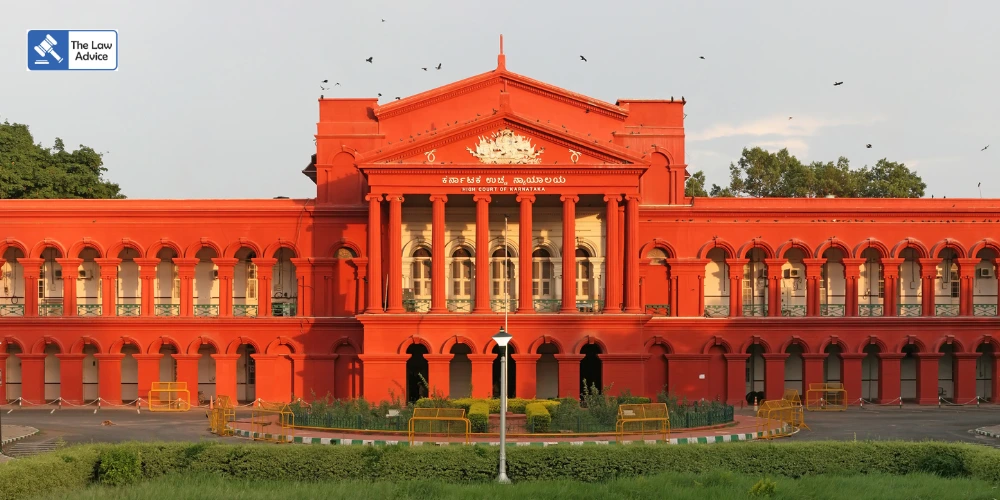
The Karnataka High Court has reiterated that arbitration is fundamentally a consensual mechanism and can only involve those who are parties to the arbitration agreement, except in narrowly defined exceptional scenarios.
Justice Suraj Govindaraj delivered the ruling while allowing a plea filed by petitioner Lubna Shah. Shah had entered into a Joint Development Agreement (JDA) with Varun Infra Projects (Respondent No. 3) on 27.06.2016, which contained an arbitration clause under Clause 22.
Following a failed attempt to amicably resolve disputes through a letter dated 27.01.2025, Shah invoked the arbitration clause and issued a notice on 18.02.2025 nominating an arbitrator. Varun Infra Projects responded on 04.03.2025 seeking time to revert, but Shah approached the Court alleging lack of consent and requesting appointment of an arbitrator by the Court.
The company contended that its directors (Respondents 1 & 2) were not signatories to the agreement and could not be compelled to participate in the arbitral process. Shah argued that since one director had signed the JDA and the company was merely a shell entity formed for the project—without assets beyond the subject property—the directors must be arrayed to ensure enforceability of any future award.
The Court relied on the landmark decision in Salomon v. Salomon & Co. Ltd., [1897] AC 22, affirming the principle of corporate personality: “A company and its directors are distinct entities, and they cannot be equated or dragged into arbitration merely because the company may face financial incapacity to satisfy an award.” The appropriate remedy in such a situation, the Court observed, lies in enforcement proceedings—not by prematurely enlarging the arbitral circle.
Underscoring contractual privity, the Court held: “Arbitration derives its legitimacy from the agreement itself. Even a signatory may not automatically qualify as a party unless the agreement explicitly binds them.”
The Bench also considered Section 21 and Section 11(4) of the Arbitration and Conciliation Act, holding that although the petition was filed before expiry of the 30-day reply period, it need not be dismissed purely on procedural grounds—particularly since Varun Infra Projects did not convey concurrence to the arbitrator’s appointment.
Given submissions from both sides favoring a mediated settlement prior to arbitration, the Court referred the dispute to the Karnataka Mediation Centre, directing the Director to appoint a mediator.
Representation:
Adv. Samarth Shreedhar for the petitioner.
Adv. Rakshith Pai for Respondents 1–3.
Website designed, developed and maintained by webexy