
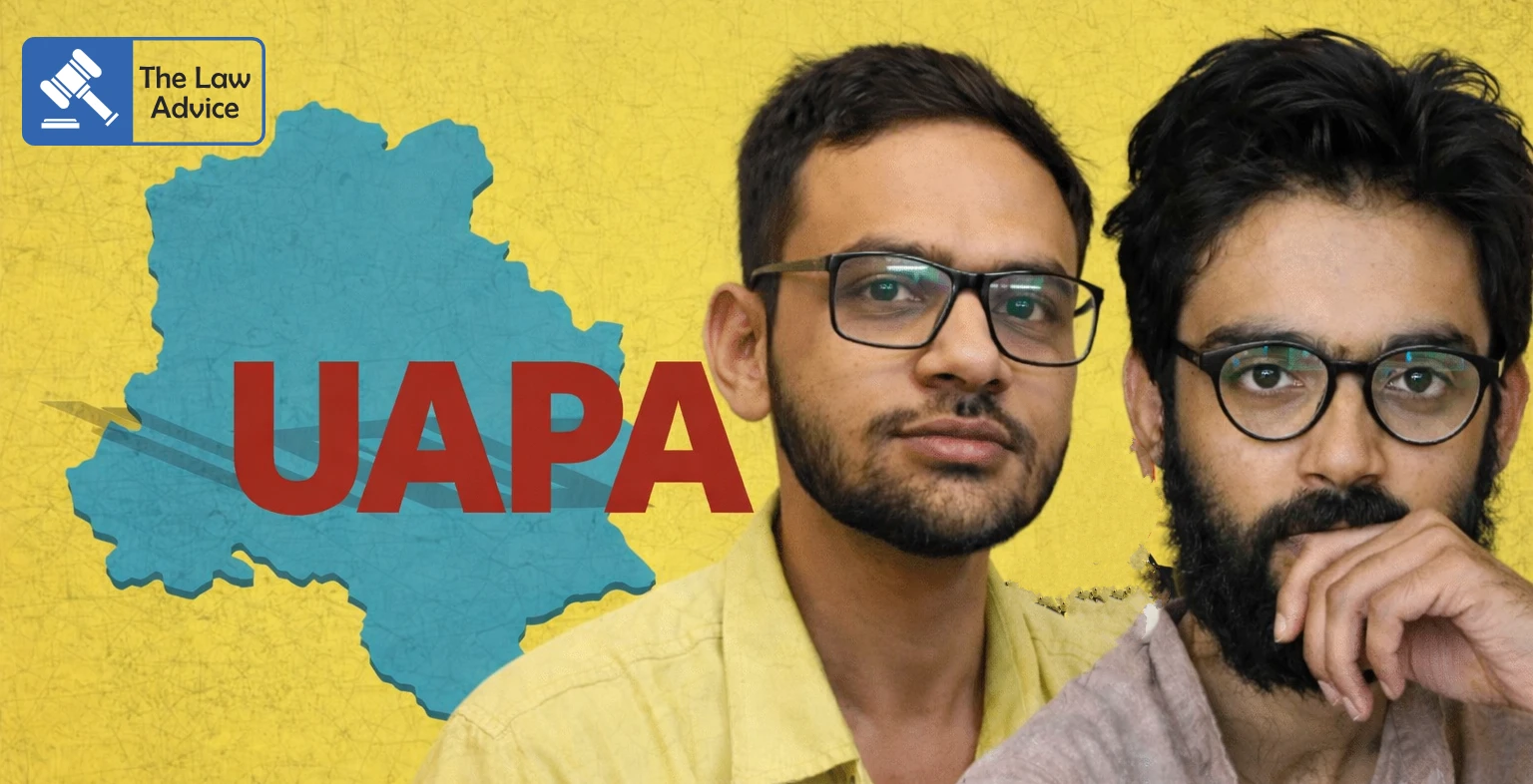
Today, the Supreme Court refused to grant bail to Umar Khalid and Sharjeel Imam in the 2020 Delhi riots larger conspiracy case, in which they face charges under the Unlawful Activities (Prevention) Act (UAPA).
Meanwhile, a divison bench of Justices Aravind Kumar and N.V. Anjaria granted bail to five other accused—Gulfisha Fatima, Meeran Haider, Shifa ur Rehman, Shadab Ahmed and Mohd. Saleem Khan.
Justifing the act, the Court said that bail pleas must be assessed on a case-by-case basis, noting that all seven accused could not be treated as being on the same footing in terms of their alleged roles and culpability.
"Umar Khalid and Sharjeel Imam stand on a qualitatively different footing as compared to other accused," the Bench said.
"This court is satisfied that the prosecution material disclosed a prima facie allegation against the appellants Umar Khalid and Sharjeel Imam. The statutory threshold stands attracted qua these appellants. This stage of proceedings do not justify their enlargement on bail," the Court directed.
Further, the Court clarifies that Umar Khalid and Sharjeel Imam would be at liberty to apply for bail afresh upon completion of the examination of protected witnesses or after one year from the date of the present order, whichever is earlier.
In respect of the other five accused, the Court granted bail subject to strict conditions.
The Bench further observed that prolonged delay in trial can warrant judicial scrutiny even in cases involving offences under the UAPA, including the present matter.
Emphasising the right to personal liberty under Article 21 of the Constitution, the Bench underscored that the State must justify prolonged pre-trial incarceration.
The Court noted that although bail in UAPA cases is not granted as a matter of course, the statute does not prescribe denial of bail as a default rule, nor does it oust the Court’s jurisdiction to grant bail in appropriate cases.
"Section 43D(5) of UAPA departs from general provisions for grant of bail. (But) it does not exclude judicial scrutiny or mandate denial of bail in default," the Bench said.
Case History:
The riots broke out in February 2020 amid clashes linked to protests against the then-proposed Citizenship Amendment Act (CAA). According to the Delhi Police, the violence claimed 53 lives and left several hundred people injured.
The case relates to allegations that the accused were part of a larger conspiracy to engineer multiple riots. The FIR was registered by the Special Cell of the Delhi Police under various provisions of the Indian Penal Code (IPC) and the Unlawful Activities (Prevention) Act (UAPA).
Umar Khalid was arrested in September 2020 and charged with offences including criminal conspiracy, rioting, unlawful assembly and multiple provisions of the UAPA. He has remained in judicial custody since his arrest.
Sharjeel Imam was also named in several FIRs across different states, largely invoking charges of sedition and the UAPA. While he has secured bail in other cases, he continues to remain incarcerated in the larger conspiracy case.
Khalid and other accused had approached the Supreme Court challenging the Delhi High Court’s September 2 order rejecting their bail pleas. The apex court issued notice to the Delhi Police on September 22.
Opposing the bail petitions, the Delhi Police filed an affidavit claiming the existence of irrefutable documentary and technical evidence indicating a conspiracy aimed at a “regime-change operation,” including plans to incite nationwide communal violence and target non-Muslims.
During the hearing on October 31, the accused submitted that they had never called for violence and were merely exercising their constitutional right to peaceful protest against the CAA.
The Delhi Police, however, argued that the accused could not claim parity with other co-accused who had earlier been granted bail by the Delhi High Court.
On November 18, Solicitor General Tushar Mehta, appearing for the Delhi Police, contended that the riots were premeditated and not spontaneous, asserting that speeches delivered by the accused were intended to deepen communal divisions.
Subsequently, on November 20, the police described the accused as anti-national elements who allegedly sought to overthrow the government through violence. Similar submissions were reiterated on November 21, with the police drawing comparisons to recent incidents of unrest in Bangladesh and Nepal to support their claim of an attempted regime change.
When the matter was taken up on December 3, the Supreme Court directed the accused to furnish their permanent residential addresses to the Court.
Website designed, developed and maintained by webexy