
In an important judgment interpreting the Indian Succession Act, 1925, the Supreme Court has clarified how property inherited by Christians is to be distributed where a deceased man had two wives and children from both marriages. The Court held that property purchased in the names of the wives belongs to them individually and cannot automatically be treated as the husband's property for succession purposes.
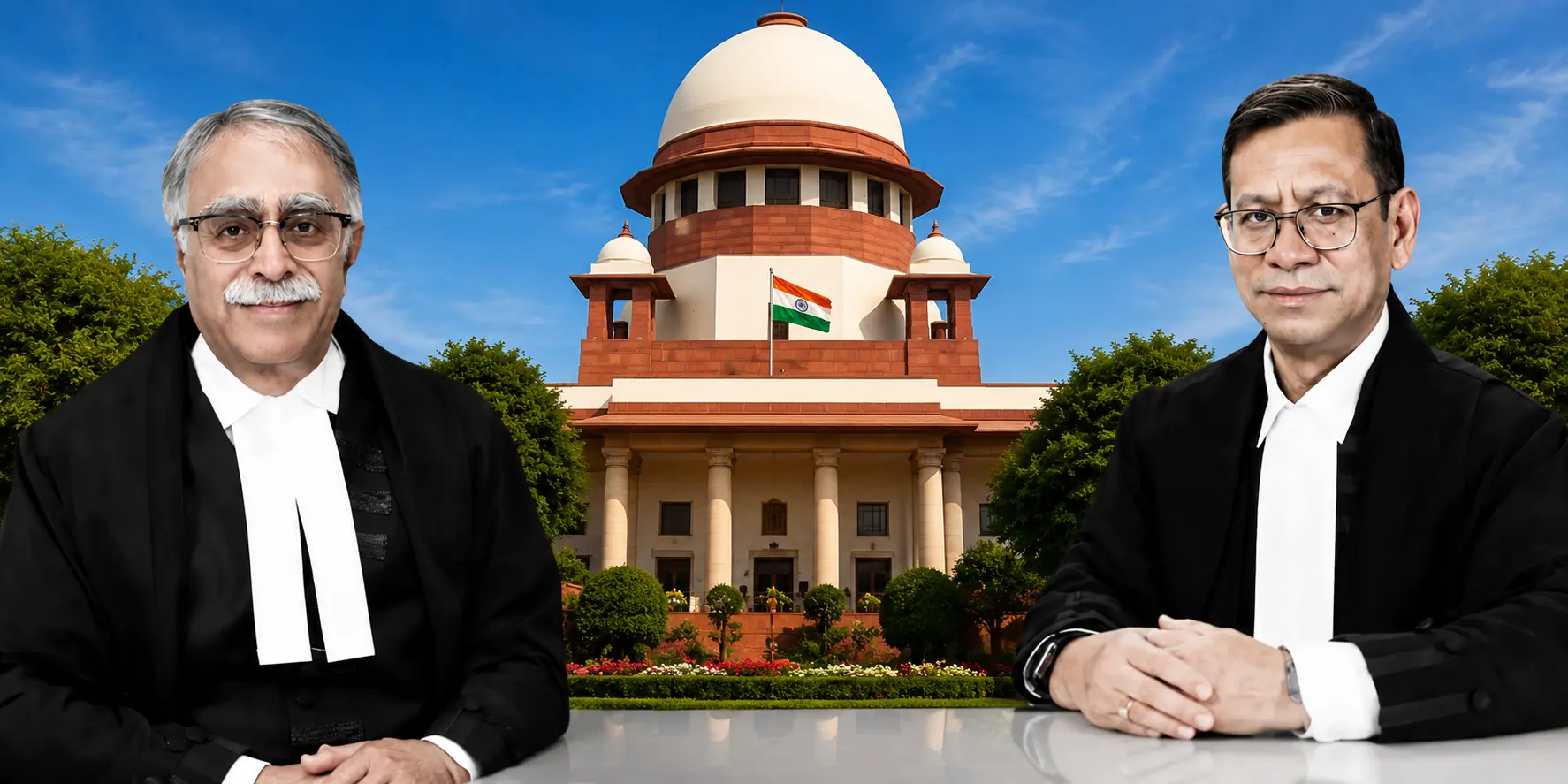
A Bench of Justice Sanjay Karol and Justice Nongmeikapam Kotiswar Singh allowed the appeal and set aside the judgments of the Trial Court, the First Appellate Court, and the Chhattisgarh High Court after finding that all three courts had adopted incorrect approaches while determining the shares of the parties.
Background of the Dispute
The dispute concerned a parcel of land purchased in 1959 by Mattus Anthony, a Christian, for ₹300. Although the purchase money was paid by Mattus Anthony, the sale deed was executed in the names of his two wives—Filomina and Shyam Bai.
Mattus Anthony had three children through his first wife Filomina and one son, John Anthony, through his second wife Shyam Bai. Filomina died in 1985, Mattus Anthony died intestate in 1991, while Shyam Bai died in 2000. John Anthony had predeceased his mother in 1985, leaving behind his own legal heirs.
In 2002, the heirs of John Anthony sold what they claimed to be their share in the property, prompting the children of Filomina to challenge the sale deed before the civil court.
Three Courts Took Three Different Views
The litigation witnessed three entirely different conclusions:
The matter eventually reached the Supreme Court.
Section 33 Was Wrongly Applied
The principal issue before the Supreme Court was whether the High Court had correctly applied Section 33 of the Indian Succession Act, which governs succession where a Christian male dies intestate leaving behind a widow and lineal descendants.
The Court answered the question in the negative.
It observed that Section 33 applies only where the property belongs to the deceased male. In the present case, however, the property had been purchased directly in the names of the two wives.
Therefore, the Court held that the property legally belonged to the wives themselves and could not be treated as the exclusive estate of Mattus Anthony merely because he had paid the purchase price.
Accordingly, the High Court erred in distributing the entire property as though it formed part of Mattus Anthony's intestate estate.
Property Purchased in Wife's Name Remains Her Property
The Supreme Court explained that since the property stood in the names of Filomina and Shyam Bai, each owned one-half share.
After Filomina's death, Section 35 of the Indian Succession Act, which grants a surviving husband the same succession rights in his wife's estate as a widow enjoys in her husband's property, became applicable.
Consequently:
The Court clarified that Section 33 operated only in relation to Filomina's share through Section 35 and not upon the entire property, as wrongly assumed by the High Court.
Husband's Share Further Passed to All Four Children
The Supreme Court further explained that the one-third portion inherited by Mattus Anthony from Filomina did not remain with him permanently.
After his death intestate, that share devolved equally upon all his children from both wives.
Thus, the son born through Shyam Bai also became entitled to a proportionate share in that limited portion inherited by Mattus Anthony.
The legal heirs of John Anthony would therefore succeed only to the extent of the share inherited by John Anthony and not to the entirety of Shyam Bai's half share.
No Joint Family Concept Under Christian Law
The Bench also highlighted a significant distinction between Hindu and Christian succession laws.
The Court observed that Christian law does not recognise the concept of joint family or coparcenary property.
Instead, inherited property is held by heirs as tenants-in-common, each owning a definite and separate share.
Accordingly, succession had to be worked out strictly in accordance with the provisions of the Indian Succession Act rather than principles applicable to Hindu joint family property.
Benami Issue Not Examined
The Court noted that although arguments regarding benami transactions and the validity of Mattus Anthony's second marriage had been referred to during the proceedings, neither issue had been pressed before the Court.
The Bench therefore refrained from adjudicating those questions.
However, it observed that the property had been purchased by Mattus Anthony in the names of both wives out of love and affection, and the parties themselves had accepted the legal status of both wives for the purposes of succession.
Appeal Allowed
Allowing the appeal, the Supreme Court set aside the judgments of all the courts below and directed that the rights of the parties be worked out in accordance with the principles laid down in its judgment.
The Court held that succession must be determined on the basis that the property belonged to the two wives individually and not as the exclusive estate of Mattus Anthony, thereby clarifying the correct application of the Indian Succession Act in such family property disputes involving Christians.

Representation:-
For Petitioner(s) : Mr. Satish Pandey, AOR
For Respondent(s) : Mr. Gagan Gupta, Sr. Adv., Mr. Vikrant Singh Bais, AOR, Mr. Yogesh Tiwari, Adv., Ms. Neema Singh, Adv., Ms. Priya Hingorani, Sr. Adv., Mr. Nikhil Jain, AOR, Ms. Aditi Ladda, Adv., Ms. Divya Jain, Adv., Ms. Arveen Sekhon, Adv., Ms. Ankita Sharma, AOR, Mr. Arjun D Singh, Adv., Ms. Ishika Neogi, Adv., Mr. Divya Tripathi, Adv.
Amicus Curie: Mr. Gaurav Agrawal, Sr. Adv.(A.C.)
Ms. Akriti Chaubey, AOR
Ms. Shrija Rawat, Adv.
Mr. Darshan Sejwal, Adv.
Website designed, developed and maintained by webexy