
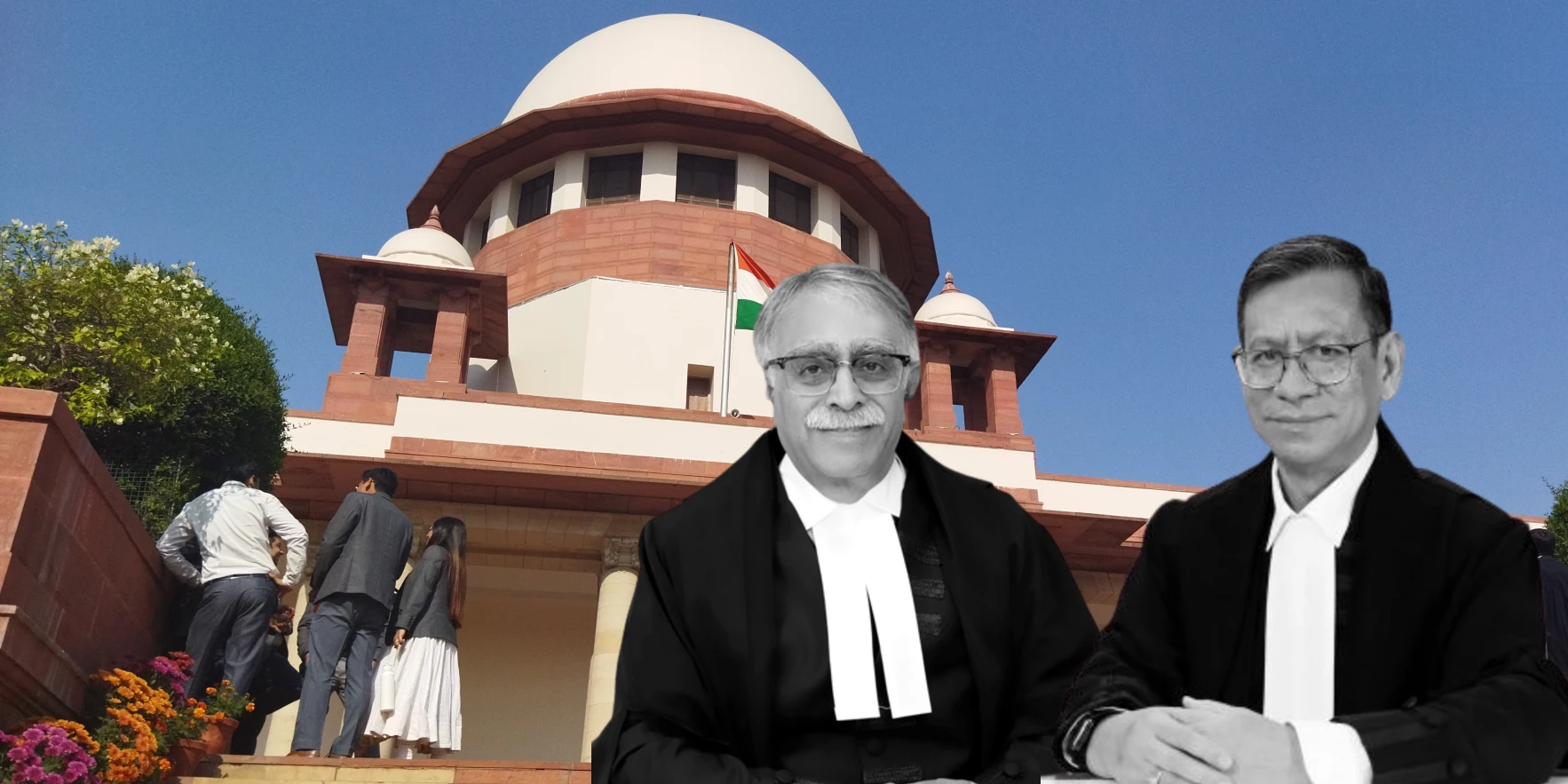
In a significant judgment concerning motor accident compensation and the responsibilities of vehicle owners, the Supreme Court has held that an insurance company cannot be saddled with the ultimate liability where the driver of the offending vehicle did not possess a valid driving licence on the date of the accident. While applying the principle of "pay and recover" to protect the interests of accident victims, the Court emphasized that owners have a continuing duty to ensure that their drivers hold valid and effective driving licences.
A Bench of Justice Sanjay Karol and Justice Nongmeikapam Kotiswar Singh allowed the appeals filed by Reliance General Insurance Company Ltd., setting aside the Punjab and Haryana High Court's finding that had fastened final liability on the insurer.
Background
The case arose from a road accident that occurred on October 14, 2009, in which an offending vehicle hit a two-wheeler being driven by the claimant. Negligence of the driver was not in dispute.
The controversy before the Supreme Court was limited to one question:
Whether the driver possessed a valid driving licence on the date of the accident?
The answer to this question determined whether the insurer would ultimately bear the compensation liability.
The Motor Accident Claims Tribunal (MACT) had held that the driver did not possess a valid licence on the relevant date and, therefore, directed only the driver and the owner to pay compensation.
However, the Punjab and Haryana High Court reversed that finding after accepting evidence suggesting that due to a technical error during digitisation of records, the licence renewal data had been lost. On that basis, the High Court held the insurer liable to satisfy the award.
The insurer challenged this finding before the Supreme Court.
Supreme Court Rejects High Court's Reliance on Oral Evidence
Examining the evidence in detail, the Supreme Court found that the High Court had placed undue reliance on oral testimony and a communication claiming that renewal records had been lost during migration of computer data.
The Court observed that when the authenticity of an official document such as a driving licence is in dispute, its validity must ordinarily be established through official records and primary documentary evidence, not merely through oral assertions.
The Bench held that although an officer had stated that data had been lost during transfer from one outsourced agency to another, no official records were produced to establish the alleged data loss, the recovery process, or similar instances affecting other licence holders.
According to the Court, if the licensing authority could produce records supporting one aspect of the licence, it could equally have produced official material demonstrating the alleged gap in the database.
In the absence of such evidence, the Court found the High Court's conclusions unsustainable.
Penalty Payment Raised Serious Doubts
The Supreme Court also noted an important inconsistency.
Evidence showed that the driver had paid a penalty while renewing the licence after the relevant period.
The Bench questioned why such a penalty would have been imposed if the licence had remained continuously valid throughout.
The Court observed that although both the Tribunal and the High Court acknowledged payment of the penalty, only the Tribunal appreciated its significance, whereas the High Court ignored its legal implications and accepted the licensing officer's statement without adequate scrutiny.
Owner Has Duty to Verify Driving Licence
Reiterating settled principles under the Motor Vehicles Act, the Court emphasized that vehicle owners have a statutory obligation to ensure that persons driving their vehicles possess valid and effective driving licences.
The Bench observed that merely verifying a licence once is not sufficient.
Owners must exercise reasonable care to ensure that the licence continues to remain valid through timely renewals.
The Court relied upon its earlier decisions, including Beli Ram v. Rajinder Kumar, to hold that an owner cannot simply wash his hands of responsibility after initially verifying a licence.
Pay and Recover Principle Applied
Although the insurer succeeded in establishing that it should not bear the final liability, the Supreme Court protected the interests of the accident victims by applying the doctrine of "pay and recover."
Since compensation had already been directed to be released to the claimants, the Court held that the insurer would first satisfy the award and would thereafter be entitled to recover the amount from the owner and the driver in accordance with law.
Supreme Court Calls for Driving Licence Awareness Campaign
In an important policy observation, the Court expressed concern that lack of attention to licence renewals could expose vehicle owners and drivers to enormous financial consequences.
The Bench observed that imposing compensation running into crores of rupees upon individual drivers or owners could completely disrupt their lives, particularly where such liability arose merely because they failed to ensure continuous validity of the driving licence.
Highlighting the importance of driving licences as documents certifying a person's legal competence to drive on public roads, the Court suggested that the Ministry of Road Transport and Highways and State Governments should undertake nationwide awareness campaigns through social media, public outreach programmes and other communication platforms.
The Court also recommended:
Appeal Allowed
Allowing the appeals, the Supreme Court held that the insurance company cannot be fastened with the ultimate liability where the driver did not possess a valid licence on the date of the accident.
However, applying the principle of pay and recover, the Court permitted the insurer to recover the compensation from the owner and driver after satisfying the award already granted to the claimants.

Representation:-
For Petitioner(s) :Mr. Atul Nanda, Sr. Adv., Ms. Vartika Aggarwal, Adv., Ms. Prerna Mehta, AOR
For Respondent(s) :Mr. Rameshwar Singh Malik, Sr. Adv., Mr. Jitesh Malik, Adv., Mr. Jatin Hooda, Adv., Mr. Abhaya Nath Das, Adv., Ms. Barnali Basak, Adv., Mr. Yogendra Kumar Verma, Adv., Dr. Jyoti Verma, Adv., Mr. Satish Kumar, AOR, Ms. Sunita Sharma, AOR, Mr. Hari Om Singh Rajaur, Adv. Mr. Anurag Agarwal, Adv., Mr. Aditya Kumar, Adv.
Website designed, developed and maintained by webexy