
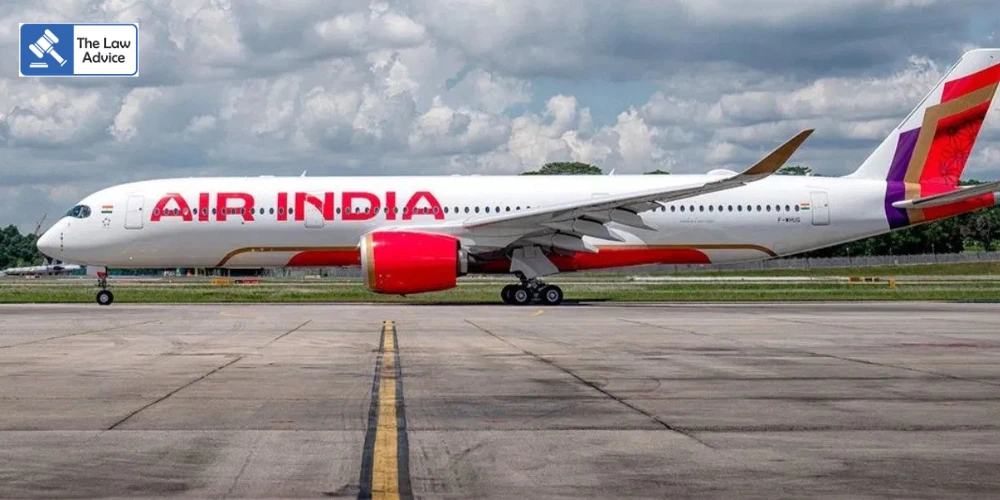
The Delhi High Court has directed the Directorate General of Civil Aviation (DGCA) and the Ministry of Civil Aviation to expeditiously decide a complaint filed against Air India over allegedly inadequate meals served during a 16-hour Delhi–San Francisco flight.
The complaint was filed by two passengers who alleged that despite informing the airline about their medical conditions, including diabetes and hypertension, they were served only one hot meal along with limited snacks during the journey.
A Division Bench comprising Chief Justice Devendra Kumar Upadhyaya and Justice Tejas Karia directed the DGCA to conclude the grievance redressal process in a time-bound manner.
“We direct that the grievance redressal exercise, if not already concluded, shall be completed expeditiously after taking into consideration the written replies submitted by the Appellants as well as Respondent No. 3/Air India, and a reasoned order shall be passed within a period of six weeks,” the Court said in its order dated May 23.
The matter relates to Air India flight AI-173 operating from New Delhi to San Francisco on November 11, 2020.
According to the passengers, the quality and quantity of food served during the flight were grossly inadequate. One of the passengers allegedly suffered food poisoning, dehydration and weakness after consuming the meal provided onboard.
The petitioners further claimed that one passenger experienced repeated hypoglycaemic episodes during the long-haul flight and had to consume sugar and sweetened beverages to stabilise her condition.
It was also alleged that the cabin crew failed to properly recognise or respond to the medical emergency, reflecting inadequate training in handling such situations.
The passengers had approached the High Court in 2021 seeking constitution of an independent committee to review the quality and quantity of meals served on the flight.
Earlier, a single judge of the High Court, in an order passed on April 8, 2025, observed that the passengers appeared to have suffered serious inconvenience. The single judge directed the Ministry of Civil Aviation to treat the petition as a formal complaint and decide it in accordance with law, while disposing of the petition.
Subsequently, the passengers sought recall of the April 2025 order, arguing that the directions had not been complied with. They later filed an appeal before the Division Bench contending that the single judge ought to have adjudicated the matter instead of relegating it to the Ministry and DGCA.
The appellants also argued that the DGCA could not independently decide the issue since allegations had also been levelled against the regulator.
The Division Bench, however, rejected the contention and observed that merely because notice had been issued in a writ petition did not mean the Court was bound to decide the matter on merits. It added that parties could still be relegated to an equally efficacious alternative remedy.
The Court further observed that the dispute involved contested questions of fact, which could not be effectively adjudicated in writ proceedings. It held that the Ministry of Civil Aviation and DGCA, being sectoral regulators, were better equipped to first examine the grievance.
At the same time, the Bench noted that the grievance had not yet been effectively addressed and directed the authorities to complete the exercise after considering the responses filed by both the passengers and Air India.
The Court also clarified that the passengers would be free to pursue further legal remedies if they remained dissatisfied with the final decision.
Case Title: Nivedita Sharma v. Ministry of Civil Aviation.
Website designed, developed and maintained by webexy