
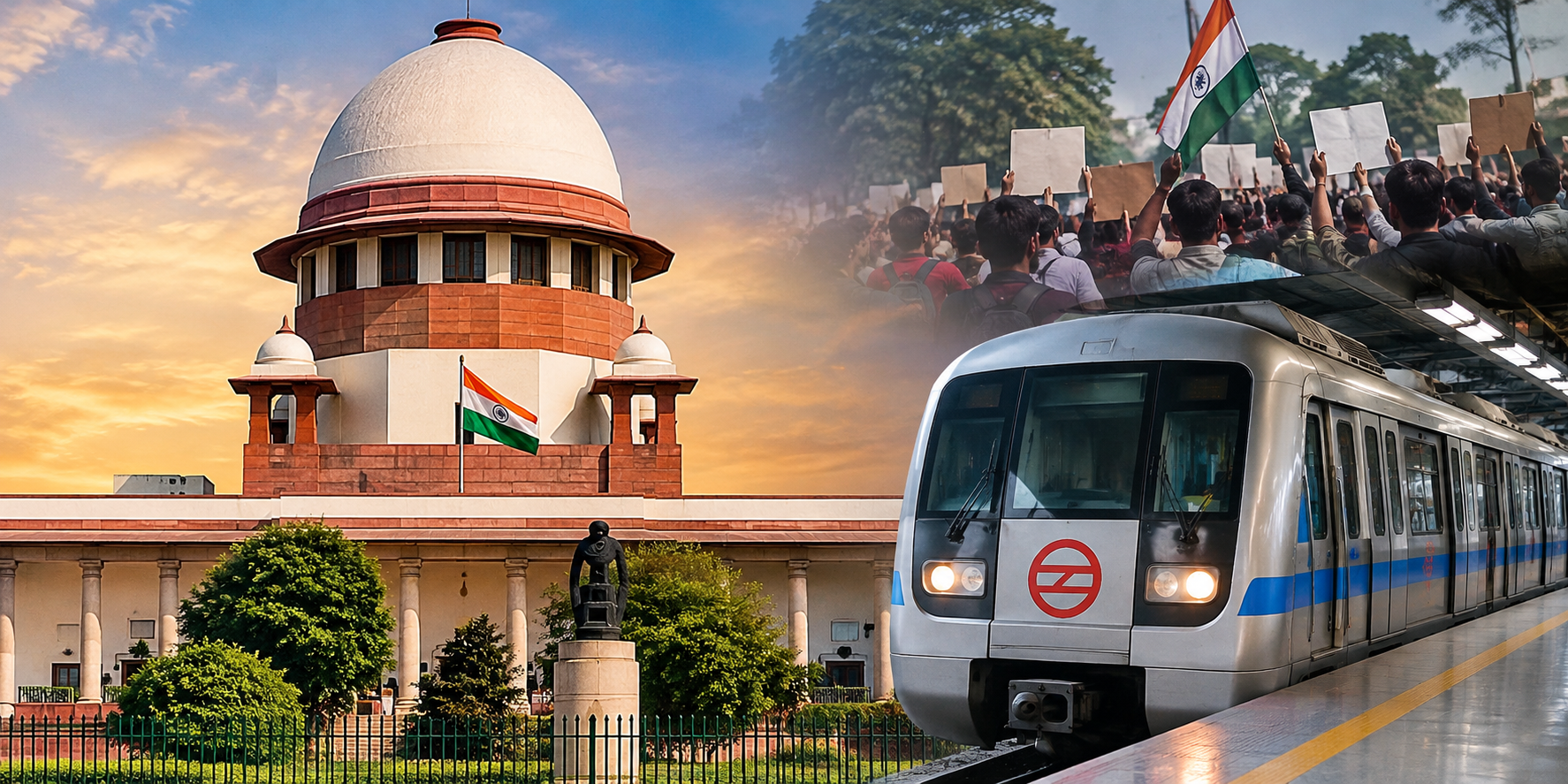
The Supreme Court on Friday directed that there shall be no complete prohibition on the movement of Delhi Metro trains ahead of the October 10 protests demanding the removal of Chief Election Commissioner (CEC) Gyanesh Kumar.
The Court asked authorities to reconsider restrictions on metro and railway services and ensure that public transport remains available through suitable regulation.
A bench comprising Chief Justice of India Surya Kant and Justices Joymalya Bagchi and V Mohana passed the order while hearing petitions challenging the closure of metro stations and the cancellation of long-distance trains arriving at New Delhi Railway Station and Hazrat Nizamuddin Railway Station.
The Court expressed serious concerns over the closure of metro station entry and exit points, observing that such restrictions could cause significant inconvenience to thousands of commuters, including students, employees, senior citizens and people travelling to Delhi from Gurugram, Greater Noida and other parts of the National Capital Region.
“We are speaking on behalf of the common citizens of this city,” CJI Surya Kant said, stressing that while law enforcement authorities could regulate movement to maintain public order, they could not bring public transport to a complete halt and leave people without alternative means of travel.
The Chief Justice emphasised the importance of the doctrine of proportionality, stating that authorities must take measures only to the extent necessary to prevent potential disturbances. He cautioned against imposing excessive restrictions when less intrusive security measures were available.
Solicitor General Tushar Mehta told the Court that the government would reconsider the restrictions in light of the concerns expressed by the bench. He, however, submitted that the authorities needed some flexibility to respond to the situation as it developed.
Justice Bagchi questioned the apparent contradiction in the Delhi Metro communication, which referred to reducing train frequency before directing the closure of station entry and exit points from 9 am until the situation normalised. The judge observed that reducing frequency amounted to regulation, whereas closure amounted to prohibition.
The bench also raised concerns over restrictions on railway services. Senior Advocate Kapil Sibal referred to a railway communication directing the cancellation at source of Mail and Express trains scheduled to reach New Delhi Railway Station and Hazrat Nizamuddin Railway Station during specified hours on October 10, citing anticipated traffic congestion.
The Solicitor General assured the Court that the government would reconsider the restrictions and take proportionate measures. He submitted that the authorities had to account for previous incidents during protests, including injuries to police personnel and alleged attacks on women police officers.
Mehta told the bench that permission for an earlier protest had been granted for one day but the demonstration continued for 17 days, with alleged violations of the conditions imposed by the authorities. He also submitted that the police needed to make security arrangements in view of calls asking people from different places to march towards Delhi.
The Chief Justice acknowledged the responsibility of law enforcement agencies to maintain public order but stressed that their duty extended beyond protecting government property to safeguarding citizens. He said that children, women, senior citizens and patients who rely on public transport must also be considered while imposing restrictions.
The bench further observed that road closures should be reviewed to identify areas where restrictions were necessary and ensure the free flow of traffic wherever possible. It also suggested that authorities provide advance information about any transport restrictions so commuters could make alternative arrangements.
During the hearing, counsel also raised allegations that police personnel had visited mosques, hostels and paying guest accommodations and discouraged people from participating in the proposed protests. The Chief Justice declined to comment on the allegations without hearing the authorities concerned, while observing that citizens should not be unduly harassed.
The bench clarified that the immediate issue before it was not the protesters' right to organise or participate in the demonstration, but whether the restrictions on public transport and movement were proportionate. It also granted liberty to the protest organisers to approach the Court through an urgent petition, noting that no such petition had been filed on their behalf.
In its order, the Court recorded that the communications issued on October 8 and October 9 concerned restrictions on metro services and Mail and Express trains reaching the two railway stations in view of the likelihood of unruly movement towards the locations.
The bench noted that the Solicitor General had agreed to impress upon the authorities to reconsider the prohibition and permit metro and other railway services to operate in a suitably regulated manner.
“In terms of that assurance, we make it clear that there shall be no complete prohibition on the movement of metro trains,” the Court ordered.
The bench further directed the authorities to give wide publicity to their decisions regarding the regulated movement of metro trains and railway services to minimise inconvenience to the public.
Website designed, developed and maintained by webexy