
Holding that a departmental inquiry cannot be allowed to become a “pre-arranged farce” through the concentration of management, prosecutorial and adjudicatory roles within a close-knit family, the Supreme Court restored the reinstatement of a woman teacher whose services had been terminated following a disputed disciplinary inquiry.
The Supreme Court has held that a departmental inquiry conducted under the influence of close family members of the management, where the complainant, principal witness and adjudicator are closely related, violates the principles of natural justice and is liable to be set aside on the ground of reasonable likelihood of bias.
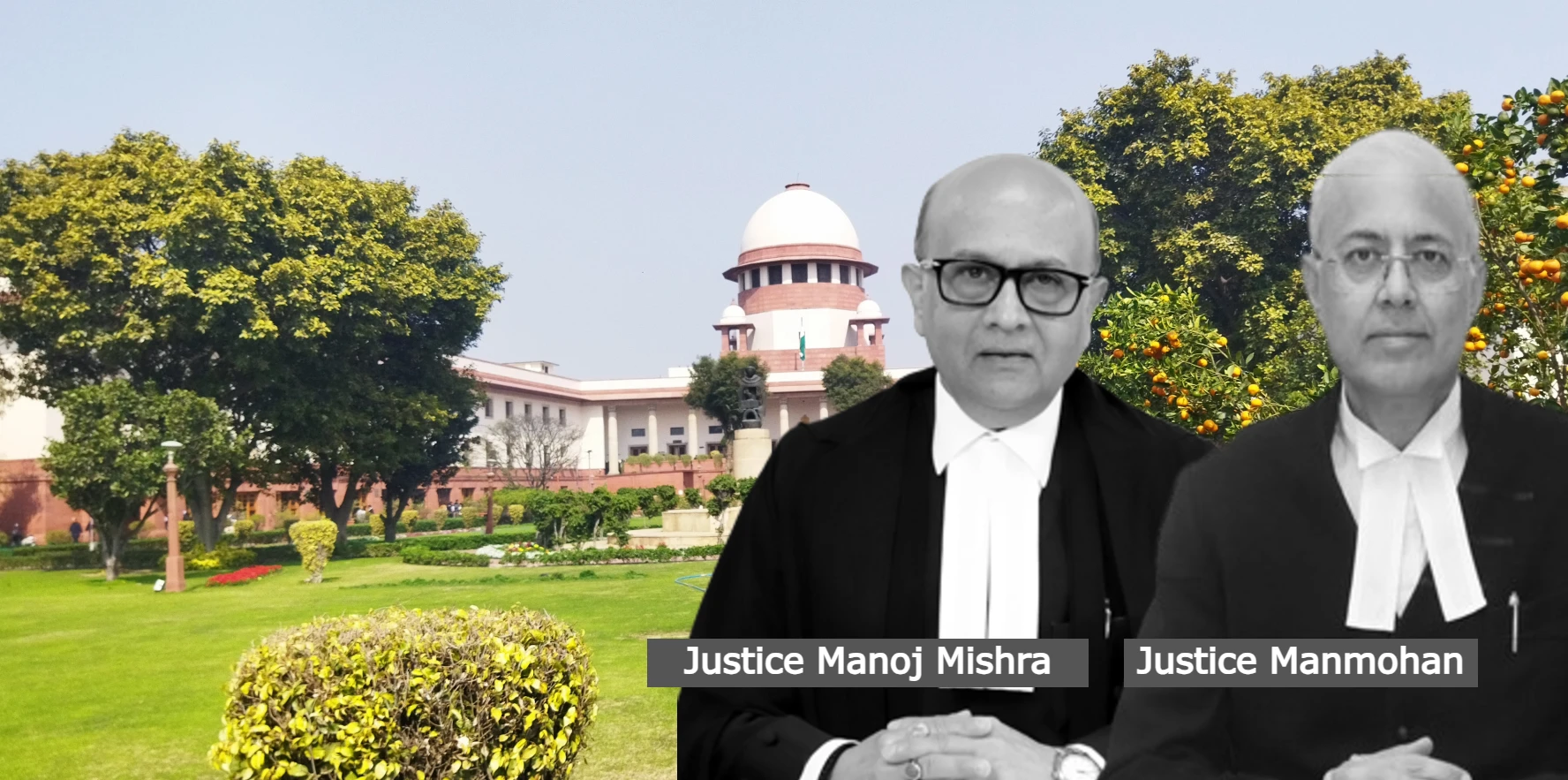
A Bench of Justice Manmohan and Justice Manoj Misra allowed the appeal filed by Ku. Kiran Bhujade against Sudhir Shikshan Sanstha and others, setting aside the Bombay High Court's judgment which had upheld her termination from service.
The Court restored the School Tribunal, Nagpur's order dated March 21, 2024, which had quashed the termination order and directed the management to reinstate the teacher with continuity of service and full back wages.
The judgment was delivered on November 17, 2026, in Ku. Kiran D/o Purushottam Bhujade v. Sudhir Shikshan Sanstha & Ors., 2026 INSC 1229.
Background
The appellant was appointed as an Assistant Teacher at the respondent school on June 26, 2009, with effect from July 1, 2009. Her appointment was subsequently approved by the Education Officer, Zilla Parishad, Nagpur, on September 5, 2015, with retrospective effect from July 1, 2009.
On July 1, 2016, the State Government granted 20% grant-in-aid status to the school. The appellant alleged that the management, acting through its Secretary, Rajesh Masurkar, deliberately excluded her name from the salary grant bills submitted to the Education Department, thereby depriving her of the benefits of the grant-in-aid scheme.
She submitted a complaint on March 26, 2021, to the Education Minister and other authorities. Following the complaint, the Education Officer constituted a three-member Inquiry Committee on April 15, 2021, to examine the issue of non-payment of her salary.
The Committee subsequently found that the Headmaster/Secretary had failed to include her name in the list of teachers eligible for the 20% grant benefit and directed that her name be included.
Meanwhile, the management initiated disciplinary proceedings against the appellant, alleging misconduct, including tampering with documents. An Inquiry Committee was constituted under Rule 36 of the Maharashtra Employees of Private Schools (Conditions of Service) Rules, 1981.
On February 18, 2022, the Inquiry Committee submitted its findings by a majority of two out of three members. Based on the report, the management issued an order terminating the appellant's services with effect from February 24, 2022.
School Tribunal Set Aside Termination
The appellant challenged the termination before the School Tribunal, Nagpur.
By an order dated March 21, 2024, the Tribunal quashed the termination order and directed the management to reinstate her with continuity of service and full back wages.
The Tribunal observed that Rajesh Masurkar, who had issued the charge-sheet and statement of allegations, was also the key witness for several charges. It held that his evidence could not be accepted without considering the settled principle that no person can be a judge in his own cause.
The Tribunal further concluded that the allegations had not been proved and that the appellant had been made a target of harassment.
However, the Bombay High Court, Nagpur Bench, allowed the management's writ petition on April 29, 2025, set aside the Tribunal's order and upheld the termination.
The appellant thereafter approached the Supreme Court.
Allegation of Family Control Over Departmental Inquiry
Before the Supreme Court, the appellant argued that the disciplinary proceedings were fundamentally vitiated by bias because the management of the institution was dominated by members of the Masurkar family.
It was pointed out that Rajesh Masurkar, the Secretary of the institution, had issued the charge-sheet, acted as the Chief Executive Officer of the inquiry, examined management witnesses, appeared as a principal witness on several charges and signed the termination order.
The appellant also objected to the appointment of Prakash Masurkar, the real brother of Rajesh Masurkar, as Convenor of the Inquiry Committee.
It was argued that Rajesh Masurkar was simultaneously the complainant, prosecutor and principal witness, while his brother presided over the inquiry and acted as the adjudicator.
The appellant contended that such an arrangement destroyed the independence and impartiality of the disciplinary proceedings.
On the other hand, the management argued that the appellant had accepted the appointment of Prakash Masurkar as Convenor and had waived her objection. It further submitted that the inquiry was conducted in accordance with the applicable rules and that several witnesses had supported the charges.
Supreme Court on the Test of Reasonable Likelihood of Bias
The Supreme Court examined the principles governing bias in administrative and disciplinary proceedings.
Referring to its earlier decisions, including A.K. Kraipak v. Union of India, Ashok Kumar Yadav v. State of Haryana, S. Parthasarathi v. State of Andhra Pradesh and Ranjit Thakur v. Union of India, the Court reiterated that it is not necessary to establish actual bias to invalidate a proceeding.
The relevant test is whether there exists a reasonable likelihood or real possibility of bias from the perspective of a reasonable and fair-minded person.
The Court observed:
“Consequently, it is today universally accepted that the test is not whether actual bias is proved, but whether there exists a ‘reasonable likelihood of bias’ or ‘real possibility of bias’, in the mind of a reasonable person as distinguished from a merely fanciful apprehension.”
It rejected the management's contention that the appellant was required to establish a specific instance of bias.
The Court further held that close kinship can disqualify a person from participating in an adjudicatory process where the relationship is sufficiently close to give rise to a reasonable likelihood of bias. The same principles apply to administrative bodies and disciplinary committees.
Inquiry Apparatus Subjected to “Total Familial Capture”
The Supreme Court found that the inquiry mechanism had been subjected to what it described as a “total familial capture.”
It noted that Prakash Masurkar, the Convenor of the Inquiry Committee, was the real brother of Rajesh Masurkar, who had acted as the complainant, principal witness and prosecutor in the disciplinary proceedings.
The Court also took note of the fact that Rajesh Masurkar was the sole witness in respect of eleven out of the twenty charges framed against the appellant.
Rejecting the argument that Rajesh Masurkar was merely a formal witness, the Court observed that his personal interest in the outcome of the proceedings was evident, particularly in view of the circumstances surrounding his appointment as Headmaster.
The Court held:
“Where the roles of complainant, prosecutor, witness and adjudicator overlap or intersect, as in the present case, the inquiry suffers from a fundamental vice, as the separation of functions essential to a fair disciplinary proceeding collapses entirely.”
It further observed that concentrating the roles of prosecutor, witness and adjudicator within a single close-knit family deprives the employee of an effective and meaningful hearing.
In strong terms, the Court stated:
“Permitting immediate family members to simultaneously function as the management, prosecutor, chief witness and adjudicator reduces the inquiry to a pre-arranged farce, rendering the consequential disciplinary action per se arbitrary, capricious and unconstitutional.”
The Court also held that the principle of Nemo Judex in Causa Sua—no one should be a judge in their own cause—is a constitutional imperative under Article 14 of the Constitution.
Procedural Compliance Cannot Cure Foundational Bias
The Supreme Court rejected the argument that the inquiry could be sustained merely because several witnesses were examined and the appellant was given opportunities to participate and cross-examine witnesses.
It held that procedural formalities, including multiple hearings and extensive cross-examination, cannot cure a foundational illegality arising from bias or unfairness in the decision-making process.
The Court observed that bias affecting the root of the disciplinary mechanism is not a curable procedural irregularity but a foundational illegality that vitiates the entire proceedings.
Doctrine of Necessity Not Applicable
The management had also relied on the doctrine of necessity to justify the nomination of Prakash Masurkar as a member of the Inquiry Committee under Rule 36(2)(a)(i) of the MEPS Rules.
Rejecting this argument, the Supreme Court observed that although the rules permitted the nomination of a member of the Executive Committee, procedural fairness required that immediate family members of the Masurkar family be avoided, particularly when two unrelated members of the Executive Committee were available.
The Court, therefore, held that the doctrine of necessity was not attracted.
No Waiver of Objection by the Teacher
The management had contended that the appellant had waived her objection to Prakash Masurkar's appointment as Convenor by accepting his appointment during the inquiry.
The Supreme Court explained that an effective waiver must be voluntary, informed and unequivocal.
After examining the record, the Court found that the appellant had raised objections to the appointment of Prakash Masurkar at different stages of the proceedings, including before the Inquiry Committee and the School Tribunal.
The Court also noted that the High Court had apparently confused the names of Rajesh Masurkar and Prakash Masurkar while examining the issue of bias.
It observed that the High Court had mistaken the Convenor of the Inquiry Committee to be Rajesh Masurkar instead of Prakash Masurkar.
Supreme Court Restores Reinstatement With Full Back Wages
Concluding that the circumstances established a reasonable likelihood of bias from the perspective of a fair-minded person, the Supreme Court held that the disciplinary inquiry was unsustainable in law.
Accordingly, the Court:
1. Allowed the appeal filed by Ku. Kiran Bhujade.
2. Set aside the Bombay High Court judgment dated April 29, 2025.
3. Restored the School Tribunal, Nagpur's order dated March 21, 2024.
4. Directed the Education Officer to consider the feasibility of absorbing the appellant in any other 100% grant-in-aid school within its jurisdiction, in accordance with Rule 26(2)(iii) of the MEPS Rules.
The restored School Tribunal order provides for the appellant's reinstatement with continuity of service and full back wages.

Representation:-
For Petitioner(s): Mr. Sachin Patil, Adv., Mr. Satyajit A. Desai, Adv., Mr. Pratik Kumar Singh, Adv., Mr. Sachin Singh, Adv., Mr. Shashank Upadhyay, Adv., Mr. Vishwesh S. Gadage, Adv., Ms. Anagha S. Desai, AOR.
For Respondent(s): Mr. Sudhanshu Choudhari, Sr. Adv., Ms. Rucha Pande, Adv., Mr. Yash Singhania, Adv., Mr. A. Selvin Raja, AOR, Mr. Nitin Lonkar, Adv., Mr. Siddharth Dharmadhikari, Adv., Mr. Aaditya Aniruddha Pande, AOR, Mr. Shrirang B. Varma, Adv.
Website designed, developed and maintained by webexy