
The Supreme Court held that alleged acts of preparing forged documents, manipulating property records and conspiring to fraudulently transfer property cannot be treated as acts performed in the discharge of official duties.
The Supreme Court has set aside a Bombay High Court order quashing criminal proceedings against a public servant on the ground that prior sanction under Section 197 of the Code of Criminal Procedure (CrPC), read with the Maharashtra amendment to Section 156(3) CrPC, was required before ordering an investigation.
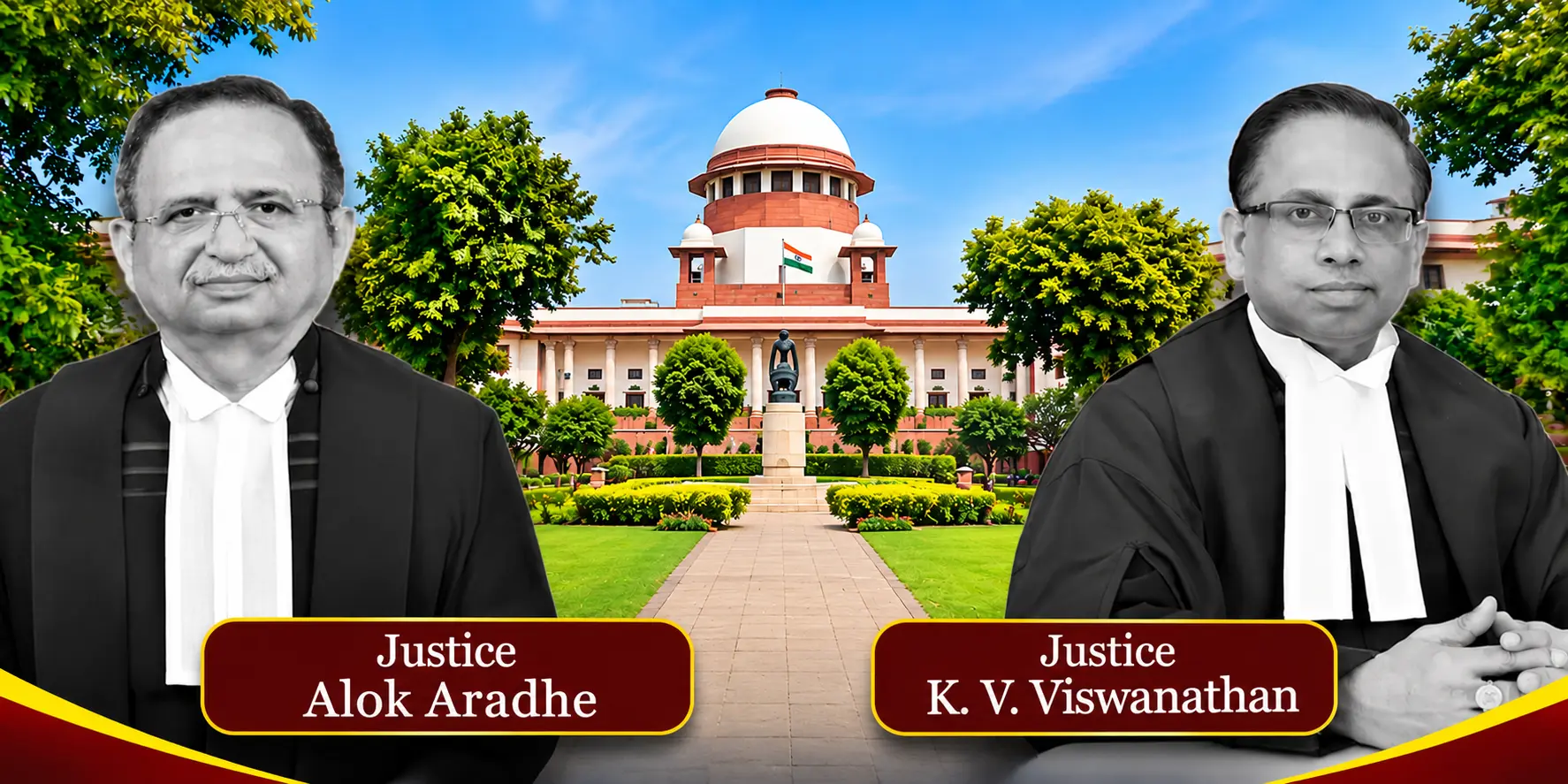
A Bench comprising Justice K. V. Viswanathan and Justice Alok Aradhe allowed the appeals filed by Ashok in Ashok v. Mahesh & Anr., 2026 INSC 1235, and directed that the criminal proceedings be restored before the Chief Judicial Magistrate, Dhule.
The Court held that the alleged acts of conspiring to prepare forged documents, presenting them as genuine and manipulating property records with the intention of fraudulently transferring property were not acts done in the discharge of, or purported discharge of, official duties.
Background
The dispute arose from allegations concerning mutation entries relating to certain properties in Dhule, Maharashtra.
The appellant, Ashok, claimed that the Priyadarshini Charitable Trust had received a land parcel measuring 21,000 square feet, bearing City Survey No. 1888, through a gift deed dated September 18, 1992. The Trust was stated to have remained in ownership and possession of the property since then.
Separately, a civil suit was instituted by the original owners concerning properties situated at Devpur, Dhule. On August 1, 2018, the Civil Court decreed the suit and declared certain sale deeds void and not binding on the plaintiffs' shares.
According to the appellant, an application was subsequently made before the City Survey Officer seeking mutation of names in the property records. It was alleged that the properties covered by the civil suit were different from those belonging to the Priyadarshini Charitable Trust.
The appellant alleged that, despite this distinction, an incorrect mutation entry was made in favour of the decree-holders, resulting in the removal of the Trust's name from the property records.
The appellant further alleged that the application submitted for mutation had been tampered with, including alterations, overwriting and the subsequent addition of a photograph and signature.
Criminal Proceedings and High Court Order
Following the alleged irregularities, complaints were filed under Section 156(3) CrPC before the Judicial Magistrate First Class, Dhule.
Pursuant to the Magistrate's directions, FIR No. 79 of 2020 and FIR No. 62 of 2021 were registered at Dhule City Police Station. Chargesheets were subsequently filed for offences under Sections 465, 466, 468, 471, 474, 420, 120-B and 34 of the Indian Penal Code, 1860.
The accused public servant approached the Bombay High Court seeking quashing of the criminal proceedings.
The High Court allowed the applications and quashed the proceedings, holding that prior sanction under Section 197 CrPC was necessary in view of the Maharashtra amendment to Section 156(3) CrPC. It also held that the applications seeking sanction had not been submitted before the competent authority and, therefore, the provision relating to deemed sanction after 90 days could not be invoked.
Aggrieved by the decision, the complainant approached the Supreme Court.
Arguments Before the Supreme Court
The appellant argued that the alleged offences, including forgery and use of forged documents, could not be considered acts performed in the discharge of official duties. It was further submitted that the protection under Section 197 CrPC was not available merely because the accused held a public office.
The State of Maharashtra also submitted that the protection under Section 197 CrPC would apply only where the alleged act had a reasonable nexus with the discharge of official duties. Fabrication of records and creation of false documents, it argued, could never form part of the discharge of official functions.
On the other hand, the counsel appearing for Respondent No. 1 contended that the mutation application had been duly received and that the mutation was carried out after obtaining the opinion of the District Government Pleader. It was argued that an erroneous official decision could not, by itself, give rise to criminal liability.
Supreme Court's Observations
The Supreme Court examined the scope of Section 197 CrPC and the Maharashtra amendment to Section 156(3) CrPC.
The Court referred to its decision in Om Prakash Yadav v. Niranjan Kumar Upadhyay & Ors., 2024 SCC OnLine SC 3726, which summarised the principles governing protection available to public servants under Section 197 CrPC.
The Court reiterated that the protection under Section 197 CrPC is intended to safeguard public servants against false or vexatious criminal proceedings concerning acts performed in the discharge of their official duties. However, the protection cannot be extended to acts that have no reasonable connection with official functions.
It observed that the nature and quality of the act complained of must be examined to determine whether it was performed in the course of official duty. Merely because the official position provided an opportunity to commit an offence would not be sufficient to attract the protection under Section 197 CrPC.
The Court further emphasised that public servants cannot misuse the protection of the provision to camouflage criminal acts committed under the supposed colour of public office.
Forgery and Fabrication Cannot Be Treated as Official Duty
Applying these principles to the facts of the case, the Supreme Court observed that the allegations against Respondent No. 1 concerned a conspiracy to prepare forged documents and falsely present them as genuine, allegedly with the intention of transferring property to Accused No. 1 and other individuals.
The Court also took note of the allegations concerning manipulation of property records at the City Land Survey Office and the execution of a mutation entry with the intention to cheat.
In this context, the Court held:
“We are inclined to hold that the acts complained of were not in discharge of or in purported discharge of official duty.”
The Court consequently held that Section 197 CrPC, read with the Maharashtra amendment to Section 156(3) CrPC, was not attracted in the present case.
Since the alleged acts were not connected with the discharge of official duties, the Court found it unnecessary to examine the question of deemed sanction or whether the authority approached by the complainant was competent to grant sanction.
High Court Order Set Aside; Criminal Proceedings Restored
The Supreme Court clarified that its observations were confined to deciding the issue of sanction for prosecution and that the trial and other proceedings would continue independently on their own merits.
Accordingly, the Court set aside the Bombay High Court's order dated November 27, 2024, passed in Criminal Application Nos. 1371 of 2020 and 3235 of 2021.
The appeals were allowed, and the Supreme Court directed that RCC Nos. 1020 of 2023 and 119 of 2024 be restored to the file of the Chief Judicial Magistrate, Dhule, for proceedings in accordance with law.
Case Title: Ashok v. Mahesh & Anr.
Citation: 2026 INSC 1235
Bench: Justice K. V. Viswanathan and Justice Alok Aradhe
Date of Judgment: November 17, 2026

Representation:-
For Petitioner(s): Mr. Sagar Pahune Patil- 3717, AOR, Mr. Krishna Pratap Rodge, Adv., Mrs. Sangeeta S. Pahune Patil, Adv.
For Respondent(s): Mr. Siddharth S. Chapalgaonkar, Adv., Ms. Sneha Sanjay Botwe, AOR, Mr. Akash Tripathi, Adv., Mr. Siddhesh Ghodke, Adv., Mr. Raman Yadav, Adv., Mr. Siddharth Dharmadhikari, Adv., Mr. Aaditya Aniruddha Pande- 3259, AOR, Mr. Shrirang B. Varma, Adv.
Website designed, developed and maintained by webexy