
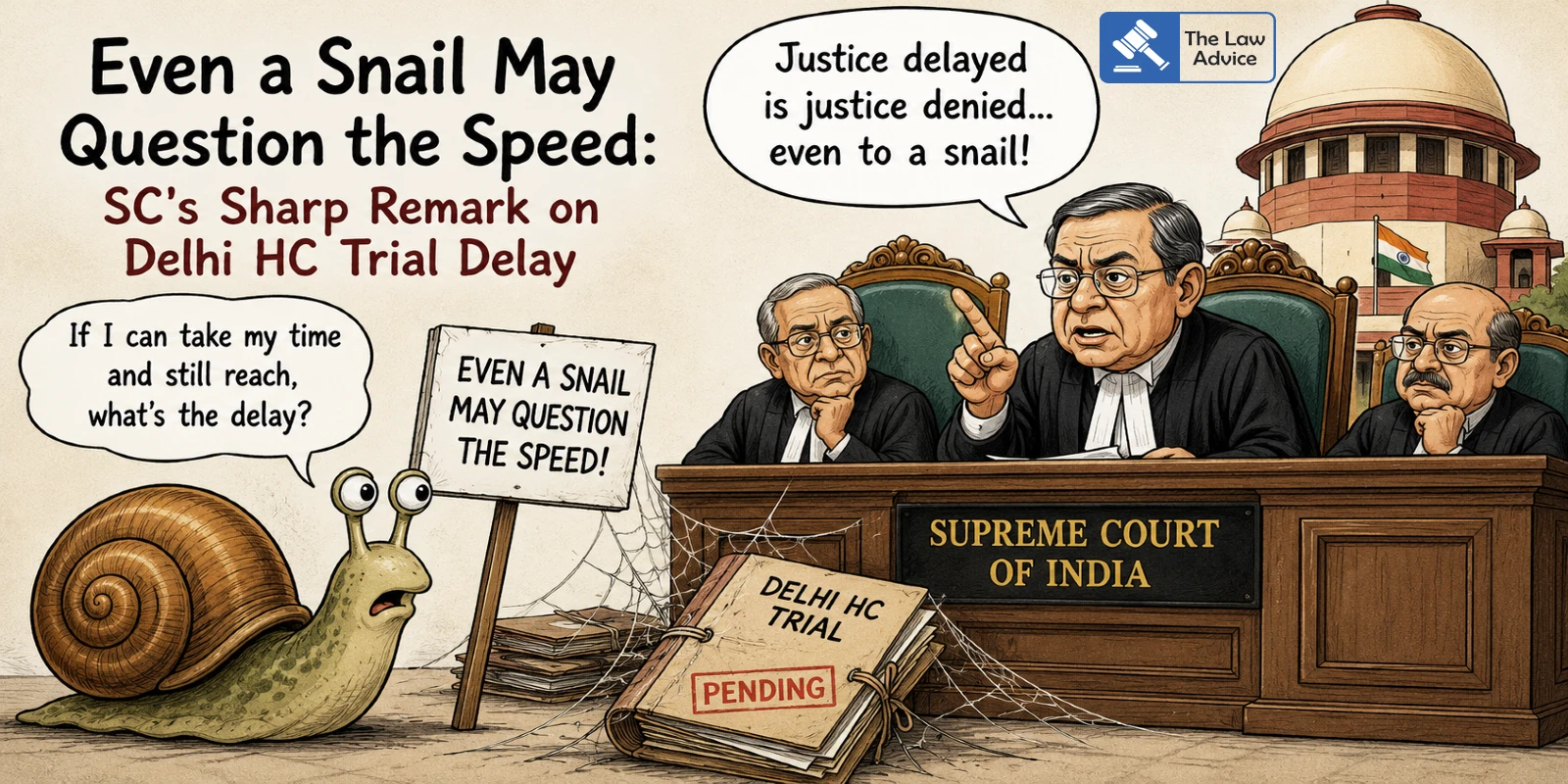
The Supreme Court recently expressed strong displeasure over the prolonged delay in the trial of a commercial dispute pending before the Delhi High Court since 2015, remarking that "even a snail may question the speed" at which the proceedings were moving.
A Bench of Justices Sanjay Karol and Nongmeikapam Kotiswar Singh made the observation while dismissing an appeal filed by Levitate Mobile Technologies Private Limited (LMT) against an order refusing to permit it to place additional documents on record in its commercial suit against Standard Chartered Bank (SCB).
"The suit in question was filed in 2015. As of 2026, plaintiff's evidence is ongoing. We may say that even a snail may question the speed at which this trial is proceeding. When this reality is juxtaposed with the intent of the legislation and the malady it sought to cure within civil and specifically business litigation in India, the contrast is stark," the Bench observed.
The dispute stems from a professional services agreement executed in February 2013, under which LMT was engaged to develop and manage a mobile application for Standard Chartered Bank. Although the application was launched on Android and iOS platforms, the bank later instructed LMT to remove it.
Claiming losses under the revenue-sharing arrangement, LMT issued a legal notice in April 2015 seeking ₹4.46 crore along with 18 per cent annual interest. After the bank rejected the demand, LMT instituted a civil suit before the Delhi High Court in May 2015. Issues in the case were framed in November 2016, and the matter was transferred and renumbered as a commercial suit in January 2018.
On the same day, the High Court permitted LMT to place certain additional documents on record.
However, the examination of LMT's first witness concluded only in May 2023. Later that year, the company filed another application seeking to introduce further documents, including email exchanges with SCB, agreements with other vendors, backend server data, and also sought recall of the witness.
The Delhi High Court dismissed the application in February 2025, holding that LMT had failed to provide any satisfactory explanation for the delay and appeared to be attempting to fill gaps in its evidence.
Upholding that decision, the Supreme Court noted that the documents sought to be produced had always been in LMT's possession, both when the suit was instituted and when its earlier application for additional documents was allowed.
"What cannot be countenanced is a stop and go or a piecemeal approach. Voluminous evidence too, is entirely an uninspiring ground," the Court observed.
The Bench emphasised that the Commercial Courts Act was enacted to ensure the speedy adjudication of high-value commercial disputes and warned that permitting piecemeal production of evidence would undermine the statute's objective.
"Evidence, however voluminous, cannot water down the statutory intent and rigours of the statute," the Court said.
Rejecting LMT's contention that the stricter procedural framework under the Commercial Courts Act could not apply because the suit was originally filed in 2015, the Court pointed out that Section 15 of the Act expressly extends the commercial court procedure to pending suits transferred to commercial courts.
Accordingly, the appeal was dismissed. At the same time, the Supreme Court directed the Delhi High Court to dispose of the commercial suit as expeditiously as possible.
Website designed, developed and maintained by webexy