
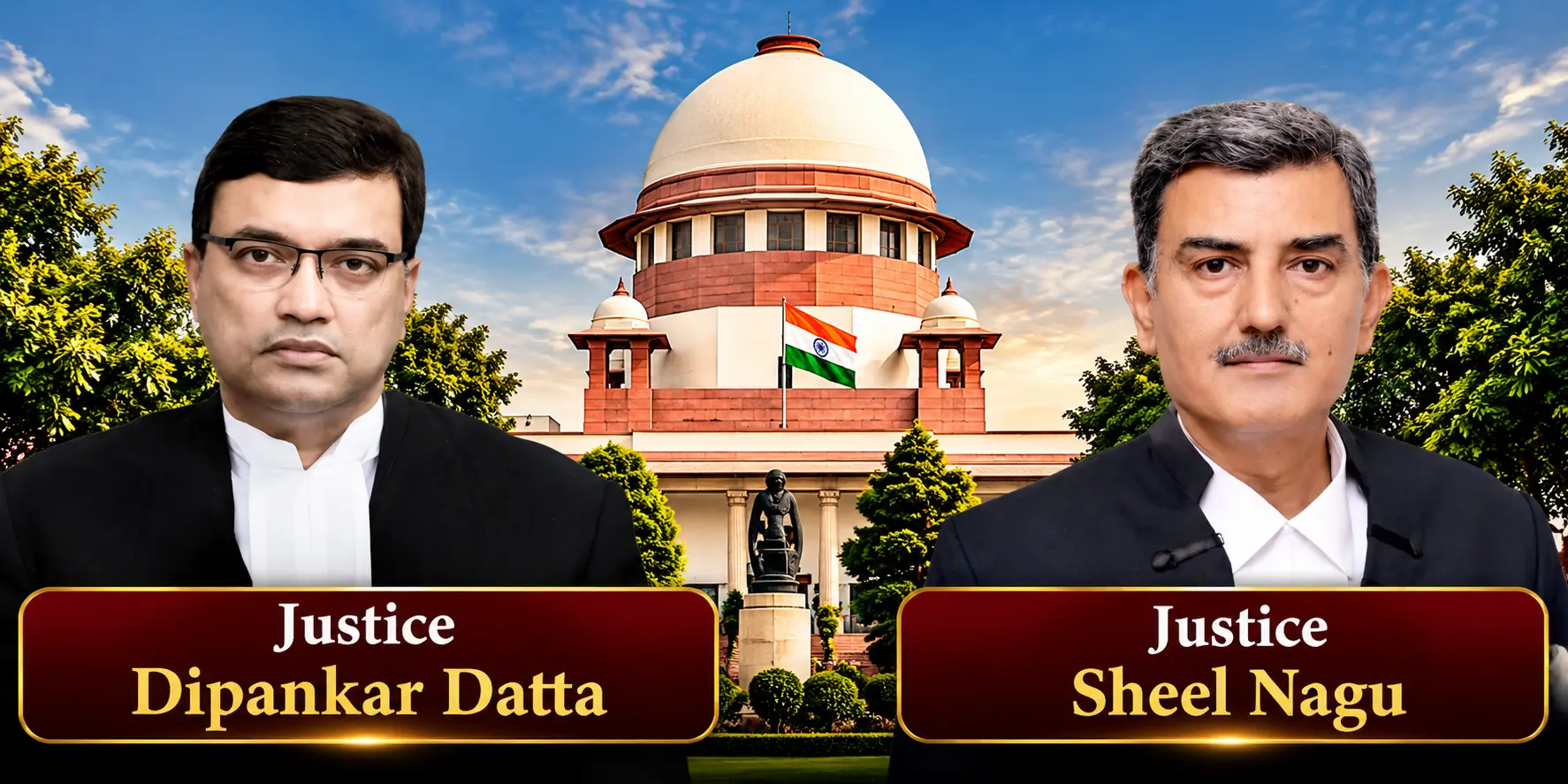
The Supreme Court has dismissed a batch of appeals filed by lecturers/assistant professors of the National Institute of Technology (NIT), holding that recovery of excess financial benefits paid to employees is permissible where the employees had undertaken to refund any amount found to have been wrongly paid.
A Bench comprising Justice Dipankar Datta and Justice Sheel Nagu held that the protection against recovery of excess payments cannot be applied mechanically, particularly where the employee had expressly undertaken to permit recovery in case of erroneous pay fixation. Pasted markdown
The judgment was delivered in Dr. M.K. Ravi Varma & Ors. v. National Institute of Technology & Ors., Civil Appeal Nos. 8329-8336 of 2016, decided on September 23, 2026.
The appellants were Lecturers/Assistant Professors who had been extended financial benefits pursuant to the grant of Academic Grade Pay. The benefits were released around October 2009 but were withdrawn in January 2010 after the authorities found that the teachers had not completed the requisite years of service.
The dispute before the Supreme Court was whether such financial benefits, which had been extended without any misrepresentation or fraud on the part of the teachers, could subsequently be recovered.
The appellants relied heavily upon the Supreme Court's judgment in State of Punjab v. Rafiq Masih (White Washer), particularly the categories identified in paragraph 18 where recovery of excess payments may be impermissible.
The Court noted that the law concerning recovery of excess payments has developed through a series of decisions, including Chandi Prasad Uniyal v. State of Uttarakhand, Rafiq Masih, Thomas Daniel v. State of Kerala, and High Court of Punjab & Haryana v. Jagdev Singh.
The Bench observed that Chandi Prasad Uniyal had held that excess payments made from public money can ordinarily be recovered, even where the excess payment resulted from a bona fide mistake, subject to recognised exceptions based on extreme hardship.
The Court also noted that the subsequent decision in Rafiq Masih had identified certain situations in which recovery would be impermissible, including recovery from Class III and IV employees, retired employees or those nearing retirement, recovery of payments made for more than five years, and cases where recovery would be inequitable, harsh or arbitrary. Pasted markdown
The Supreme Court found that the appellants had given an undertaking, contained in Exhibit R2(c), expressing their willingness to permit recovery of amounts in the event that the pay fixation was subsequently found to be erroneous.
Referring to its earlier judgment in High Court of Punjab & Haryana v. Jagdev Singh, the Court held that where an employee has been put on notice that excess payment would have to be refunded and has furnished an undertaking to that effect, the employee is bound by such undertaking. Pasted markdown
The Court held:
“It is, therefore, clear that a mistake was committed in extending financial benefits to the appellants; and this was immediately withdrawn upon detection of such mistake.”
It further held that recovery of the amounts paid by mistake, in view of the undertakings given by the appellants, did not warrant interference by the Single Judge of the High Court.
The Court also dealt with the appellants' argument regarding hardship.
It observed that hardship cannot be presumed in every case merely because an employee is required to return excess money. Whether recovery would cause such hardship has to be determined on the facts of each case.
The Court gave examples of circumstances where judicial interference may be justified, such as where an employee establishes that the entire excess payment had been spent on medical treatment and repayment would cause immense hardship.
However, the Court emphasised that such circumstances must be specifically pleaded and proved before the writ court. In the present case, no such hardship had been pleaded in the writ petition. Pasted markdown
The Court also noted that the appellants had not contended that they were legally entitled to the Academic Grade Pay benefits as a matter of right.
Holding that the financial benefits had been wrongly extended and were immediately withdrawn upon detection of the mistake, the Supreme Court concluded that the Division Bench of the Kerala High Court was correct in refusing to interfere with the recovery.
The appeals were accordingly dismissed, with the parties directed to bear their own costs. Pasted markdown
Case: Dr. M.K. Ravi Varma & Ors. v. National Institute of Technology & Ors.
Citation: 2026 INSC 1080
Bench: Justice Dipankar Datta and Justice Sheel Nagu
Judgment Date: September 23, 2026

Representation:-
For Appellant(s): Mr. Sanchar Anand Adv., Mr. Anant Kumar Vatsya Adv., Mr. Karan Thakur Adv., Ms. Diva Singh Adv., Mr. Anukurat Singh Baweja Adv., Ms. Ananaya Khare Adv., Ms. Rashi Agnihotry Adv., Mr. Devendra Singh AOR,
For Respondent(s): Mr. Shyam Padman Sr. Adv., Mr. Naresh Kumar AOR, Mr. Jaimon Andrews Adv., Mr. Piyo Harold J Adv., Ms. Ashwathy Shyam Adv., Mr. Firdouse C P Adv., Ms. Nandhitha Dinesh Adv.,
Website designed, developed and maintained by webexy