
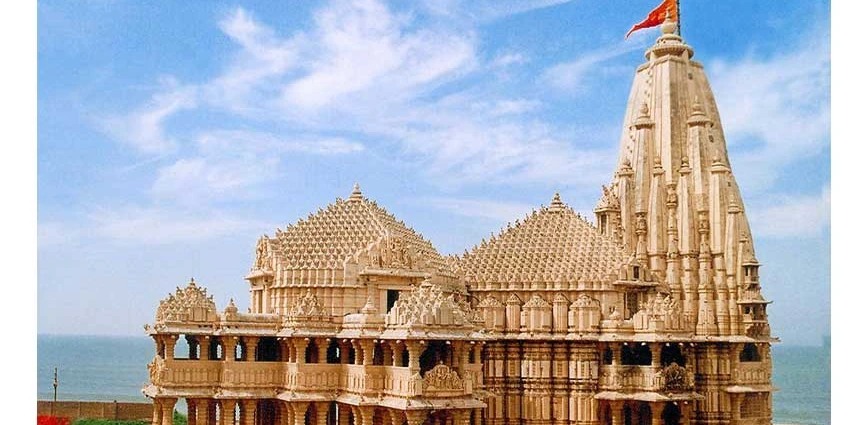
The Gujarat High Court recently dismissed a public interest litigation (PIL) seeking disclosure of an alleged archaeological survey report concerning the Somnath Temple site, holding that the petition was based on incorrect, misleading and distorted facts and amounted to an abuse of the PIL jurisdiction.
A Division Bench of Chief Justice Sunita Agarwal and Justice D.N. Ray observed that the petitioner had relied primarily on newspaper reports and social media posts without producing any authentic material to substantiate the allegations. The Court held that such petitions undermine the very purpose and sanctity of public interest litigation.
"This petition thus, is found to have been filed with incorrect, misleading and distorted facts and being in the nature of Public Interest Litigation cannot be entertained as it would cause damage to the sanctity of the benevolent cause of law of Public Interest Litigation evolved by the Apex Court," the Bench observed in its June 25 judgment.
Finding that the petitioner had abused the process of law, the High Court dismissed the PIL and imposed exemplary costs of ₹2 lakh.
The petitioner, a resident of Maharashtra, had sought directions to the Union government, the Archaeological Survey of India (ASI), IIT Gandhinagar and other authorities to make public an alleged 32-page scientific archaeological survey report, along with ground penetrating radar (GPR) survey records, maps, photographs, videography and other documents purportedly prepared in relation to the Somnath Temple site.
He had also sought directions to preserve archaeological material and make it accessible for academic and historical research.
The High Court identified several defects in the petition. It noted that the petitioner had incorrectly claimed that the Shree Somnath Trust was constituted under the Shree Somnath Trust Act, 1955. However, the State government informed the Court that no such legislation exists.
The Bench further observed that the petitioner's own pleadings revealed that the allegations were derived from media reports and social media content rather than any verified or authentic source.
"The contentions made in the writ petition that all information disclosed therein are based on some news items, published in the print media as well as information on social media, are sufficient to dismiss the writ petition outrightly, inasmuch as, none of the statements made in the writ petition can be verified by the petitioner being true to his personal knowledge or based on any authentic record or material read over or researched by him," the Court held.
The Court also found that the accompanying affidavit was defective as it failed to disclose the source of the petitioner's knowledge or information in a proper manner.
Making strong observations on the conduct of the petitioner, the Bench said:
"It is more than evident that the petitioner herein is an unscrupulous person who has filed the Public Interest Litigation with incorrect, incomplete, misleading and distorted facts, evidently with ulterior motives, or to gain undue publicity."
Accordingly, the Court directed the petitioner to deposit ₹2 lakh with the Registrar General of the High Court within three weeks, failing which the amount would be recovered as arrears of land revenue.
Advocates Miren Priyadarshi and Ratna Vora appeared for the petitioner. Government Pleader Gursharan H. Virk, assisted by Assistant Government Pleader Dharitri Pancholi and Advocate Devanshee N. Kariel, represented the State, while Advocate Prutha Bhavsar appeared for the Union of India.
Case Title; Dr. Vilas Tukaram Kharat v. The Union of India & Ors..
Website designed, developed and maintained by webexy