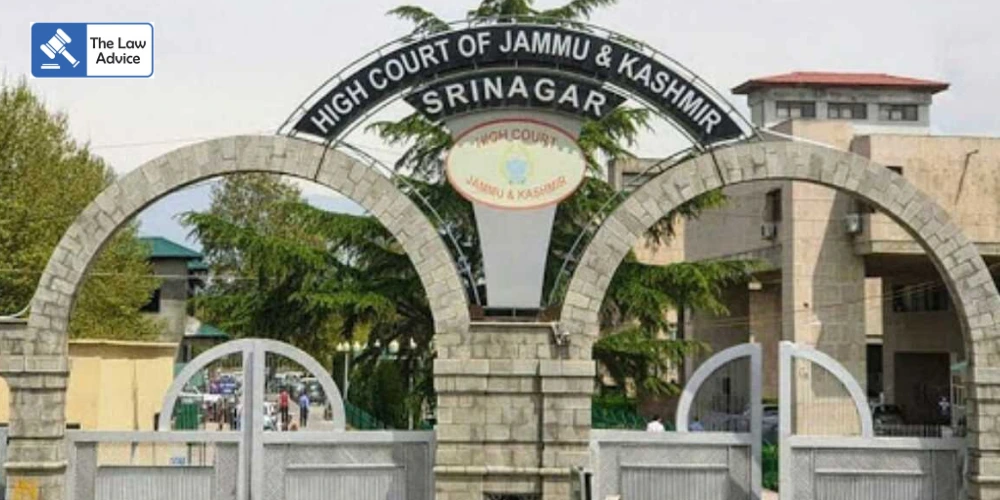
In a significant step aimed at reinforcing discipline and institutional decorum, the High Court of Jammu & Kashmir and Ladakh has issued a circular mandating all its employees to strictly adhere to the prescribed uniform while attending office and performing official duties. The order, which has come into immediate effect, applies to both Gazetted and Non-Gazetted employees across the High Court establishment.
The directive, issued by Registrar General (Officiating) M.K. Sharma, comes in response to increasing instances of staff members attending office in casual attire, a trend the Court has termed as “a cause of great indiscipline” that undermines the solemn functioning of a constitutional institution. The circular underlines that discipline, decorum, and uniformity in appearance are indispensable to the smooth conduct of the Court’s day-to-day affairs.
The order has been made binding on all employees without exception. This includes:
• Officers and staff members of the High Court Registry,
• Personal staff attached to Judges and officers,
• Employees of the e-Courts Mission Project and the IT Section,
• Orderlies, ushers, drivers, and other supporting personnel.
By specifying these categories, the High Court has made it clear that the uniform requirement is not restricted to front-facing or administrative staff but covers every individual associated with the functioning of the Court.
The circular carries a strong warning: any violation of the dress code will invite disciplinary action. While the exact nature of penalties has not been detailed, the language of the circular leaves no room for ambiguity—non-compliance will be taken seriously.
Additionally, the order directs all controlling officers to ensure that their subordinates follow the directive without fail. This provision effectively decentralises enforcement, making supervisory officials accountable for monitoring adherence within their sections.
A High Court is not merely an administrative workplace; it is a constitutional authority that commands public trust. By insisting on a uniform dress code, the High Court seeks to achieve several objectives:
1. Institutional Discipline: A visible uniform code symbolises order, seriousness, and respect for the judicial process.
2. Equality Among Staff: Prescribed attire minimises visible differences in economic or social status, fostering a sense of collective identity.
3. Professional Image: Courts are public-facing institutions. Every employee, from officers to support staff, plays a role in shaping the perception of litigants, lawyers, and citizens. A uniform look enhances credibility.
4. Continuity with Judicial Tradition: Just as judges and advocates are required to wear prescribed court dress to maintain dignity, staff too are expected to reflect the same decorum.
The J&K and Ladakh High Court’s decision aligns with long-standing traditions in Indian courts. Judicial officers and advocates follow strict dress codes—black coats, gowns, and bands—signifying neutrality and authority. Many High Courts and subordinate courts also prescribe uniforms for their staff to ensure discipline and visual uniformity.
In recent years, with the expansion of e-Courts and IT-based functioning, the line between courtroom presence and administrative workspaces has blurred. Employees working on digital platforms often appeared in semi-formal or casual clothing, particularly after the COVID-19 pandemic when hybrid working became common. The new circular seems to be a corrective measure to restore pre-pandemic standards of formal conduct.
Immediate and Long-Term Implications
• Immediate Compliance: Staff members will have to procure and wear the prescribed uniforms without delay, as the order has already come into effect.
• Stronger Workplace Discipline: The order sends a broader signal that the High Court is intolerant of lapses in office discipline. It may pave the way for stricter scrutiny of punctuality, attendance, and general work ethics.
• Precedent for Subordinate Courts: Given that the High Court is the supervising authority for all courts in J&K and Ladakh, it is possible that similar directives may trickle down to the district and subordinate judiciary, reinforcing uniformity across the judicial setup.
The High Court’s circular is not just about dress—it is about restoring order, dignity, and respect for judicial institutions. By explicitly warning of disciplinary action, the Court has signalled its intent to maintain a high benchmark of professionalism among its staff.
While the decision may invite mixed responses from employees—some viewing it as a matter of personal freedom and others as an enhancement of institutional pride—what is clear is that the High Court is determined to ensure that its functioning reflects the gravity of its constitutional role.