
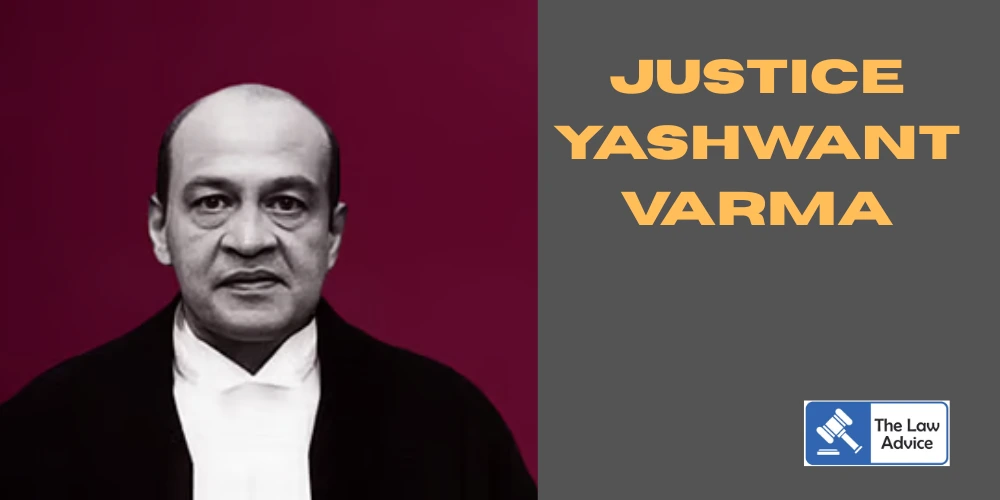
The Supreme Court on Tuesday (December 16) issued notice in a petition challenging the legality of the Parliamentary Inquiry Committee constituted under the Judges (Inquiry) Act, 1968, to inquire into allegations against Justice Yashwant Varma in connection with impeachment proceedings arising from the alleged discovery of unaccounted cash at his official residence.
Senior Advocate Mukul Rohatgi, appearing for Justice Yashwant Varma—who has filed the petition anonymously as “X”—addressed a Bench comprising Justice Dipankar Datta and Justice A.G. Masih. Assailing the procedure adopted, Varma has contended that despite impeachment motions having been moved in both the Lok Sabha and the Rajya Sabha, Lok Sabha Speaker Om Birla proceeded to constitute the inquiry committee unilaterally, without awaiting the Rajya Sabha Chairman’s decision on admission of the motion and without undertaking the mandatory joint consultation required under law.
Referring to the composition of the Committee and the provisions of the Judges (Inquiry) Act, 1968, Rohatgi submitted that where impeachment notices are “given” in both Houses on the same date—as in the present case—a committee cannot be constituted unless the motion is admitted in both Houses. He argued that where such admission takes place in both Houses, the committee must necessarily be constituted jointly by the Speaker of the Lok Sabha and the Chairman of the Rajya Sabha.
Rohatgi clarified that if a motion is admitted in only one House, then a committee may be constituted by that House alone. However, he submitted that this situation did not arise here because not only were the motions given on the same date, but they were also admitted on the same date. In support of this submission, he relied on the proviso to Section 3(2) of the 1968 Act, which states that where notices of a motion are given on the same day in both Houses, no committee shall be constituted unless the motion is admitted in both Houses, and if so admitted, the committee shall be jointly constituted by the Speaker and the Chairman.
By way of background, it was noted that in July, impeachment notices sponsored by 145 Members of Parliament in the Lok Sabha and 63 Members of Parliament in the Rajya Sabha were submitted to Lok Sabha Speaker Om Birla and Rajya Sabha Chairman Jagdeep Dhankhar, respectively.
Subsequently, in August, the Lok Sabha Speaker announced the constitution of the inquiry committee comprising Justice Arvind Kumar of the Supreme Court, Justice M.M. Shrivastava, Chief Justice of the Madras High Court, and Senior Advocate Vasudeva Acharya of the Karnataka High Court.
Elaborating further, Rohatgi submitted that in the rare situation where impeachment notices are given in both Houses on the same day, a joint committee can be constituted only after the motion is formally admitted, following consultation between the Speaker and the Chairman. He argued that the statutory language is peremptory and leaves no discretion where admission occurs on the same date in both Houses.
Justice Datta, however, queried how admission could arise on the same day merely because motions were presented to both Houses simultaneously. In response, Rohatgi submitted that while the date of “giving” the motion and the date of “admission” may differ, the statute draws a clear distinction between the two concepts. He argued that “given” should be understood as filed, and stressed that when both Houses of Parliament—being institutions of equal constitutional stature—are moved on the same day, the legislative scheme mandates the constitution of a joint committee upon admission.
Background
The controversy stems from the alleged accidental discovery of a large quantity of cash at an outhouse within the official residence of Justice Varma, who was then serving as a judge of the Delhi High Court, during a fire-fighting operation on March 14.
Following the public outcry, then Chief Justice of India Sanjiv Khanna constituted an in-house inquiry committee comprising Justice Sheel Nagu (then Chief Justice of the Punjab & Haryana High Court), Justice G.S. Sandhawalia (then Chief Justice of the Himachal Pradesh High Court), and Justice Anu Sivaraman (Judge, Karnataka High Court). Justice Varma was repatriated to the Allahabad High Court and divested of judicial work pending the inquiry.
In May, the committee submitted its report to the Chief Justice of India, recording a prima facie finding of culpability against Justice Varma. The report was subsequently forwarded by the CJI to the President of India and the Prime Minister for further action, after Justice Varma declined to resign despite being advised to do so.
It is pertinent to note that the Supreme Court had earlier dismissed Justice Varma’s challenge to the in-house inquiry proceedings as well as to the recommendation made by the Chief Justice of India for his removal.
Case Details: X v. Office of the Speaker of the House of the People | W.P.(C) No. 1233/2025 | Diary No. 71319/2025
Website designed, developed and maintained by webexy