
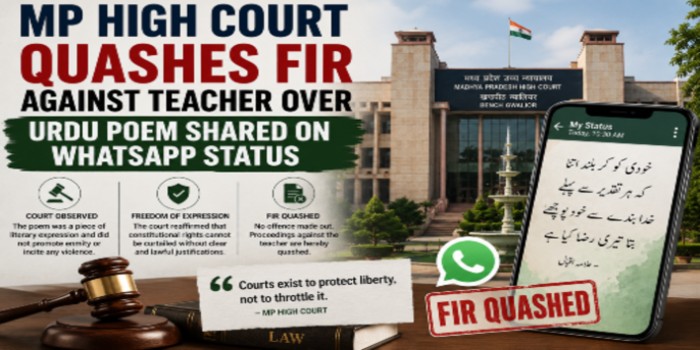
In a significant ruling on free speech and artistic expression, the Madhya Pradesh High Court has quashed the FIR registered against government school teacher Faizan Ansari over an Urdu nazm he had shared on his WhatsApp status, observing that a poem cannot be criminalised merely because some people find it objectionable.
The controversy stemmed from a 2-minute-21-second video clip from a mushaira that Ansari allegedly uploaded as his WhatsApp status on July 22, 2025. At the time, Ansari was serving as a contractual teacher at Harradhana (Dudhiya) Primary School in Betul district.
The poem, titled Be-haya, dealt with themes of women’s rights, patriarchy and social control. However, what began as a literary expression soon escalated into protests, police action and widespread outrage on social media.
Following the status upload, members of the Madhya Pradesh State Employees’ Association led by district president Sachin Rai approached Chicholi Police Station and lodged a complaint against Ansari. Protest demonstrations were also organised demanding strict action against him.
The complainants alleged that the poem was derogatory towards women, hurt public sentiments and had the potential to disturb social harmony. Acting on the complaint, police registered an FIR against Ansari under Section 353(2) of the Bharatiya Nyaya Sanhita and seized his mobile phone.
However, Justice BP Sharma of the Jabalpur Bench of the High Court found no criminality in the teacher’s actions.
The Court noted that the nazm is publicly available on public platform, dedicated to Urdu literature, and described the work as a satirical commentary on patriarchy, exploitation and women’s human rights.
Importantly, the Court observed that the poem neither directly nor indirectly targeted any religion, community or class. It further noted that Ansari had merely shared the poem on his WhatsApp status without adding any personal remarks, inflammatory comments or call for violence.
Relying on several Supreme Court decisions on freedom of speech and artistic expression, the High Court held that criminal prosecution can arise only when there is a clear intention to incite violence, hatred or public disorder. Mere apprehension, subjective outrage or claims of hurt sentiments, the Court said, are insufficient to invoke criminal law.
The Court also took note of the trolling, threats and mental harassment allegedly faced by Ansari after the FIR was registered. In view of the circumstances, it directed the Superintendent of Police, Betul, to ensure necessary security for the teacher and ordered Chicholi Police Station to immediately return his seized mobile phone.
In strong observations, the High Court held that continuing criminal proceedings against Ansari would amount to an abuse of the process of law and would violate his fundamental right to freedom of expression guaranteed under Article 19(1)(a) of the Constitution.
Website designed, developed and maintained by webexy