
Supreme Court Sets Aside Conviction of Charming Rupon, Holds That Serious Doubts Arising From Witness Identification, Delayed FIR and Non-Examination of Material Witness Make Conviction Unsafe
The Supreme Court of India has acquitted Charming Rupon, who was convicted under Section 6 of the Protection of Children from Sexual Offences (POCSO) Act, 2012, after holding that the prosecution had failed to establish his guilt beyond reasonable doubt.
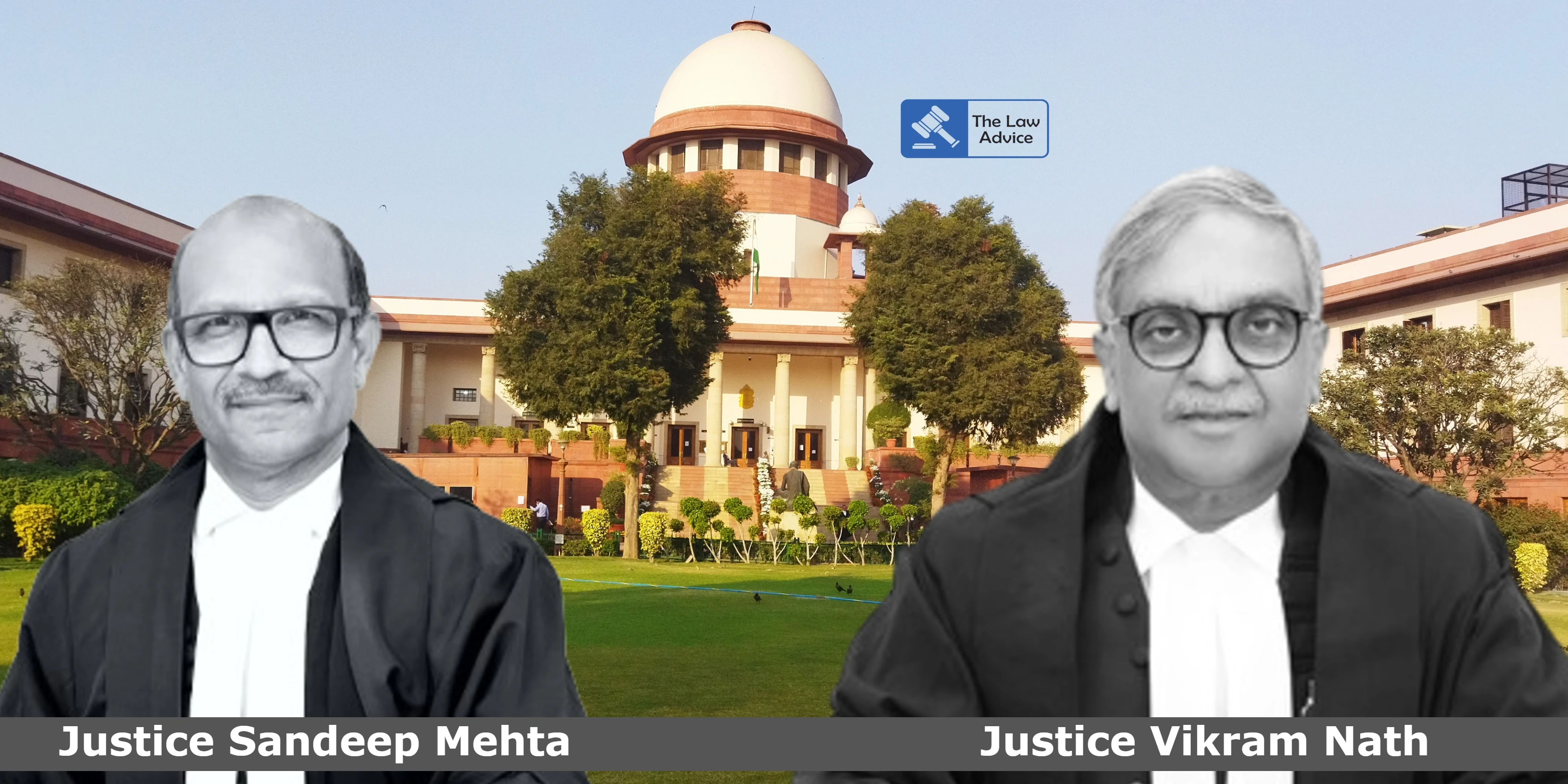
A Bench comprising Justice Vikram Nath and Justice Sandeep Mehta allowed the appeal and set aside the judgments of the Special Court and the Meghalaya High Court, which had upheld his conviction and sentence.
In its judgment dated October 9, 2026, authored by Justice Sandeep Mehta, the Court held that the cumulative effect of material inconsistencies in the prosecution evidence, the failure of key witnesses to identify the accused in court, the delay in lodging the FIR and the non-examination of a crucial witness rendered the conviction unsustainable.
The Court directed that the appellant, who was in custody, be released forthwith if not wanted in any other case.
The case arose from FIR No. 261(6)15/2015 registered at Khliehriat Police Station in Meghalaya’s East Jaintia Hills district. The prosecution alleged that the accused had sexually assaulted an 11-year-old girl with intellectual disability at her residence on May 28, 2015.
According to the prosecution, the child’s mother had left home for personal work, leaving the girl alone. The mother allegedly saw the accused plucking mulberry leaves in the adjoining garden before leaving.
The prosecution further alleged that the child later disclosed the incident to her cousin, who informed the mother the following morning. However, the FIR was lodged only on June 8, 2015, nearly 10 days after the alleged incident.
The Special POCSO Court convicted the accused on December 7, 2021, sentencing him to 10 years of rigorous imprisonment and imposing a fine of ₹1 lakh. The Meghalaya High Court dismissed his appeal on March 29, 2022, prompting him to approach the Supreme Court.
The Supreme Court closely examined the testimony of the victim, her mother and her cousin, who were the principal prosecution witnesses.
The Court noted that both the victim and her cousin failed to identify the accused during their testimony before the trial court. They also stated that they had been told the accused’s name by the victim’s mother.
The victim further admitted during cross-examination that she had met the Special Public Prosecutor before entering the witness box and had been told what to say in court. The Court observed that this admission, together with her inability to identify the accused, raised doubts about the reliability of her testimony regarding the identity of the perpetrator.
The Court also noted inconsistencies concerning the accused’s relationship with the victim’s family. While the victim described him as her paternal uncle, her mother gave a different account of the relationship.
Considering these circumstances, the Bench held that the prosecution evidence suffered from material infirmities that could not be overlooked.
The Court also examined the delay of nearly 10 days in lodging the FIR.
It observed that the prosecution claimed that the victim’s cousin had informed the mother about the alleged assault on the following day. However, the mother did not immediately approach the police, and the FIR did not mention either this alleged disclosure or the claim that she had seen the accused in the garden before leaving home.
The Bench held that although an FIR is not expected to contain every detail of an incident, the omission of material facts subsequently relied upon to connect an accused with the crime assumes significance.
Referring to Amar Nath Jha v. Nand Kishore Singh and Ram Kumar Pandey v. State of M.P., the Court reiterated that omissions of essential facts from the earliest version may create suspicion about the prosecution case, particularly when those facts form the foundation of the allegations.
Another significant factor was the prosecution’s failure to examine Ms. Princely, the schoolteacher to whom the victim had allegedly disclosed the incident.
According to the prosecution, the teacher informed the victim’s parents about the disclosure, which ultimately led to the registration of the FIR.
The Supreme Court observed that the teacher was a material witness whose testimony could have clarified the nature of the disclosure and the circumstances leading to the delay in reporting the incident.
The prosecution offered no explanation for her non-examination.
Relying on Takhaji Hiraji v. Thakore Kubersing Chamansing, the Court reiterated that where a material witness capable of explaining an essential part of the prosecution case is withheld without adequate justification, an adverse inference may be drawn against the prosecution.
The Court also found serious procedural shortcomings in the examination of the medical witnesses.
It noted that the defence was not given an effective opportunity to cross-examine the two medical officers examined by the prosecution. In the case of one witness, the defence counsel was unavailable, but the trial court neither arranged legal aid nor deferred the cross-examination to enable the defence to test the testimony.
The Court held that the testimony of both medical officers could not be read in evidence because the accused had not been afforded an effective opportunity to cross-examine them.
Although the medical evidence indicated injuries suggestive of sexual assault, it did not independently establish the identity of the perpetrator.
The accused had also raised a plea of alibi and examined defence witnesses, supported by documentary evidence, to establish that he had gone to another village in connection with a property transaction.
The Supreme Court observed that the trial court and the High Court had brushed aside this defence evidence without proper appreciation.
Taking this circumstance into account along with the other deficiencies in the prosecution case, the Bench concluded that the evidence was insufficient to sustain the conviction.
In its concluding observations, the Supreme Court held that the cumulative effect of the prosecution’s shortcomings created serious doubts about the genuineness and credibility of the allegations.
The Court emphasised that even in a case involving serious allegations of sexual assault against a child, the prosecution must establish the accused’s guilt beyond reasonable doubt.
Finding that the evidence fell short of the required standard of proof, the Bench set aside the conviction and sentence imposed by the trial court and affirmed by the High Court.
Accordingly, the appeal was allowed, and Charming Rupon was acquitted of the charges. The Court directed his release forthwith, provided he was not required in any other case.
Case Title: Charming Rupon v. State of Meghalaya
Citation: 2026 INSC 1102
Case Number: Criminal Appeal No. of 2026 (Arising out of SLP (Crl.) No. 11881 of 2022)
Bench: Justice Vikram Nath and Justice Sandeep Mehta
Judgment Date: October 9, 2026

Representation:-
For the Appellant: Mr. Gaurav Agrawal, Sr. Adv., Mr. Ashutosh Ghade, AOR, Mr. Ashutosh Ghade, Adv., Mr. Jopmiki Shylla, Adv., Ms. Saloni Jitendra Meshram, Adv., Mr. Jagatjeet Singh, Adv., Ms. Sneha Devrao Balapure, Adv., Ms. Gouri Monga, Adv.
For the Respondent: Mr. Amit Kumar, Advocate General, Mr. Avijit Mani Tripathi, AOR, Mr. Zh Issac Haiding, Adv., Mr. Daniel Stone Lyngdoh, Adv., Ms. Marbiang Khongwir, Adv., Mr. Aditya Kumar, Adv.
Website designed, developed and maintained by webexy