
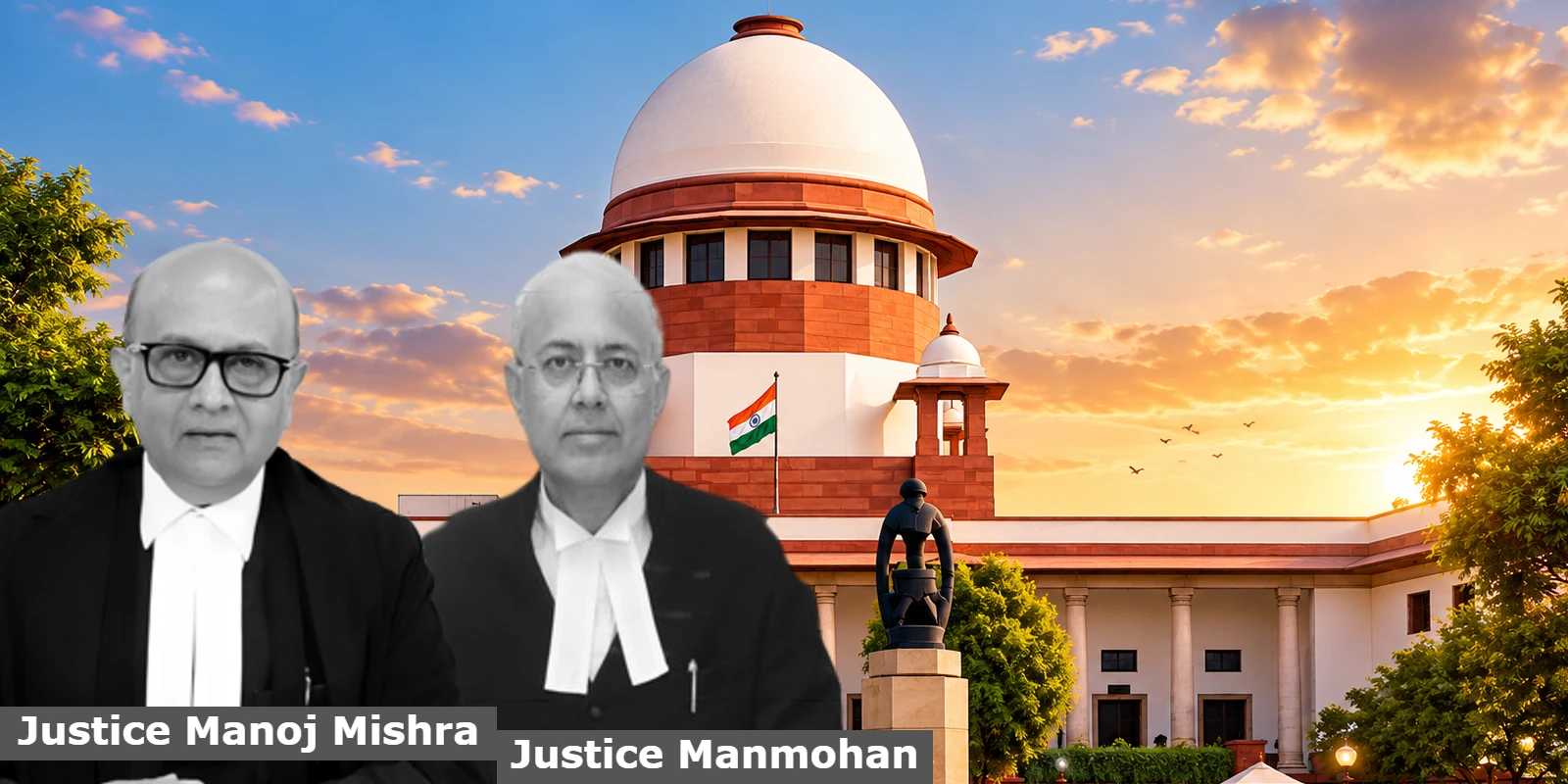
The Supreme Court has held that a consensual physical relationship between two unmarried adults cannot, by itself, be used to draw an adverse conclusion about a person's character.
A bench of Justices Manmohan and Manoj Misra observed that there is no law prohibiting consenting unmarried adults from entering into a relationship of their choice. The Court further stressed that the failure of a relationship to culminate in marriage does not automatically mean that one party deceived or cheated the other.
"Physical relationship between two consenting unmarried adults cannot and should not by itself be a ground to draw an adverse impression about the character of the person in that relationship," the Court said.
The ruling came while allowing an appeal filed by Gajula Thirupathi, whose selection for the post of Stipendiary Cadet Trainee Police Constable in Telangana was cancelled because of a criminal case registered against him in 2014 on allegations of rape on the promise of marriage.
The case stemmed from a relationship between Thirupathi and his neighbour. The matter was settled before a Lok Adalat in 2015, and the complainant chose not to pursue the case further. No charge under Section 376 of the IPC was ultimately pressed.
Despite disclosing the case in his recruitment application, Thirupathi's provisional selection was cancelled by the Telangana State Level Police Recruitment Board on the ground that the allegations reflected moral turpitude. After a prolonged legal battle, the matter reached the Supreme Court.
The Court clarified that a compromise in such a case before a Lok Adalat does not amount to an admission of guilt. It observed that an employer cannot draw adverse conclusions merely from a settlement unless there is material indicating that the compromise was forced upon the complainant.
The bench also noted that authorities must be mindful of changing social realities, observing that premarital relationships between consenting adults are increasingly common. It added that when such relationships continue over a considerable period, there is a presumption that the parties acted with valid consent.
Referring to the facts of the case, the Court pointed out that the complainant herself was the only person who could have established whether she had been deceived into the relationship. Since she chose not to pursue the allegations and consented to the settlement, there was no basis for the recruitment board to infer misconduct or question the candidate's character.
The Court further held that before denying public employment on the basis of a past criminal case, an employer must have material showing both that a crime was committed and that the candidate was connected to it.
Finding no such material in the present case, the Supreme Court set aside the Telangana High Court Division Bench judgment and restored the order directing Thirupathi's appointment as a police constable.
Case Details:-
CIVIL APPEAL No.8059 OF 2026
(Arising out of SLP (C) No. 018626/2026)
GAJULA THIRUPATHI …APPELLANT
VERSUS
THE TELANGANA STATE LEVEL POLICEcRECRUITMENT BOARD AND OTHERS …RESPONDENT(S)

Representation:-
For Appellant(s) :- Mr. Ankolekar Gurudatta, AOR
For Respondent(s) :- Mr. K. Radhakrishnan, Sr. Adv., Ms. Devina Sehgal, AOR, Mr. Srikanth Varma Mudunuru, Adv.
Website designed, developed and maintained by webexy