
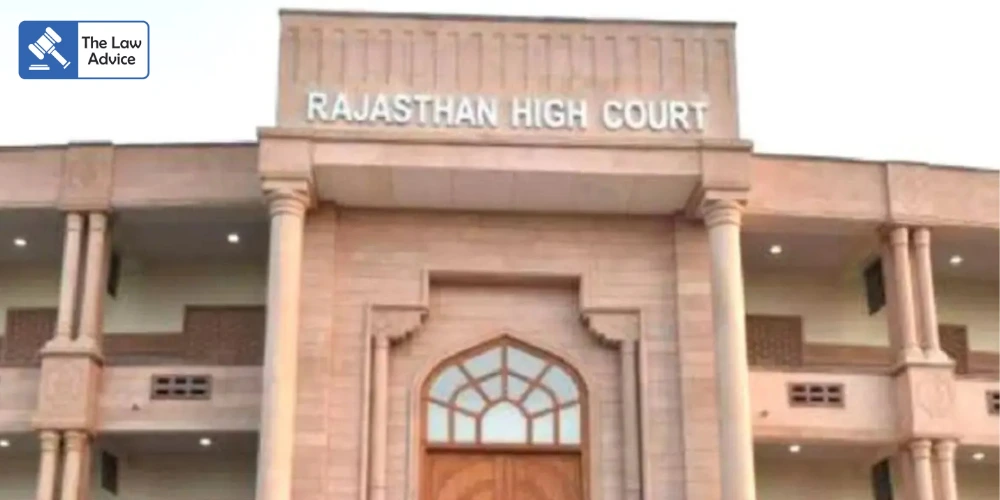
The Rajasthan High Court has issued notice on a writ petition challenging the constitutional validity of the Rajasthan Advocates Welfare Fund (Amendment) Act, 2020, which significantly enhanced the stamp duty on Vakalatnamas and increased the membership fee payable to the Rajasthan Advocates Welfare Fund constituted under the Rajasthan Advocates Welfare Fund Act, 1987.
The challenge pertains to the 2020 amendment which raised the welfare stamp affixed on a Vakalatnama by four times and also revised the membership fee for advocates seeking enrollment under the welfare fund scheme.
According to the petitioner, the underlying objective of the parent Act was to bring the maximum number of advocates within the welfare fund framework. However, by substantially increasing the membership fee, the amendment defeats this very purpose, as the enhanced cost has rendered membership unaffordable for a large section of advocates, particularly those at the junior and mid-career stages.
It was further contended that the steep increase in the price of welfare stamps—from the earlier rate to ₹100, coupled with a provision for an annual increment of ₹10—was manifestly arbitrary and unreasonable. The petitioner argued that the legislative intent behind the welfare fund was never to impose a disproportionate financial burden on members of the legal profession.
The petition also pointed out that despite a fourfold increase in the welfare stamp value, the benefits payable to an advocate on completion of 40 years of practice were not even doubled. This, it was argued, demonstrates that the 2020 amendment would result in the welfare fund “swelling” without any commensurate enhancement in benefits to advocates.
Additionally, the plea highlighted that only a negligible number of advocates actually complete 50 years of practice. In this backdrop, the amendment’s structure of earmarking substantially higher benefits for advocates completing 50 years, as compared to those completing 40 years of practice, was assailed as discriminatory and violative of Article 14 of the Constitution.
On these grounds, the petitioner asserted that the 2020 Amendment Act places advocates in a disadvantageous and unequal position, rendering it manifestly arbitrary, patently illegal, and constitutionally invalid.
Taking note of the submissions, the Rajasthan High Court issued notice to the State of Rajasthan, seeking its response.
Case Title: Satish Kumar Khandal v. State of Rajasthan & Anr.
Website designed, developed and maintained by webexy