
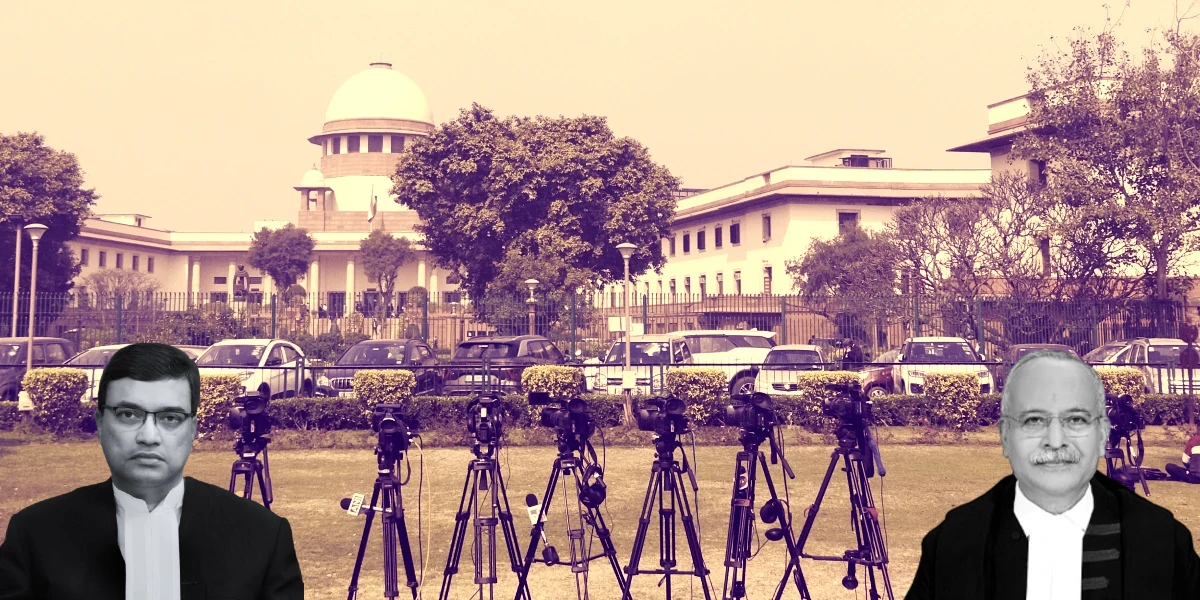
The Supreme Court has ruled that an accused facing serious criminal charges cannot leave India without prior permission from the trial court, emphasizing that the right to travel abroad must be balanced against the victim's right to a speedy trial and the interests of criminal justice.
In Seesa Santosh v. State of Telangana & Anr., a Bench of Justice Dipankar Datta and Justice Satish Chandra Sharma set aside a Telangana High Court order that had allowed accused Seesa Santosh to travel to the United States for medical treatment.
The Court observed that although the respondent's passport need not be deposited with authorities, he cannot travel abroad without obtaining express permission from the Sessions Court after committal of the case.
The case stems from a 2014 FIR registered following the suspicious death of the appellant's father. Seesa Santosh was chargesheeted in 2016 for offences under Sections 120-B and 306 read with Section 34 of the IPC.
Over the years, the accused filed multiple petitions before the High Court seeking quashing of the proceedings and obtained interim protections, including suspension of a Look Out Circular (LoC), which enabled him to leave India in 2017. He returned only in April 2025 and was arrested at Hyderabad airport.
After his release, Santosh sought return of his passport. While the Magistrate allowed the request, the Sessions Court later directed him to deposit the passport and recommended restrictions under the Passports Act. The High Court subsequently reversed that decision and permitted him to travel to the United States subject to certain conditions.
The Supreme Court noted that despite the filing of the chargesheet nearly a decade ago, the criminal trial had not even commenced and remained at the stage of committal.
The Bench found that the respondent had repeatedly approached courts and secured interim orders that effectively delayed the progress of the criminal proceedings.
The Court observed that the accused's conduct of filing petitions, obtaining interim protection, and then withdrawing those proceedings without a final adjudication raised serious concerns regarding his bona fides.
It also took note of allegations that the respondent had previously utilized the suspension of the Look Out Circular to leave the country and evade criminal proceedings.
The High Court had relied on the respondent's claim that he suffered two brain strokes in 2023 and required treatment in the United States.
However, the Supreme Court found this reasoning unconvincing, observing that India possesses advanced medical facilities comparable to those available abroad.
The Bench held that the High Court had shown undue indulgence by permitting foreign travel solely on medical grounds without adequately considering the accused's past conduct and the long-pending criminal proceedings.
Rejecting the argument that travel restrictions violated Article 21 of the Constitution, the Court held that personal liberty must be balanced against the right to a speedy trial and society's interest in effective criminal justice administration.
Relying on the decision in Rajesh Ranjan Yadav v. CBI, the Court reiterated that no fundamental right is absolute and reasonable restrictions may be imposed where public interest and administration of justice so require.
While restoring the Magistrate's order allowing retention of the passport, the Supreme Court clarified that:
The accused cannot leave India without express permission from the Sessions Court.
Any future request to travel abroad must be considered on its own merits.
The Sessions Court may impose appropriate safeguards and conditions before granting such permission.
Civil, police and airport authorities must coordinate to ensure that the accused does not leave the country without judicial approval.
The Court also encouraged the authorities to expedite the committal proceedings so that the criminal trial can commence without further delay.

Case Details:-
SLP (CRL) No. 18022 OF 2025
SEESA SANTOSH VERSUS THE STATE OF TELANGANA
Representation:-
For Petitioner(s) :Mr. K. Parameshwar, Sr. Adv., Mr. M. Sharath Chandra Reddy, Adv., Mr. Yashaswi Sk Chocksey, Adv., Mr. Krishna Kumar Singh, AOR
For Respondent(s) :Ms. Devina Sehgal, AOR, Mr. Srikanth Varma Mudunuru, Adv., Mr. Yatharth Kansal, Adv., Mr. S. Niranjan Reddy, Sr. Adv., Mr. Krishna Dev Jagarlamudi, AOR, Mr. Arpit Kumar Mishra, Adv., Mr. Vishnu Kanth Mundada, Adv., Mr. Shadab Azhar, Adv.
Website designed, developed and maintained by webexy