
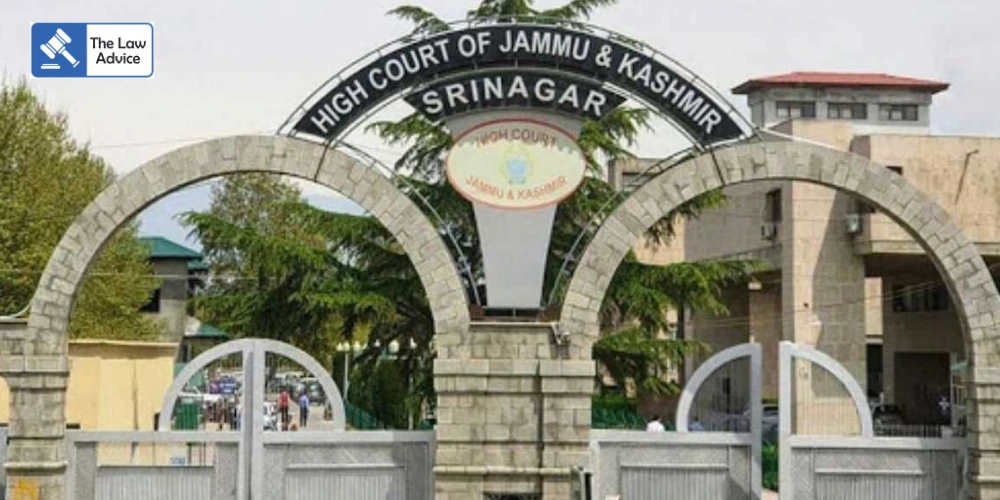
Reaffirming procedural safeguards in cheque dishonour proceedings, the Jammu & Kashmir and Ladakh High Court has held that an order passed by a Magistrate on an application under Section 143A of the Negotiable Instruments Act, 1881 is not interlocutory in nature. Instead, such an order qualifies as an intermediate order and is therefore open to challenge by way of a revision before the Sessions Court.
The Court clarified that an order under Section 143A conclusively determines the rights and liabilities of the parties with respect to interim compensation and cannot be shielded from scrutiny on the ground that it is merely interlocutory.
This ruling was delivered by Justice M. A. Chowdhary while dismissing a petition filed by Tafazul Fazili, who had directly approached the High Court by invoking its inherent jurisdiction to challenge a Magistrate’s order directing payment of interim compensation in a cheque dishonour case.
The dispute arose from a complaint filed by Sabzar Ahmad Bandh under Section 138 of the Negotiable Instruments Act, alleging dishonour of cheques. Along with the complaint, an application under Section 143A of the Act was moved seeking interim compensation. Acting on the application, the Special Mobile Magistrate, PT & E, Srinagar directed the accused to pay 10% of the cheque amount, quantified at ₹6.10 lakh, as interim compensation.
Aggrieved by this order, the accused approached the High Court under Section 528 of the Bharatiya Nagarik Suraksha Sanhita, 2023, seeking quashing of the Magistrate’s direction. It was contended that the order was arbitrary, unreasoned and passed without proper application of mind. The petitioner argued that Section 143A confers discretionary power on the Magistrate, which must be exercised judiciously and in line with the law laid down by the Supreme Court. Reliance was placed on Rakesh Ranjan Srivastava v. State of Jharkhand to support the plea.
Upon hearing the submissions and examining the record, the High Court first addressed the issue of maintainability. It noted that the petitioner had bypassed the statutory remedy of revision and had directly invoked the inherent jurisdiction of the High Court. This required the Court to determine the nature of an order passed under Section 143A—whether interlocutory, intermediate, or final.
Justice Chowdhary explained that the decisive factor is not the stage at which the order is passed, but its legal effect. The Court observed that if an order finally determines the rights and liabilities of the parties, it cannot be treated as interlocutory merely because it is passed during the pendency of proceedings.
The Court further explained the applicable test, noting that if consideration of objections raised by a party leads to culmination of proceedings on a particular issue, any order passed thereon cannot be regarded as purely interlocutory.
Applying these principles, the High Court categorically held that an order passed on an application under Section 143A of the Negotiable Instruments Act is not interlocutory in nature. It observed that once such an application is filed, heard and decided, the proceedings under that provision stand concluded, thereby decisively determining the parties’ rights and obligations with regard to interim compensation.
“The order passed on an application under Section 143A of the Negotiable Instruments Act is not an interlocutory order but an intermediate order, as the application is filed and disposed of under the said provision, determining the rights and liabilities of the parties,” the Court held. It further clarified that a revision against such an order is maintainable before the Sessions Court, whether preferred by the complainant or the accused.
In view of this settled position, the High Court held that the petitioner had an effective alternative remedy available in the form of a revision before the Sessions Court. Since this remedy had not been availed and the High Court’s inherent jurisdiction had been invoked directly, the petition was found to be not maintainable.
Accordingly, Justice Chowdhary concluded that the petition was misconceived and dismissed it in limine, while granting liberty to the petitioner to pursue the appropriate remedy available under law.
Appearances:
For Petitioner: Mr. Umar Mir, Advocate
Case Title: Tafazul Fazili v. Sabzar Ahmad Bandh
Website designed, developed and maintained by webexy