
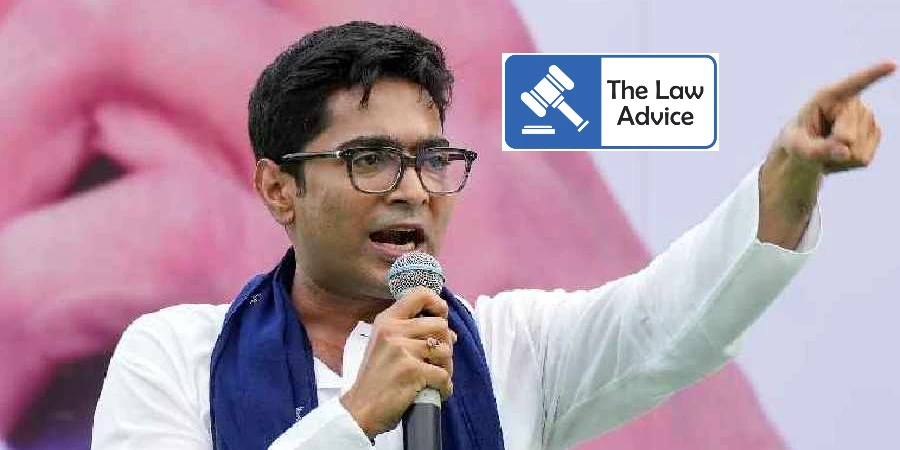
The Supreme Court on Monday permitted Trinamool Congress leader and Lok Sabha MP Abhishek Banerjee to travel abroad for three weeks to undergo medical treatment for his eye.
A bench comprising Chief Justice of India Surya Kant, Justice Joymalya Bagchi and Justice V Mohana allowed Banerjee's appeal against the Calcutta High Court's refusal to relax the restriction on his foreign travel.
The restriction had been imposed as a condition while staying his arrest in a criminal case arising out of an alleged provocative speech made during the 2026 West Bengal Assembly election campaign.
The Supreme Court allowed Banerjee to travel subject to his undertaking that he would use only his diplomatic passport. He has also been directed to provide his travel itinerary and details of his place of stay to the investigating agency.
Additional Solicitor General SV Raju, appearing for the West Bengal government, opposed the plea, pointing out that 16 cases were pending against Banerjee. He argued that there was a possibility that Banerjee may not return to India if permitted to travel abroad.
The bench, however, was not inclined to accept the objection.
"Every individual has the right to go abroad, every individual has the right to choose the medical care," Justice Bagchi observed, while noting that the case before the Court concerned an alleged election speech.
Senior Advocate Gopal Sankaranarayanan, appearing for Banerjee, submitted that his client currently holds only a diplomatic passport, which had been issued to him in connection with Operation Sindoor outreach.
He argued that Banerjee's movements would be monitored by Indian embassies while travelling on the diplomatic passport, thereby addressing the State's apprehension that he could abscond.
The senior counsel also submitted that Banerjee was unlikely to flee the country as he is a sitting MP, General Secretary of a national political party and has his family in India.
He further claimed that most of the criminal cases against Banerjee were registered after the change of government in West Bengal.
The ASG disputed this submission, stating that the previous government had not dared to register such cases.
Raju clarified that the State had no objection to Banerjee receiving medical treatment abroad as such, but argued that it should first be established whether overseas treatment was genuinely necessary. According to the State, this required Banerjee to undergo a medical evaluation.
The ASG argued that Banerjee's refusal to appear before the medical board should lead to an adverse inference against him.
The Supreme Court, however, proceeded to grant permission for foreign travel.
After the order was dictated, Sankaranarayanan requested that Banerjee's travel itinerary be kept confidential. The bench accepted the request and directed that the itinerary should not be published.
Banerjee had approached the Supreme Court after the Calcutta High Court, on August 5, refused to permit him to travel abroad for eye treatment.
The restriction on foreign travel was imposed as a condition while granting protection from arrest in a criminal case concerning an alleged provocative speech made during the recently concluded West Bengal Assembly elections.
Banerjee had earlier challenged the Calcutta High Court's July 20 order refusing permission to travel abroad. The High Court had instead directed him to seek treatment at the State-run SSKM Hospital and the Institute of Post Graduate Medical Education & Research (IPGME&R).
On August 3, the Supreme Court disposed of Banerjee's plea and asked the High Court to decide the issue expeditiously.
However, on August 5, the High Court rejected his application after noting that Banerjee had declined to appear before a medical board constituted to assess whether he required treatment abroad.
The High Court observed that had Banerjee appeared before the medical board, its opinion could have assisted the court in determining whether overseas treatment was medically necessary.
It also noted that the court was not a medical expert and that the immediate question was whether Banerjee required treatment, rather than where the treatment should be provided.
The High Court further rejected the argument that Banerjee had an absolute right to choose a particular doctor or medical institution, taking into account the criminal cases and investigations pending against him.
Senior Advocate Rebecca John, who appeared for Banerjee before the High Court, had submitted that he wanted to continue treatment with a specialist in the United States who had previously operated on him. She had also said that Banerjee was unwilling to undergo treatment at SSKM Hospital.
The West Bengal government had opposed overseas travel, arguing that there was no medical emergency requiring treatment abroad and that permitting Banerjee to leave the country could potentially affect ongoing investigations.
Case: Abhishek Banerjee v. State of West Bengal, SLP (Crl) 14489/2026
Website designed, developed and maintained by webexy