
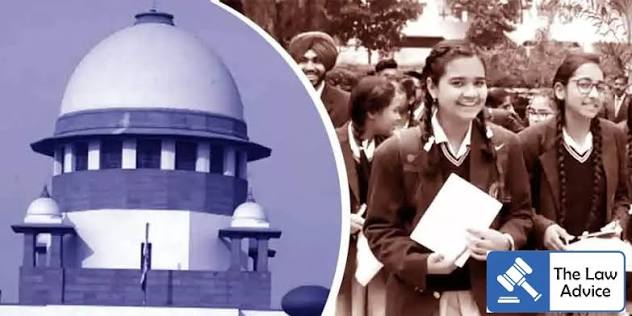
The Supreme Court on Monday disposed of a petition filed by a CBSE private candidate from Saudi Arabia after the Central government informed the Court that it has introduced a new policy to assess students affected by the cancellation of Class XII board examinations in Gulf countries due to the recent regional conflict.
Solicitor General Tushar Mehta, appearing for the Centre, told a Bench of Justice SVN Bhatti and Justice Vipul M Pancholi that a nationwide policy has now been notified to address the concerns of private candidates whose examinations were disrupted in West Asian countries.
The case was filed by Pransu Jigarkumar Patel, a private candidate from Al Jubail, Saudi Arabia. He had approached the Supreme Court after CBSE failed to declare his Class XII Improvement Examination result, even though a special assessment scheme had already been announced for students in affected Gulf nations.
Patel argued that the assessment scheme issued by CBSE on March 27, 2026, only covered regular school students and did not explain how private candidates appearing for improvement exams would be evaluated. Because of this, his result was kept on hold and marked as "Result Later" (R.L.), which he said negatively impacted his higher education plans.
The Supreme Court had earlier, on June 8, asked the Centre to find a solution. On June 13, the government informed the Court that a policy was being prepared and sought additional time.
During Monday's hearing, Mehta explained that the cancellation of CBSE exams had affected two categories of students across seven Gulf countries — regular school students and private candidates. While regular students could be assessed through internal records such as periodic tests and pre-board examinations, private candidates did not have any such school-based evaluation records.
To address this gap, the Centre notified a fresh policy on June 21.
Under the new formula, marks for cancelled subjects will be calculated by taking 40 per cent of a student's Class X theory marks and 60 per cent of their Class XII theory marks. For the Class X component, the average marks of the student's top three subjects will be considered after normalisation.
In Patel's case, he had appeared for Physics and Chemistry, while examinations for Mathematics, English and Computer Science were cancelled. The completed subjects were evaluated based on actual performance, while the cancelled subjects were assessed under the new formula.
The Solicitor General informed the Court that Patel's revised result was better than his previous performance. The result has already been shared with him through email and will also be updated on DigiLocker. Students dissatisfied with their assessed marks will have the option of appearing in the next regular examination.
The petitioner's lawyer also requested that the Court protect his client's right to seek answer scripts and apply for re-evaluation under CBSE rules.
However, the Bench noted that these requests were not part of the original petition.
Observing that the main grievance had been addressed through the new policy, the Supreme Court disposed of the case while clarifying that the petitioner remains free to pursue any remaining remedies in accordance with law.
Case: Pransu Jigarkumar Patel vs Union of India | W.P.(C) No. 747/2026
Website designed, developed and maintained by webexy