
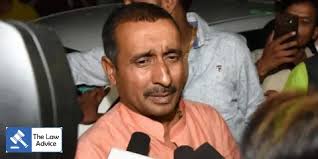
Today, a three-judge bench of the Supreme Court is hearing a plea filed by the Central Bureau of Investigation (CBI) challenging the Delhi High Court judgement of suspending the life sentence of former Uttar Pradesh MLA Kuldeep Singh Sengar in the Unnao rape case.
The matter is being taken up by a vacation bench comprising Chief Justice of India Surya Kant and Justices J.K. Maheshwari and Augustine George Masih.
After the High Court judgement, CBI approaches the apex court
Back in December 2019, a Delhi court had convicted Sengar for offences under the IPC and the Protection of Children from Sexual Offences (POCSO) Act, sentencing him to imprisonment for the remainder of his natural life.
The High Court suspended the sentence after recording a prima facie finding that the offence of aggravated penetrative sexual assault under the POCSO Act was not made out. Under Section 5 of the POCSO Act, penetrative sexual assault is considered “aggravated” when committed by, among others, a public servant, police officer, member of the armed forces, or a person in a position of authority or trust. The offence carries a minimum sentence of 20 years’ imprisonment, extendable to life.
The trial court had held Sengar guilty of aggravated penetrative sexual assault on the ground that he fell within the definition of a “public servant.”
Later, a Division Bench of the Delhi High Court comprising Justices Subramonium Prasad and Harish Vaidyanathan Shankar held that Sengar could not be categorised as a public servant under Section 5(c) of the POCSO Act or Section 376(2)(b) of the IPC.
The High Court further held that Sengar did not fall within the ambit of Section 5(p) of the POCSO Act, which applies to persons in a “position of trust or authority.”
Aggrieved by this finding, the CBI moved the Supreme Court, contending that the High Court erred in concluding that the offence under Section 5(c) of the POCSO Act was not attracted. According to the agency, a sitting MLA occupies a constitutional position of trust and authority and discharges public duties in which the State and the community have a direct interest.
Website designed, developed and maintained by webexy