
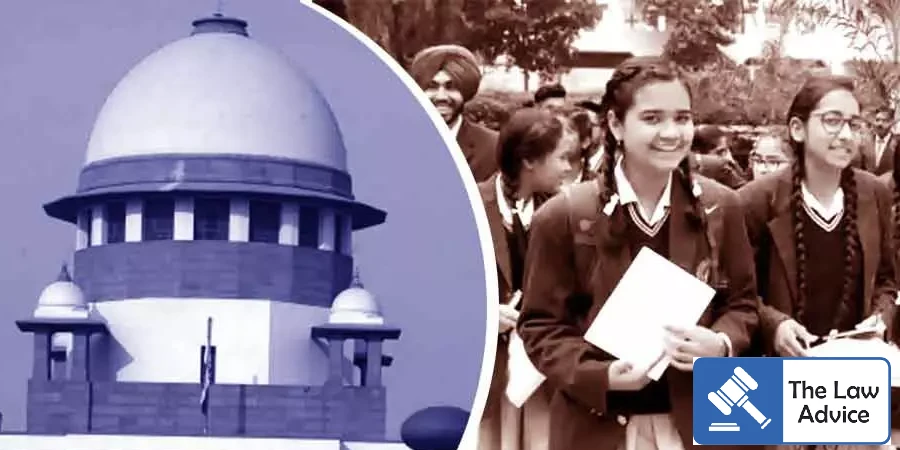
The Supreme Court on Monday directed the Central Board of Secondary Education (CBSE) to extend to Class 6 students the same relaxation from the three-language formula that has been granted to Class 7 students.
A bench comprising Chief Justice of India Surya Kant and Justices Joymalya Bagchi and V Mohana was hearing a batch of petitions challenging the CBSE's three-language formula.
The Court's direction means that Class 6 students will not face a pass-or-fail consequence in the third language under the transitional arrangement. The assessment will be limited to an appearance certificate, similar to the relaxation already available to Class 7 students.
At the beginning of the hearing, Solicitor General Tushar Mehta told the Court that detailed discussions had taken place on the earlier suggestion to exempt current Class 6 students from the three-language formula. He urged the Court to permit implementation of the policy for Class 6 from the current academic year.
Mehta submitted that out of 28,819 schools, only around 1.2% were yet to comply with the requirements, while textbooks and other learning materials were available and students had already opted for the scheme.
Additional Solicitor General Aishwarya Bhati explained that Classes 7, 8 and 9 had already been granted a transitional relaxation under which students would not face a CBSE Board examination in the third language when they reach Class 10. The third language would instead be assessed internally by the school without any pass-or-fail consequence affecting the Board results.
Justice Bagchi observed that the CBSE had by then covered almost its entire school network. Since the policy was notified only in March, he suggested a “soft launch” for Class 6 students and proposed extending the same relaxation to them in view of the logistical challenges.
Senior Advocate Gopal Sankaranarayanan, appearing for the petitioners, opposed immediate implementation for Class 6. He argued that students had opted for the scheme because they had no alternative and pointed to difficulties in accessing textbooks and learning materials.
He also submitted that the CBSE caters to around 28.83 lakh students and argued that neither the ICSE Board nor state boards were imposing a similar requirement on students midway through their schooling. He urged the Court to defer implementation for Class 6 until at least 2027.
The petitioners also raised concerns over English being classified as a non-native language under the policy. One counsel questioned the classification, noting that English is used in the Constitution and in proceedings before the Supreme Court.
Justice Bagchi said the issue would be considered by the Court.
Other lawyers highlighted concerns over increased academic pressure, infrastructure gaps, limited language choices and difficulties in accessing textbooks, particularly in rural areas. One counsel pointed out that some schools offered only Hindi and Sanskrit as language options and questioned what choice would be available to students seeking to study languages such as Punjabi.
After considering the submissions, the bench directed that Class 6 students be given the same transitional exemption as Class 7 students.
“There will be no pass/failure. There will only be appearance certificate,” Chief Justice Surya Kant observed.
The Court's order recorded the submission that around 99% of schools had adequate infrastructure, with about 1.2% still working to provide the required facilities.
The bench also directed the CBSE to appoint an officer to contact the remaining schools and ascertain the difficulties they were facing.
Justice Bagchi further observed that if any school withheld a student's promotion on the basis of internal assessment under the three-language formula, the Court would intervene.
The CBSE has been directed to file its counter-affidavit within four weeks, after which the petitioners will file their rejoinder. The main matter has been listed for further hearing.
Case: Yashica Bhandari Jain and Others v. Union of India and Others | W.P.(C) No. 694/2026 and connected cases
Website designed, developed and maintained by webexy