
The Supreme Court has held that prior sanction under Section 197 of the Code of Criminal Procedure (CrPC) is not required at the stage of registration of an FIR or commencement of investigation, even when the allegations are against public servants for acts allegedly committed in the discharge of official duties.
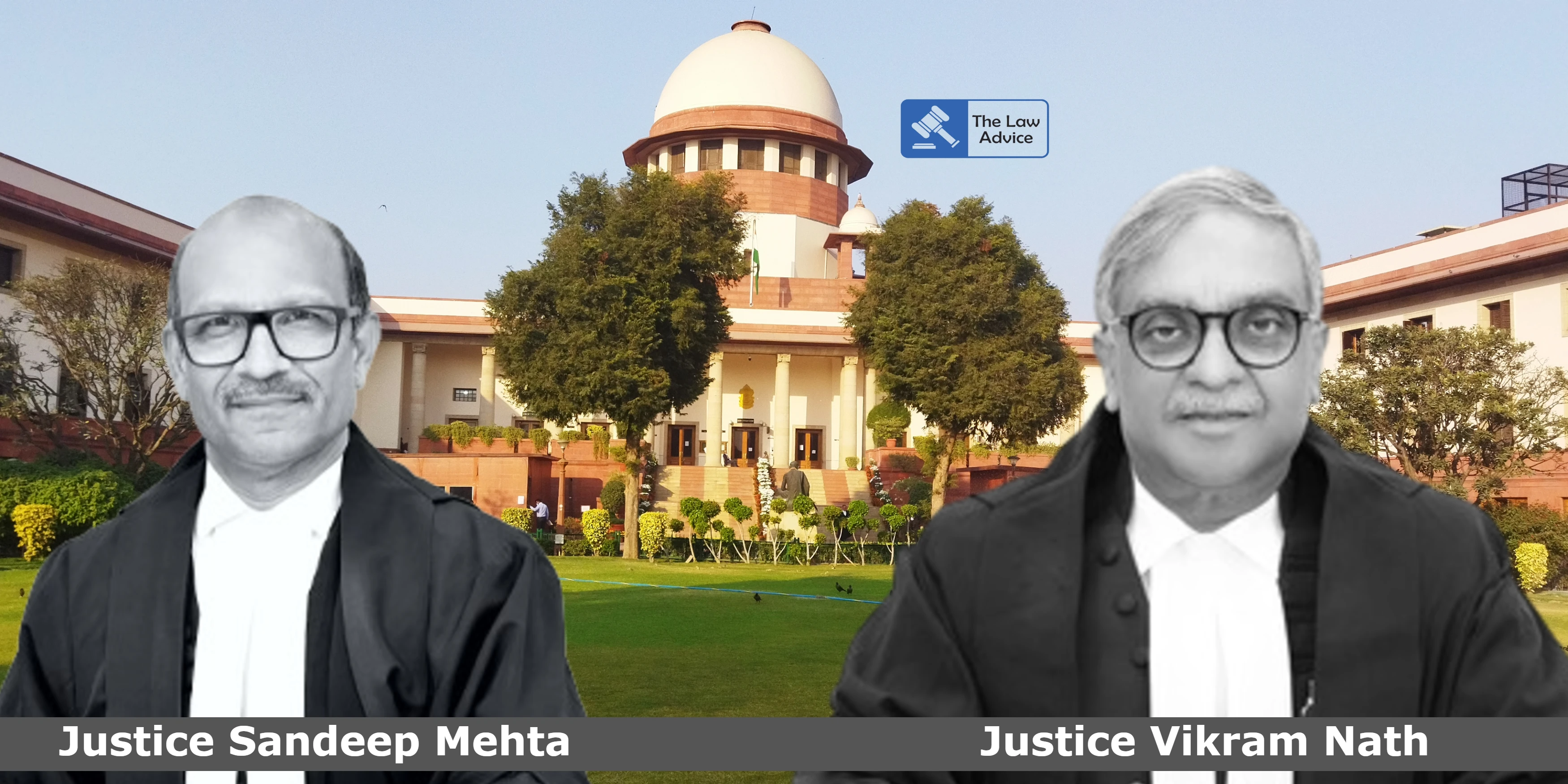
A Bench comprising Justice Vikram Nath and Justice Sandeep Mehta set aside a Karnataka High Court order that had quashed criminal proceedings against police officials on the ground that sanction under Section 197 CrPC had not been obtained.
The Court clarified that the protection under Section 197 CrPC operates only when the Court proceeds to take cognizance of an offence. It does not create a bar against registration of an FIR or investigation.
The Court observed that an order under Section 156(3) CrPC directing registration of an FIR and investigation is a pre-cognizance step and does not amount to taking cognizance. Therefore, absence of prior sanction under Section 197 cannot prevent registration of an FIR or investigation.
The Supreme Court further relied upon the principles laid down in Pastor P. Raju and other decisions to hold that the requirement of sanction operates at the stage of cognizance and not at the anterior stage of investigation.
The case arose from a complaint filed by Sri Anumandala Rajesh Reddy, who alleged, among other things, illegal detention, coercion, tampering with digital evidence and misuse of police machinery.
After the police allegedly failed to act on his complaints, he approached the Magistrate under Section 200 CrPC. The Magistrate referred the complaint for investigation under Section 156(3) CrPC, following which FIR Crime No. 73 of 2022 was registered.
The Karnataka High Court subsequently quashed the proceedings, holding that the police officials had acted in discharge of their official duties and therefore prosecution could not proceed without sanction under Section 197 CrPC. It also held that the procedure contemplated by Priyanka Srivastava v. State of Uttar Pradesh had not been followed.
The Supreme Court rejected the High Court's approach, holding that the statutory scheme does not contemplate an embargo on directing registration of an FIR or conducting investigation at the pre-cognizance stage.
The Court explained that the criminal process is sequential: information of a cognizable offence → FIR → investigation → police report → consideration of cognizance. The requirement of sanction under Section 197 arises only at the cognizance stage.
The Court also disagreed with the High Court's finding that the complaint was liable to be quashed for non-compliance with Priyanka Srivastava.
The Supreme Court noted that the complainant had repeatedly approached the police authorities and subsequently sent complaints to higher authorities, including the DCP and the Director General and Inspector General of Police, before approaching the Magistrate.
The Court held that the safeguards laid down in Priyanka Srivastava are intended to prevent routine or mechanical invocation of Section 156(3) CrPC and cannot be treated as mere procedural formalities divorced from the circumstances of a particular case.
It further held that where a complainant has substantially approached the police and higher police authorities, insisting upon a further representation to the Superintendent of Police merely as a matter of form would elevate the form of the safeguard over its underlying purpose.
The Supreme Court set aside the Karnataka High Court's order. Since the investigating agency had submitted a Final Report after the High Court's order, the Supreme Court directed that the Final Report be reopened and the investigation resumed from the stage at which it was submitted, in accordance with law.
The Court clarified that if, after investigation, the offences are found proved and the acts of the officials are concluded to have been committed in discharge of their official duties, the Investigating Officer shall keep in mind the desirability of seeking sanction.
Case: Sri Anumandala Rajesh Reddy v. State of Karnataka & Anr.
Citation: 2026 INSC 1039
Judges: Justice Vikram Nath and Justice Sandeep Mehta
Date: August 24, 2026.

Representation:-
For Petitioner(s) :Mr. Nikhil Goel, Sr. Adv. Mr. P. Venkat Reddy, Adv. Mr. Prashant Kumar Tyagi, Adv. Mr. P. Srinivas Reddy, Adv. Mr. Adithya Koshy Roy, Adv. Mr. P.V. Narsimha Reddy, Adv. M/s Venkat Palwai Law Associates, AOR
For Respondent(s) :Mr. Avishkar Singhvi, A.A.G. (V.C.) Mr. Sanchit Garga, AOR Mr. Naved Ahmed, Adv. Mr. Kunal Rana, Adv. Mr. Shashwat Jaiswal, Adv. Ms. Diksha Arora, Adv. Mr. Bhanu Pratap Singh, Adv. Mr. Vijender Kumar, Adv Mr. Gaurav Agarwal, Sr. Adv. Mr. Alok Nayak, Adv. Mr. Divyanshu Kumar Srivastava, AOR Mr. Shivam Nagpal, Adv. Ms. Rasika Jalan, Ad
Website designed, developed and maintained by webexy