
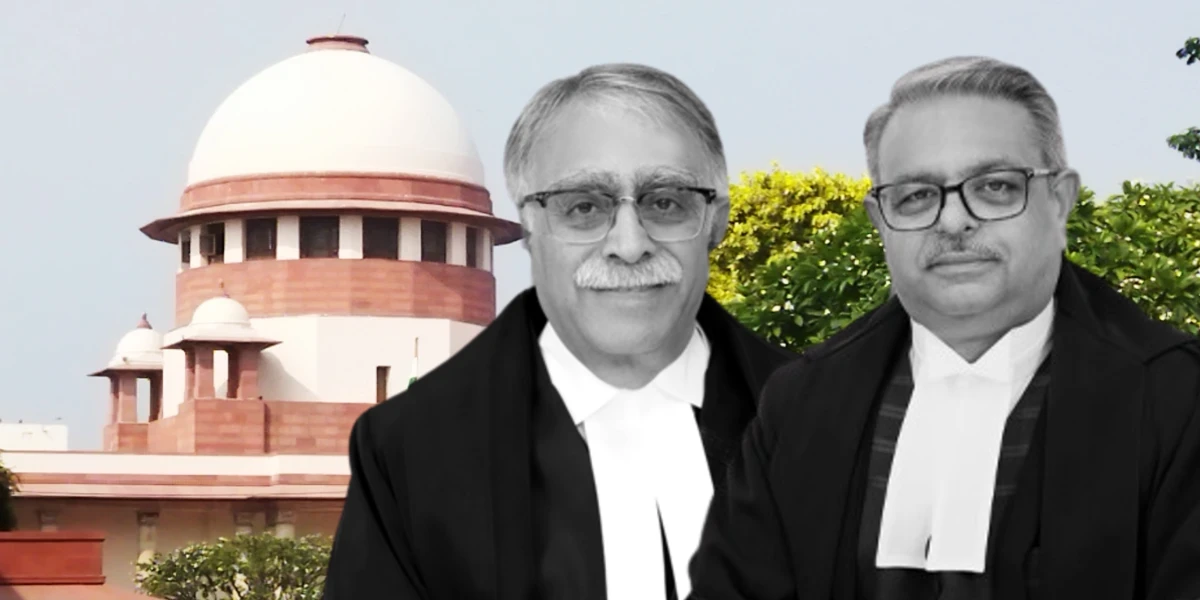
The Supreme Court has held that an employee cannot be terminated for allegedly suppressing criminal antecedents when the existence of the criminal case was not within the candidate’s knowledge at the time of making the declaration.
A Bench of Justices Sanjay Karol and Augustine George Masih observed that knowledge of a fact is a necessary prerequisite for its non-disclosure. The Court clarified that a person cannot be held responsible for suppressing information about a criminal case of which he had no knowledge.
The case concerned Shatrughn Yadav, who was appointed as a Technician (Process) by Fertilizers and Chemicals Travancore Ltd. In his attestation form, he declared that no criminal case was pending against him. Later, an NCR registered under Sections 323 and 504 IPC was discovered during verification. His services were subsequently terminated on the allegation that he had furnished false information.
Yadav maintained that he was unaware of the NCR, had never been summoned, arrested or called to the police station, and had no means of knowing about the proceedings. He also produced a police certificate showing no adverse entry against him and a subsequent certificate confirming that his name had been deleted from the NCR after no evidence was found against him.
The Supreme Court laid down a two-pronged enquiry for cases involving alleged suppression of criminal antecedents. First, the employer must determine whether there was actually suppression or false information, considering the candidate’s knowledge at the relevant time. Second, the employer must assess the nature of the alleged suppression, seriousness of the offence, nature of the post, duties involved and outcome of the criminal proceedings before deciding whether termination is warranted.
The Court emphasised that termination is not an automatic consequence of criminal antecedents and that the employer must apply its mind to the individual facts and circumstances of the case.
Finding that Yadav's claim of bona fide ignorance was supported by documentary evidence and that the authorities had failed to undertake the required enquiry, the Court held that his termination was illegal and suffered from non-application of mind.
The Supreme Court accordingly set aside the termination and directed his reinstatement with consequential benefits, restricting back wages to 50%, payable within eight weeks.
Case: Shatrughn Yadav v. The Fertilizers and Chemicals Travancore Ltd. (F.A.C.T.) & Ors., 2026 INSC 829.
Bench: Justice Sanjay Karol and Justice Augustine George Masih.

Representation:-
For Petitioner(s) : Mr. Pv. Dinesh, Sr. Adv. Ms. Anna Oommen, Adv. Mr. Abdulla Naseeh V.T., AOR
For Respondent(s) : Mr. Parthiv Goswami, Sr. Adv. Mr. Siddhartha Jha, AOR Mr. Kartik Jha, Adv. Ms. Atiga Singh, Adv. Ms. Nitika Sud, Adv.
Website designed, developed and maintained by webexy