
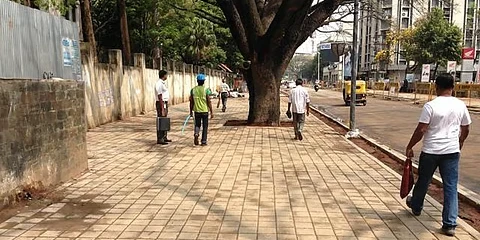
The Supreme Court on Friday held that people have a fundamental right to walk on safe and clearly marked footpaths, and this right must be given priority over the privilege of motorised vehicles on roads.
A Bench of Justice PS Narasimha and Justice AS Chandurkar said this right flows from Articles 19 and 21 of the Constitution, which guarantee freedom of movement, life and personal liberty.
The Court said that if a road exists, authorities have a legal duty to provide and maintain footpaths for pedestrians.
“If a road exists, there must then be a duty to ensure that a footpath is demarcated and maintained for the walkers. This is an enforceable duty. The fundamental right to walk on demarcated footpaths shall override the privilege of a motorised vehicle,” the Court said.
The Bench observed that Indian cities have been designed mainly with vehicles in mind, while pedestrians have often been ignored.
Calling it a “civilisational problem”, the Court said the lack of safe footpaths and the dominance of motor vehicles have made walking difficult and unsafe for people.
The judges said that over time, roads became centred around vehicles, pushing pedestrians to the sidelines and treating them as an inconvenience.
Making its position clear, the Court said this approach cannot continue and formally declared the right to walk on demarcated footpaths as a fundamental right.
The Bench also said that Urban Development Authorities, Municipal Corporations, Municipalities and Panchayats are responsible for creating and maintaining footpaths.
The Court added that people can take legal action against authorities if safe pedestrian infrastructure is not provided, apart from seeking compensation under the Motor Vehicles Act in accident cases.
It also noted that India currently lacks a dedicated law on pedestrian rights and suggested creating a regulatory body to strengthen and enforce these rights.
The Court directed that a copy of the judgment be sent to the concerned ministries and the Law Commission so that appropriate legislation can be considered.
The observations came while hearing a case involving the death of a five-year-old child who was hit by a tanker while walking to school with his father. The Court noted that there was no footpath or pedestrian crossing at the accident spot.
The Supreme Court set aside a High Court order that had reduced the compensation awarded to the child's family and increased the amount to ₹11.44 lakh.
It also directed that the issue of pedestrian rights and infrastructure be examined separately in a fresh proceeding and asked the Union government and relevant ministries to assist the Court.
Website designed, developed and maintained by webexy