
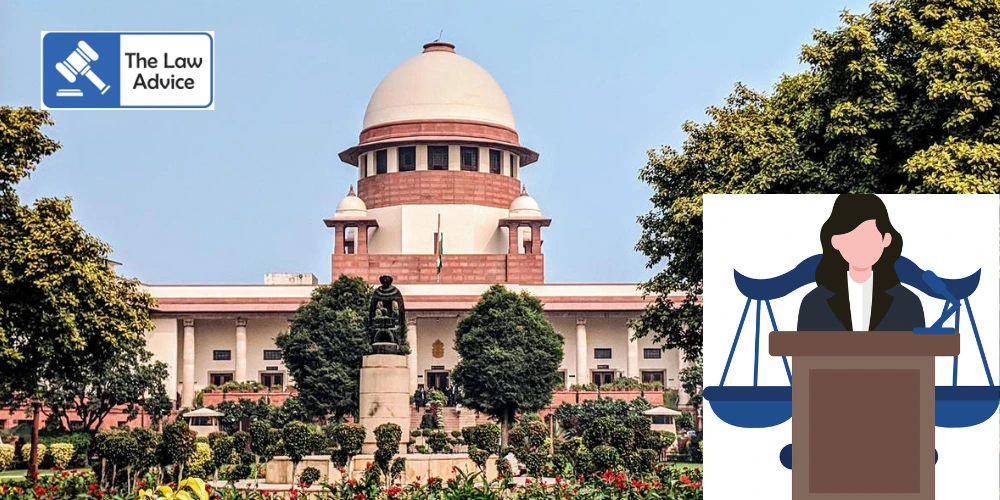
In a landmark directive, the Supreme Court on Monday mandated that State Bar Councils — where elections are yet to be announced — must ensure 30% representation for women advocates.
For the ongoing electoral cycle, the Court clarified that 20% of the seats should be occupied through direct election of women candidates, while an additional 10% may be filled through co-option. A detailed proposal regarding the co-option process must be submitted before the Court, particularly in councils where the number of practising women lawyers is insufficient.
The bench also noted that it would be inappropriate to alter electoral arrangements in bar councils where the election process has already commenced.
“We must encourage women lawyers contesting elections in the Bar Councils of Andhra Pradesh, Punjab & Haryana, Uttar Pradesh, and Telangana to participate with confidence. Advocate voters should also make a conscious effort to ensure adequate female representation,” the Court stated. Elections in Bihar and Chhattisgarh have also been initiated, and these councils too will remain outside the reservation mandate for this year.
For all other State Bar Councils, the Court directed that 30% of seats must be held by women — with 20% through election and 10% by co-option. Where women are hesitant to contest, co-option should be utilised to ensure the final quota is met.
The order was issued by a bench of Chief Justice of India Surya Kant and Justice Joymalya Bagchi in petitions filed by advocates Yogamaya M.G. and Shehla Chaudhary, who sought gender-based reservation in Bar Councils. The Court had earlier asked the Bar Council of India (BCI) to submit a concrete plan for implementing 30% representation.
Appearing for the BCI, Senior Advocate Manan Kumar Mishra, Chairman of the Council, stated that the BCI supports 30% reservation in principle but sought permission to fill the posts through co-option this year — proposing 15% co-option. However, the Court limited co-option to 10%.
Senior Advocate Meenakshi Arora cautioned that imposing a uniform quota may pose challenges in states with a very small number of practising women advocates.
The petitioners were represented by Senior Advocate Shobha Gupta and Advocate Sriram Parakkat for Yogamaya, and Dr. Charu Mathur for Shehla Chaudhary.
TN Bar Council Co-Chairman K. Balu sought intervention, supporting the reservation and highlighting the need to break entrenched leadership patterns within councils. Senior Advocate Vinay Navare also appeared for Jan Adalat, an organisation working for lawyers’ welfare.
Cases:
Yogamaya M.G. v. Union of India, W.P.(C) No. 581/2024
Shehla Chaudhary v. Union of India, W.P.(C) No. 1060/2025
Website designed, developed and maintained by webexy