
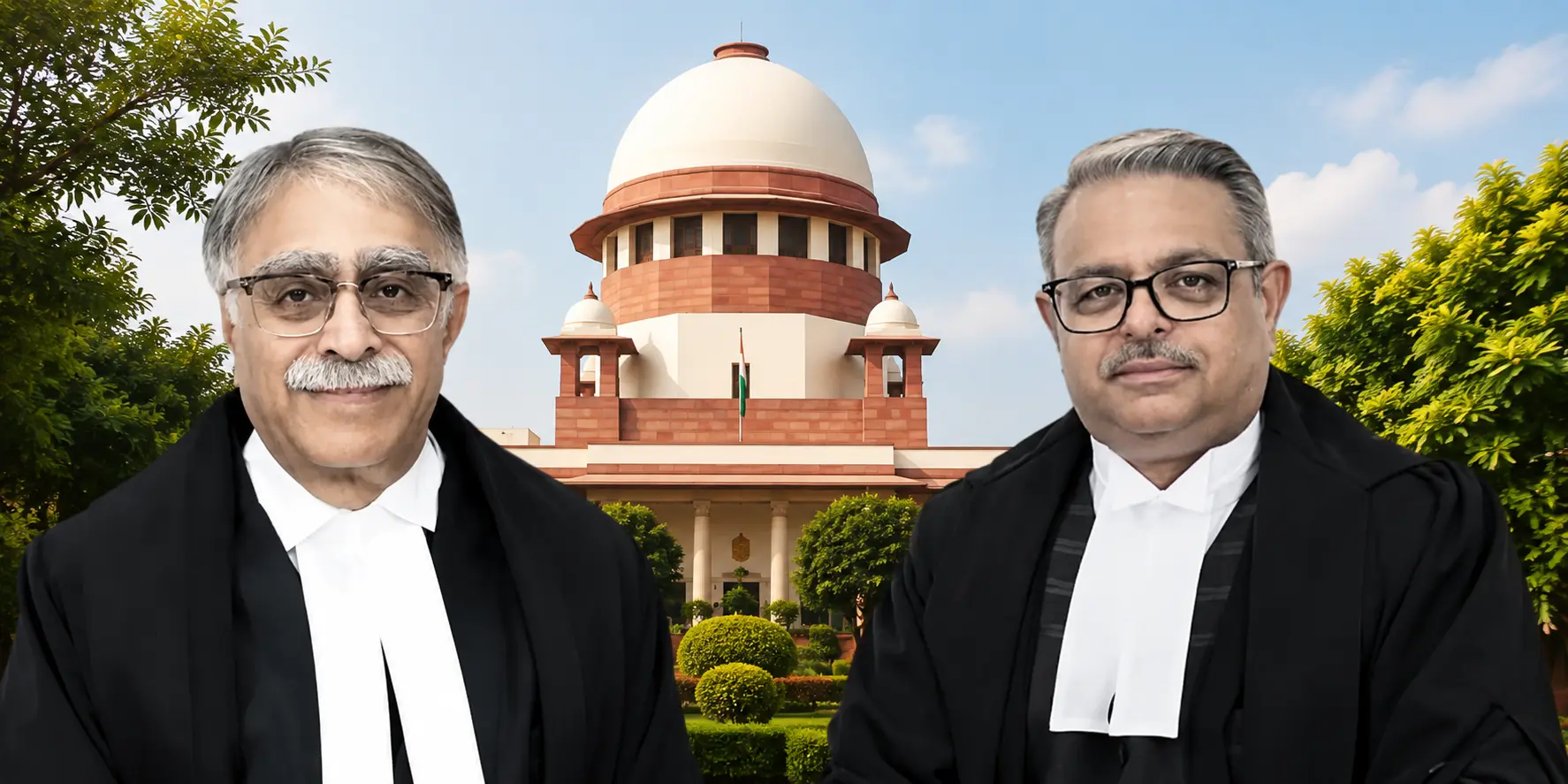
The directions include priority treatment of cases under Sections 304-B and 498-A IPC/Sections 80 and 85 BNS, monitoring of cases pending for over three years, witness calendars and stronger institutional support for women.
The Supreme Court has issued ten directions to expedite trials in cases involving dowry death and cruelty to married women, while calling for stronger institutional mechanisms, better monitoring of pending cases and improved enforcement of the Dowry Prohibition Act, 1961.
A Bench of Justice Sanjay Karol and Justice Augustine George Masih issued the directions on August 20, 2026, while considering the compliance of its earlier directions in State of Uttar Pradesh v. Ajmal Beg Etc. The directions concern offences under Sections 304-B and 498-A of the Indian Penal Code, corresponding to Sections 80 and 85 of the Bharatiya Nyaya Sanhita, 2023, as well as offences under the Dowry Prohibition Act.
The Court's directions include:
Priority for dowry-related cases: Courts dealing with offences under Sections 304-B and 498-A IPC/Sections 80 and 85 BNS should, as far as practicable, treat such matters as priority cases and endeavour to ensure their expeditious disposal.
Cases pending for over three years: The District Judiciary should identify cases pending beyond three years, particularly those pending at the stage of framing of charge or recording of evidence, and undertake monthly or quarterly monitoring of their progress.
Charges within 60 to 90 days: Trial Courts should endeavour to consider framing of charge preferably within 60 to 90 days from the filing of the charge-sheet, subject to statutory safeguards under the CrPC/BNSS. Evidence should commence within a reasonable period after framing of charge and, as far as possible, proceed continuously or on a day-to-day basis.
Benchmarks are directory: The Court clarified that the indicated timelines are ordinarily directory benchmarks and may be affected by exceptional circumstances such as multiple accused, supplementary charge-sheets, forensic delays or non-availability of accused persons.
Unnecessary adjournments to be discouraged: Trial Courts and High Courts should discourage unnecessary adjournments and grant them only after recording reasons in writing. If counsel for an accused repeatedly remains absent without sufficient cause, Legal Aid Counsel or an Amicus Curiae may be appointed so that proceedings are not unnecessarily delayed.
Witness calendars: Immediately after framing of charge, Trial Courts should prepare a witness calendar specifying dates for examination of material witnesses, service of summons and sequencing of evidence. Investigating Officers should ensure prompt service of summons and production of witnesses.
Digital monitoring: High Courts should endeavour to integrate stage-wise pendency tracking, digital dashboards, automated alerts for old matters and case-monitoring systems for dowry-related cases into existing Courts Dashboards/CIS infrastructure.
Periodic review by High Courts: High Courts should periodically review old criminal appeals, revisions, petitions under Section 482 CrPC/Section 528 BNSS and bail matters, particularly cases involving interim stays of trial proceedings.
Training and specialised prosecution: States and High Courts should conduct periodic training and sensitisation programmes for Judicial Officers, Police Officials, Prosecutors, Protection Officers, Counsellors and other stakeholders dealing with dowry-related offences. States may also designate prosecutors experienced in offences against women for such prosecutions.
Support mechanisms and awareness: States and Union Territories should strengthen Dowry Prohibition Officers, One Stop Centres, Family Counselling Centres, Women Help Desks, victim assistance mechanisms, helplines and online grievance redressal systems. They should also undertake sustained awareness programmes concerning dowry, gender equality, constitutional values and women's rights.
Periodic compliance reports: High Courts and States/Union Territories are required to file status and compliance reports on January 15, May 15 and September 15 until the pendency of cases under the relevant provisions is substantially reduced.
The Court directed that the compliance reports should include details regarding pendency and disposal statistics, stage-wise status of cases, awareness initiatives, appointment or designation of Dowry Prohibition Officers, training programmes and other measures adopted pursuant to the directions.
The directions follow the Supreme Court's earlier judgment dated December 15, 2025 in State of Uttar Pradesh v. Ajmal Beg, in which the Court restored the trial court's conviction of the accused under Sections 304-B and 498-A IPC. The Court had highlighted the continuing prevalence of dowry and difficulties in the implementation of the Dowry Prohibition Act.
In that judgment, the Supreme Court had called for coordinated efforts by the Legislature, Judiciary, law enforcement agencies and civil society to address the problem. It had also directed States and the Union Government to consider changes to educational curricula to create awareness among young people about dowry and the constitutional principle of equality in marriage.
The Court had further directed States to ensure that Dowry Prohibition Officers were properly appointed, made aware of their responsibilities and provided the necessary resources. Their official contact details were also directed to be adequately disseminated to citizens.
Importantly, the Supreme Court had noted that the case itself began in 2001 and concluded 24 years later, prompting it to ask High Courts to take stock of pending cases involving Sections 304-B and 498-A IPC and take steps for their expeditious disposal.
Pursuant to those directions, several High Courts, States and Union Territories filed affidavits and data before the Supreme Court. The Court considered the consolidated analysis of the material before issuing the present directions.
The Bench has directed that the matters be listed on October 15, 2026, along with the compliance-cum-periodic reports.

Representation:-
For Petitioner(s) :Mr. Sharan Dev Singh Thakur, Sr. A.A.G. Mr. Sudeep Kumar, AOR Mr. Abhishek Saket, Adv. Ms. Manisha, Adv. Ms. Rupali, Adv. Ms. Reya Paul, Adv. Ms. Harshita Chawla, Adv. Mr. Kunal Chatterji, AOR
For Respondent(s) :Mr. Shekhar Kumar, AOR Mr. Shantanu Krishna, AOR Mr. Varinder Kumar Sharma, AOR Mr. Hit Lal, Adv. Mr. Aravindh S., AOR Mr. Aadithya Aravindh, Adv. Ms. Anika Bansal, Adv. Mr. Avneesh Arputham, AOR Mr. Ankit Sharma, Adv. Mr. Rajat Bhardwaj, A.A.G. Ms. Baani Khanna, AOR Mr. Robin Singh, Adv. Mr. Kapil Balwani, Adv. Ms. Komal Thakkar, Adv. Ms. Tejal Tapaswini Nagauri, Adv. Mr. P. I. Jose, AOR Ms. P S Chandralekha, Adv. Ms. Mrinmayee Sahu, Adv. Ms. Mrinmayee Sahu, AOR Mr. Sugam Kumar Jha, Adv. Ms. Amruta Padhi, Adv. Mr. Aljo K. Joseph, AOR Mr. Sashwat Mishra, Adv. Mr. Aaditya Aniruddha Pande, AOR Mr. Siddharth Dharmadhikari, Adv. Mr. Shrirang B. Varma, Adv. Mr. Sourav Singh, Adv. Ms. Chitransha Singh Sikarwar, Adv. Mr. Bhuvan Kapoor, Adv. Mr. Varun Chugh, Adv. Mr. Krishna Kant Dubey, Adv. Mr. Mukesh Kr. Verma, Adv. Mr. Shashwat Parihar, Adv. Mr. Yogesh Vats, Adv. Mr. Shreekant Neelappa Terdal, AOR Ms. G. Indira, AOR Mr. Dinesh Kumar Mudgal, Adv. Mr. Devendra Upadhayay, Adv. Mr. Hitesh Kumar Sharma, Adv. Mr. Anupam Kumar, Adv. Mr. Akhileshwar Jha, Adv. Mr. Avnish Kumar, Adv. Mr. Sameer Abhyankar, AOR Mr. Aryan Srivastava, Adv. Mr. Krishna Rastogi, Adv. Mr. Ankit Roy, AOR Ms. Mrinalini Ramesh, Adv. Ms. Jaya Pandey, Adv. Mr. T. G. Narayanan Nair, AOR Ms. Samyuktha H Nair, Adv. Mr. Rahul Gupta, AOR Mr. Anando Mukherjee, AOR Mr. Shwetank Singh, Adv. Mr. Utkarsh Anand, Adv. Ms. Sanjana Saddy, AOR Mr. Aman Choudhary, Adv. Mr. Kunal Chatterji, AOR Ms. Maitrayee Banerjee, Adv. Mr. Rohit Bansal, Adv. Mr. Varij Nayan Mishra, Adv. Mr. Surjendu Sankar Das, AOR Mr. Vishwajeet Singh Shekhawat, Adv. Ms. Disha Singh , AOR Ms. Eliza Barr, Adv. Ms. Akansha, Adv. Ms. Anjali Saxena, Adv. Mr. Govind Sharma, Adv. Mr. Aaditya Singh Rajawat, Adv. Mr. Arjun Garg, AOR Ms. Manisha Ambwani, AOR Ms. Swati Ghildiyal, AOR Ms. Neha Singh, Adv. Mr. Amit Sharma, AOR Mr. Dipesh Sinha, Adv. Ms. Pallavi Barua, Adv. Ms. Aparna Singh, Adv. Mr. V.V.M.B.N.S. Pattabhiram, D.A.G. Mr. Aditya Vaibhav Singh Ga, Adv. Mr. Harmeet Singh Ruprah, AOR Mr. Kanishk Sharma, Adv. Mr. Shekhar Raj Sharma, A.A.G. Mr. Akshay Amritanshu, AOR Ms. Nidhi Narwal, Adv. Ms. Srishti Jain, Adv. Mr. Sarthak Srivastava, Adv. Mr. Utkarsh Rai, Adv. Mr. Shuvodeep Roy, AOR Mr. Gopal Jha, AOR Mr. Tilak Vij, Adv. Ms. Shireesha Sharma, Adv. Mr. Sawan Datta, Adv. Ms. Priyanshi Goel, Adv. Ms. Ratna Priya Pradhan, Adv. Mr. Nimish Arjaria, Adv. Mr. Atul Kumar, Adv. Ms. Sansriti Pathak, A.A.G. Mr. Saurabh Rajpal, Adv. Ms. Nidhi Jaswal, AOR Mr. Sudarshan Singh Rawat, AOR Mr. Madhav Gupta, Adv. Ms. Nidhi Jain, Adv. Mr. Sunny Sachin Rawat, Adv. Ms. Radhika Gautam, AOR Mr. Aditya Bharat Manubarwala, Adv. Mrs. Tanishka Grover, Adv. Mrs. Akriti Aditya Manubarwala, Adv. Mrs. Shaila Arora, Adv. Mrs. Charvi Virmani, Adv. Mrs. Pradnya Sachin Markar, Adv. Mr. Bharat Thakorlal Manubarwala, AOR Mr. Samir Ali Khan, AOR Mr. Kashif Irshad Khan, Adv. Mr. Pranjal Sharma, Adv. Mr. Ahanthem Henry, Adv. Mr. Ahanthem Rohen Singh, Adv. Mr. Mohan Singh, Adv. Mr. Aniket Rajput, Adv. Ms. Khoisnam Nirmala Devi, Adv. Mr. Yeshu Mehta, Adv. Mr. Tanay Hegde, Adv. Mr. Ravi Kumar Bodhani, Adv. Mr. Kumar Mihir, AOR Mr. Yashvardhan, Adv. Mr. Apoorv Shukla, AOR Ms. Prabhleen A. Shukla, Adv. Ms. Ilashri Gaur, Adv. Mr. Nishant Awana, AOR Ms. Rini Badoni, Adv. Mr. Suraj Kundu, Adv. Mr. Amogh Pandey, Adv. Mr. D. K. Thakur, Adv. Mr. Rajeev Kumar Gupta, Adv. Mr. Tavleen Singh, Adv. Ms. Vallabhi Shukla, Adv. Mr. Rohit Kumar, Adv. Mr. Bimlesh Kumar Singh, AOR Mr. Neeraj Agarwal, Adv. Mr. Akash Sajan Sapelkar, Adv. Mr. Shekhar Raj Sharma, A.A.G. Mr. Samar Vijay Singh, AOR Ms. Nidhi Narwal, Adv. Ms. Srishti Jain, Adv. Ms. Sabarni Som, Adv. Mr. Aman Dev Sharma, Adv. Mr. B. Shravanth Shanker, AOR Ms. Grahita Agarwal, Adv. Mr. I.V. Sai Nikhil, Adv. Ms. Prerna Robin, Adv. Mr. Shivam Kunal, Adv. Mr. Dandu Laxman, Adv. Mr. B. Yeshwanth Raj, Adv. Mr. Shreyas Jayasimha, Adv. Mr. Tushar Gadia, Adv. Mr. Suryansh Jamwal, Adv. Ms. Eliza Barr, Adv. Ms. Akansha, AOR Mr. Govind Sharma, Adv. Mr. Pukhrambam Ramesh Kumar, AOR Mr. Karun Sharma, Adv. Ms. Anupama Ngangom, Adv. Ms. Rajkumari Divyasana, Adv. Mr. Sunny Choudhary, AOR Mr. Guntur Pramod Kumar, AOR Ms. Prerna Singh, Adv. Mr. Dhruv Yadav, Adv. Ms. Deepika Nandakumar, AOR Ms. Kanimozhi J., Adv. Mr. Gunnam Venkateswara Rao, AOR Ms. Devyani Mahra, Adv. Mr. Manoj Kumar Dwivedi, Adv. Mr. Poli Naidu Vudamala, Adv. Mr. Shantanu Sagar For Patna High Court, Adv. Mr. Anil Kumar, Adv. Mr. Gunjesh Ranjan, Adv. Mr. Prakash Kumar Mangalam, Adv. Mr. Manoneet Dwivedi, Adv. Mr. Abhishek Kumar Gupta, Adv. Ms. Anshala Verma, Adv. Mr. Ruchira Gupta, S.C. Ms. Ishika Gupta, Adv. Mr. Kunal Mimani, AOR Ms. Kanika Kalaiyarasan, AOR Mr. Abhay Kumar, AOR Mr. Shagun Ruhil, Adv. Mr. Shreenivash, Adv. Mr. Karan Chopra, Adv. Ms. Sakshi Sharma, Adv. Mr. Sanchit Garga, AOR Mr. Kunal Rana, Adv. Mr. Shashwat Jaiswal, Adv. Ms. Diksha Arora, Adv. Mr. Bhanu Pratap Singh, Adv. Mr. Vijender Kumar, Adv. Ms. Oorja Goel, Adv. Ms. Ankita Sharma, AOR Mr. Rushab Aggarwal, Adv. Mr. Pashupathi Nath Razdan, AOR Ms. Devina Sehgal, AOR Mr. Srikanth Varma Mudunuru, Adv. Ms. Nidhi Mittal, AOR Mr. Sanjai Kumar Pathak, AOR Mrs. Shashi Pathak, Adv. Mr. Arvind Kumar Tripathi, Adv. Mr. Robin Kumar, Adv. Mr. Harshad V. Hameed, AOR Mr. Amit Pai, AOR Ms. Pankhuri Bhardwaj, Adv. Ms. Bhavana Duhoon, Adv. Mr. Abhiyudaya Vats, Adv. Mr. Shathaayu Patil, Adv. Mr. Niranjan Sahu, AOR Mr. Avijit Mani Tripathi, AOR Mr. Z.H. Isaac Haiding, Adv. Mr. Daniel Stone Lyngdoh, Adv. Ms. Marbiang Khongwir, Adv. Mr. T.K. Nayak, Adv. Mr. Kunal Vajani, A.A.G. Mr. Sanchit Garga, AOR Mr. Guneet S. Sidhu, Adv. Mr. Amitoj Chadha, Adv. Ms. Kanika Kalaiyarasan, AOR
Website designed, developed and maintained by webexy