
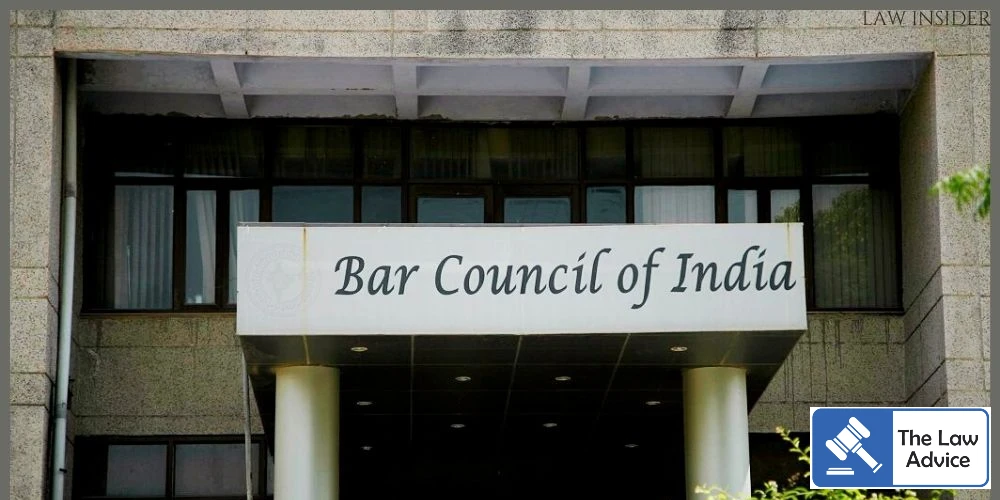
The Supreme Court on Wednesday laid down a time-bound schedule for the constitution of State Bar Councils, paving the way for the election of new office-bearers of the Bar Council of India (BCI).
The directions were issued while hearing petitions challenging the continued tenure of Senior Advocate Manan Kumar Mishra as BCI Chairman.
The bench comprising Chief Justice of India Surya Kant, Justice Joymalya Bagchi and Justice V Mohana observed that many of the concerns raised in the petitions could be addressed by expediting the long-pending BCI elections.
Under the timeline fixed by the Court, Chief Justices of the respective High Courts have been requested to complete the co-option of two women members to the State Bar Councils within two weeks.
Following this, the State Bar Councils will have one week to notify their new composition. The newly constituted councils will then have three weeks to elect their Chairperson, Vice Chairperson, other office-bearers and their representative to the BCI.
The Supreme Court said it would consider the issue concerning the composition of the BCI after this process is completed.
The Court also recorded an undertaking from the BCI that the Attorney General for India and the Solicitor General of India, both ex-officio members of the BCI, would be actively involved in major policy decisions of the Council.
The matters will next be taken up on September 17 to assess compliance with the directions relating to the co-option of members and notification of the new composition of the State Bar Councils.
The proceedings arose from petitions filed by Advocates M Varadhan and Yogamaya MG challenging the prolonged tenure of BCI Chairman Manan Kumar Mishra.
During the hearing, Senior Advocate Madhavi Divan, appearing for Varadhan, argued that serious questions had been raised regarding the continuation of the BCI Chairman and the need for clear term limits.
When CJI Surya Kant asked about the prescribed tenure, Divan submitted that the rules provide for a two-year term.
Senior Advocate Chander Uday Singh, appearing for Yogamaya MG, submitted that the April 2025 notification extending Mishra's tenure up to April 2030 had been challenged.
The petitioners argued that the notification could not override Rule 12(2) of the BCI Rules, which provides for a two-year tenure for the Chairman and Vice-Chairman.
Justice Joymalya Bagchi observed that a notification cannot supersede the governing Rules or confer an additional tenure beyond what the statutory framework permits.
The petitioners also argued that Section 4(3) of the Advocates Act, 1961, which permits BCI members to continue until their successors are elected, was being used to justify prolonged continuation in office when elections were delayed.
However, the Chief Justice indicated that the recently concluded State Bar Council elections had changed the situation and that it would be preferable to complete the constitution of the newly elected bodies before deciding the broader issues.
The hearing also saw arguments concerning the BCI-PEARL FIRST Trust, which was established in 2020.
Senior Advocate Gopal Sankaranarayanan raised questions about the Trust's structure and finances, pointing out that its trustees could continue even after ceasing to be members of the BCI.
The petitioners argued that this was different from the earlier 1974 trust deed, under which a person ceased to be a trustee upon ceasing to be a BCI member.
Justice Bagchi questioned whether an elected statutory body could create a perpetual trust and appoint individuals as permanent trustees even after they ceased to be associated with the body.
The petitioners sought a high-level investigation and an oversight committee to examine the affairs of the Trust.
The bench, however, expressed reluctance to intervene extensively at this stage, noting that the newly elected State Bar Councils were on the verge of being constituted.
Justice Bagchi also stressed that Mishra was presently functioning as a pro tem Chairman until the fresh election of BCI members takes place.
The Court indicated that while the pro tem Chairman could continue with the day-to-day functioning of the BCI, major policy decisions should involve the Attorney General and Solicitor General.
The bench said this arrangement would help preserve institutional integrity until a freshly elected BCI comes into existence.
The petitions also challenge the April 2025 Gazette notification extending Mishra's tenure from April 17, 2025, to April 16, 2030. The petitioners contend that the two-year tenure prescribed under Rule 12(2) cannot be extended through an administrative notification.
The Supreme Court will revisit the matter on September 17 after the completion of the stipulated process for reconstituting the State Bar Councils.
Website designed, developed and maintained by webexy