
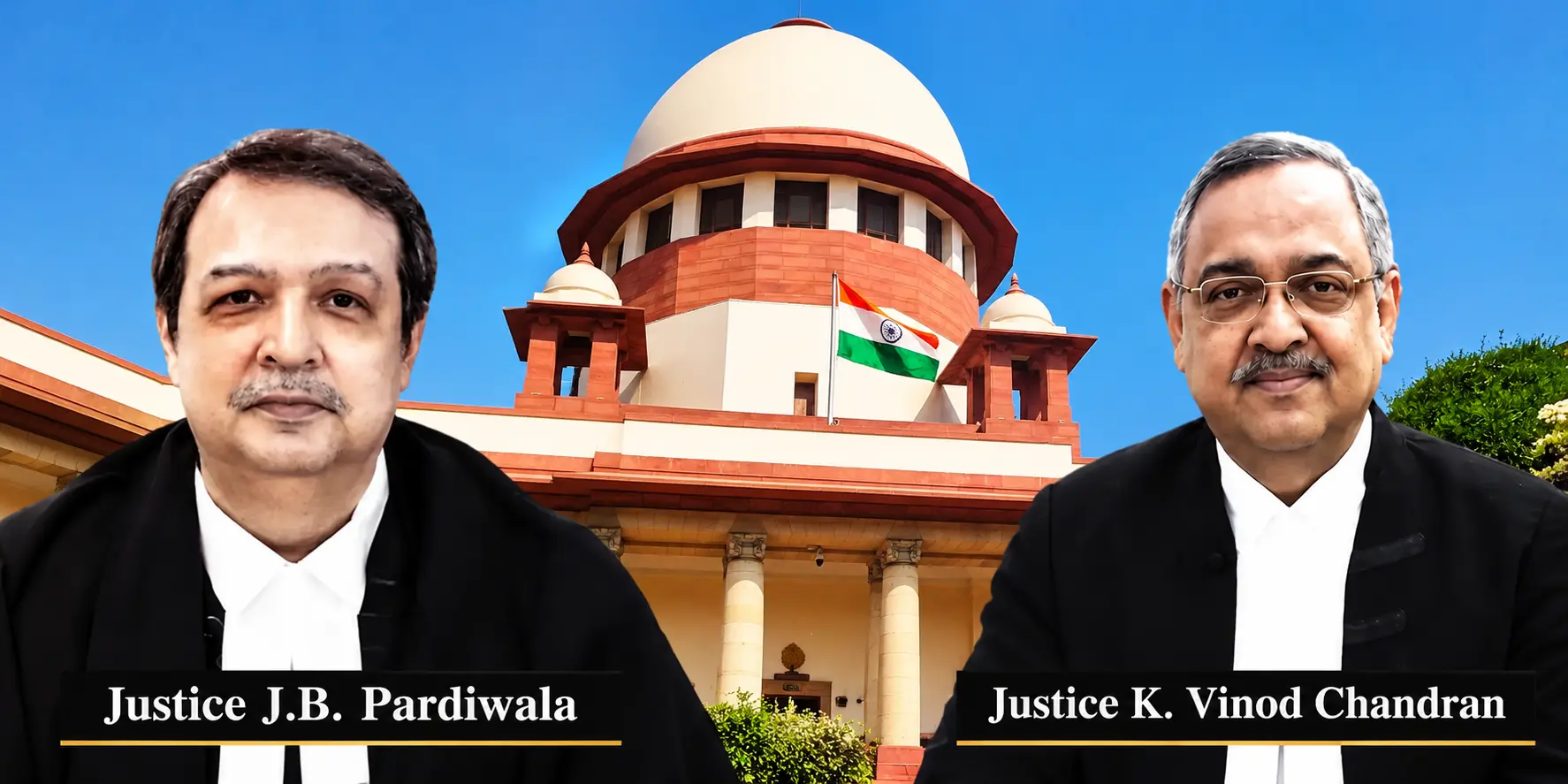
The Supreme Court has quashed criminal proceedings against a man accused of having a sexual relationship with a woman on the alleged promise of marriage, holding that a consensual relationship spanning three years cannot, in the absence of evidence that the accused never intended to marry from the very beginning, be converted into criminal liability merely because the relationship ultimately failed.
A Bench comprising Justice J.B. Pardiwala and Justice K. Vinod Chandran observed that consent cannot be loosely treated as having been obtained under fear or misconception when the parties admittedly maintained a consensual relationship for several years. The Court also cautioned that “a criminal prosecution cannot be reduced to a strong-arm tactic.”
The case arose from FIR No. 191 of 2025 registered at Sirgitti Police Station, District Bilaspur, Chhattisgarh, on the complaint of the second respondent.
The allegation was that the appellant had sexually exploited the complainant on the pretext of marriage and subsequently refused to marry her.
The complainant and the appellant had met at an academy where both were preparing for competitive examinations. They fell in love, and their respective families also discussed their marriage.
According to the Court, the parties thereafter entered into a physical relationship which continued for approximately three years.
The Court relied upon its earlier decision in Deepak Gulati v. State of Haryana, wherein it was held that in cases involving an alleged promise to marry, there must be sufficient evidence to demonstrate that from the very beginning the accused had no intention whatsoever of fulfilling the promise to marry.
The Court reiterated that mere failure to keep a promise relating to a future uncertain event does not automatically amount to misconception of fact. The relevant question is whether the accused had a fraudulent intention at the inception of the relationship.
Examining the facts, the Court noted that the physical relationship continued unabated for three years before the parties separated.
The Court observed that the complainant had willingly permitted the relationship and that there was no material indicating that her consent had been obtained through coercion or misrepresentation.
The Bench also noted that the marriage proposal subsequently discussed by the two families ultimately fell through.
The Court rejected the contention that an undertaking allegedly given by the appellant before the Mahila Thana Counselling Centre, Bilaspur, to marry the complainant could itself constitute a promise to marry capable of sustaining criminal prosecution.
The Court observed that such an undertaking would have been given in the backdrop of a threat of criminal prosecution and, in any event, could not alter the nature of the parties' three-year consensual relationship.
The Supreme Court held that even a bare reading of the complaint did not disclose any clear assurance or promise of marriage which could establish that the complainant's consent had been obtained through misconception of fact.
The Bench observed:
“A criminal prosecution cannot be reduced to a strong-arm tactic.”
The Court further noted that the complainant had stated that she would withdraw the allegations if the appellant married her.
According to the Court, this circumstance also demonstrated that the dispute had essentially arisen from the failure of the relationship and the subsequent breakdown of the proposed marriage.
The Court concluded that it was unable to find criminal culpability on the part of the appellant, observing that he had entered into a consensual relationship with the complainant and that the consent could not be said to have been obtained through coercion or misrepresentation.
The Court therefore held that there was no reason to allow the criminal proceedings to continue.
The chargesheet, Charge Sheet No. 199 of 2025 dated 17.06.2025, had been filed before the Judicial Magistrate First Class, Bilaspur, and the matter had subsequently matured into Sessions Case No. 216 of 2025 pending before the Additional Sessions Judge (FTC), Bilaspur.
The Supreme Court quashed the chargesheet and directed that no further proceedings be taken against the appellant. The pending sessions case was also ordered to be closed.
The appeal was accordingly allowed.
Case: Martanda Singh v. State of Chhattisgarh & Anr.
Citation: 2026 INSC 1081
Bench: Justice J.B. Pardiwala and Justice K. Vinod Chandran
Date: October 1, 2026
Website designed, developed and maintained by webexy