
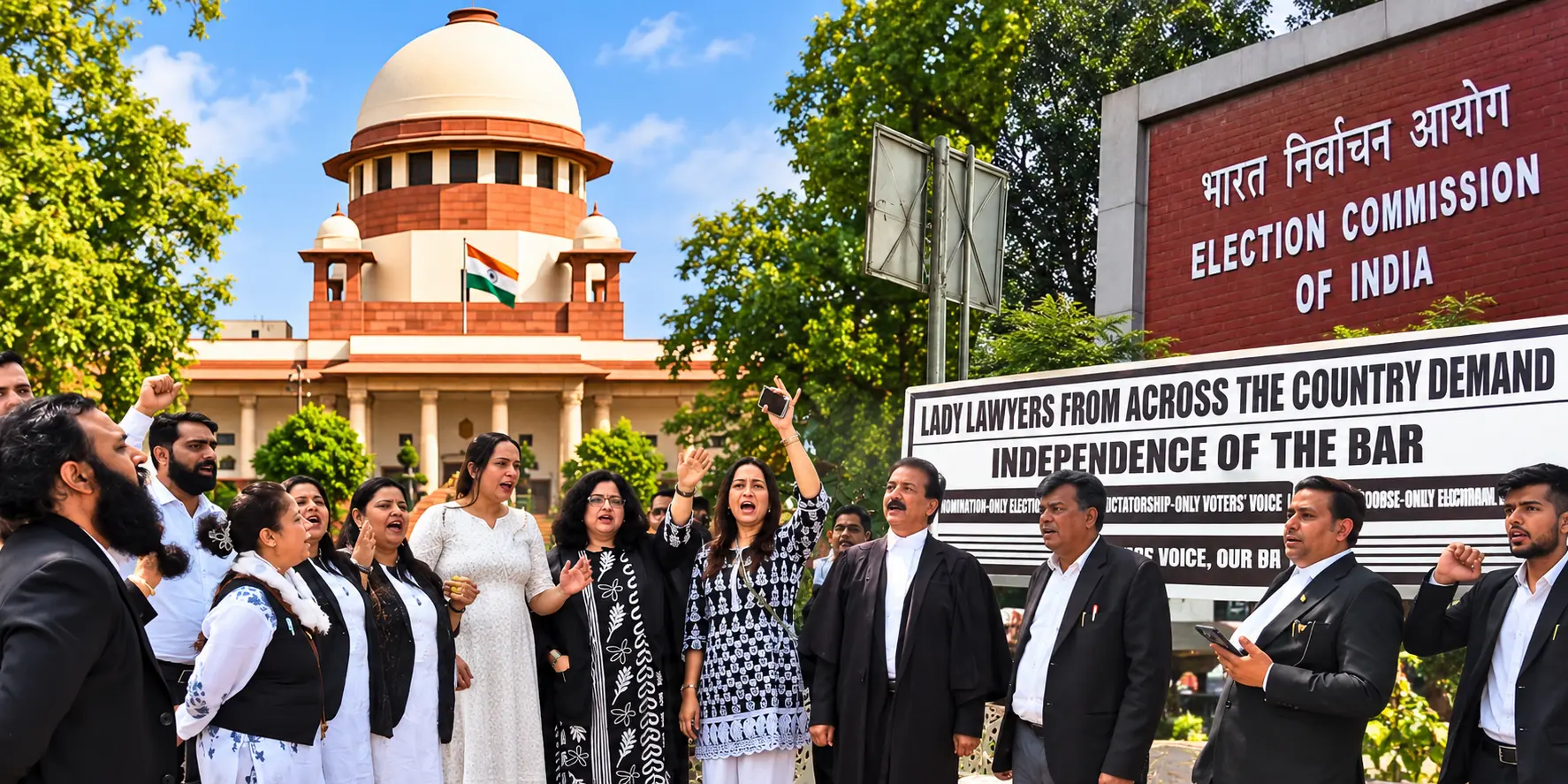
The Supreme Court on Tuesday observed that protesters cannot be allowed to occupy a designated protest site indefinitely, stressing that such spaces must remain available for other groups wishing to exercise their right to protest.
A bench comprising Chief Justice of India (CJI) Surya Kant and Justices Joymalya Bagchi and V Mohana made the observations while hearing a batch of petitions arising from the October protests in Delhi against Chief Election Commissioner (CEC) Gyanesh Kumar.
"You cannot occupy a site for all times to come. There are other protesters. Where will the farmers go? Where will the workers go? Where will the trade unions go? Where will the homeless go? Everybody has a right to protest," CJI Kant said.
The Court highlighted the competing claims between the right to protest and the right to carry on trade and business, particularly the impact of demonstrations on the livelihood of daily-wage workers.
"There are conflicting claims. The right to protest is also a constitutionally recognised right, as is the right to trade and carry on business. We are not talking about trade merely in terms of commercial establishments. We are talking about the source of livelihood of a daily-wage worker. Where does that person go for their daily bread?," the CJI observed.
The bench further stressed that one group cannot monopolise a protest site at the cost of others seeking to raise different issues.
"You must also find out why further time is not being granted. There may be another request for another protest. There may be one site or two, but everybody has a right to protest...You cannot exclude other people merely because you have occupied the site. You cannot say that because you have occupied it, you will not allow others," CJI Kant said.
Solicitor General Tushar Mehta, appearing for the authorities, submitted that the Cockroach Janta Party (CJP) protest held in July was permitted for only one day but continued for 17 days.
He further alleged that the protesters subsequently marched towards Parliament without obtaining permission.
"Then, without obtaining permission, they marched towards Parliament. Parliament is not just a political building. It is a symbol of the sovereignty of India. You cannot be permitted to go to Parliament. You cannot be permitted to go to the Supreme Court of India and protest without permission," Mehta said.
Traders claim ₹2,000 crore loss due to protests
Senior Advocate Mukul Rohatgi, appearing for traders, claimed that the protests had caused revenue losses of approximately ₹2,000 crore.
He pointed out that Ramlila Maidan, the designated protest site in Delhi, is located close to several commercial areas, including Asaf Ali Road, Daryaganj, Turkman Gate and Kamla Market.
Rohatgi urged the government to formulate a policy governing protests in Delhi and other State capitals, arguing that demonstrations in these areas affect a large population and commercial establishments.
He also highlighted the impact on traders during the festive season, stating that losses extend beyond shop owners to workers, tempo operators, labourers and loaders.
Justice Bagchi, however, questioned whether the loss of business could be attributed entirely to protesters, pointing out that restrictions and barricades imposed by the authorities could also affect commercial activity.
"Can the lack of sales be attributed only to the protests? The economy may also be in a particular position. Barricades are also placed on the streets. What if the State forces shops to close?," the Court asked.
In response, Mehta said that protesters had forced shops to shut down and that demonstrations could sometimes turn violent.
He argued that protests without official permission could disrupt the livelihood of others, adding that occupying a designated protest site was different from mobilising lakhs of people to march towards Parliament without permission.
Senior Advocate N Hariharan submitted that Ramlila Maidan was itself a notified protest site and questioned where people were expected to demonstrate if objections were also raised against protests there.
Privacy concerns during protests
Advocate Prashant Bhushan raised concerns over surveillance during protests and asked the authorities to explain the legal framework under which such monitoring was being conducted.
He argued that individuals continued to enjoy a right to privacy even while participating in public demonstrations.
Mehta responded that the authorities had only deployed CCTV cameras for surveillance, pointing out that several social media influencers were also recording and livestreaming the protests.
The bench observed that the right to privacy in a public place would have to be examined in light of the concept of a "reasonable expectation of privacy".
"The most relevant interjection here is reasonable expectation of privacy. When I am standing in a public place, what is my reasonable expectation of privacy? I cannot choose to go in public and say that my privacy must be protected," the Court observed.
Website designed, developed and maintained by webexy