
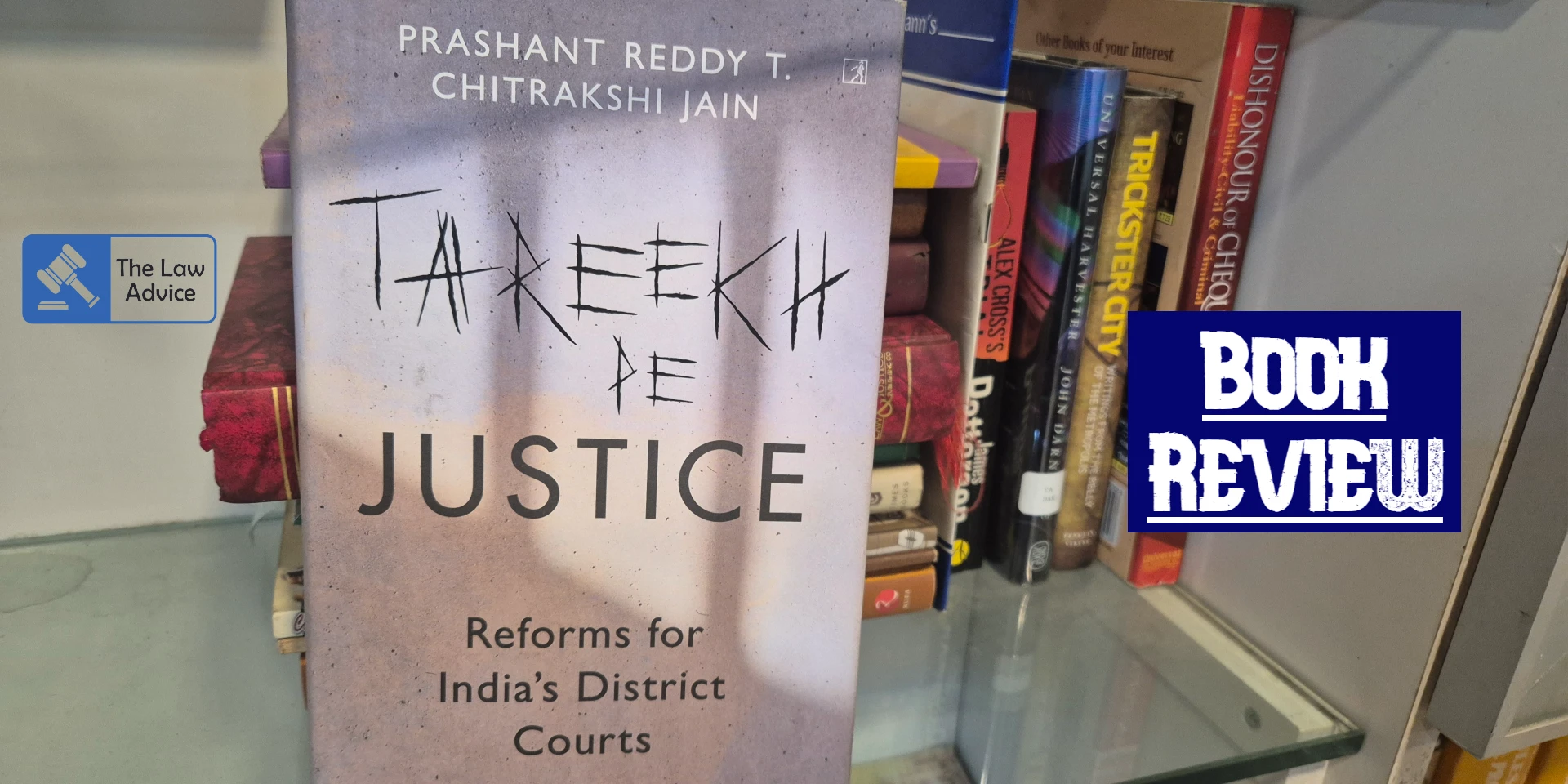
Book Review: Tareekh Pe Justice
Tareekh Pe Justice, authored by Prashant Reddy T. and Chitrakshi Jain, is a timely, courageous, and deeply insightful examination of the structural and functional challenges confronting the Indian judicial system. At a time when the judiciary is often criticised for the “Mount Everest–like pendency” of cases, frequent adjournments, and inefficiencies in case management, this book stands apart for its balanced, evidence-based, and reform-oriented approach.
While many commentators have criticised the Indian judicial system for delays and perceived inefficiency, Tareekh Pe Justice goes beyond mere criticism. The authors ground their arguments in empirical data, institutional history, and real-world examples, and—most importantly—offer constructive and pragmatic solutions aimed at systemic improvement rather than rhetorical condemnation.
The book is thoughtfully divided into three interlinked parts, each addressing a different layer of the justice delivery mechanism.
The first part focuses on judges of the trial courts and the lower judiciary, shedding light on the often-overlooked realities faced by them. The authors reveal how judges at the grassroots level function under constant pressure from public opinion, media scrutiny, and oversight by the higher judiciary. Through several forgotten and rarely discussed instances, the book exposes the vulnerability of trial court judges, who face multiple institutional challenges despite being the first point of contact for litigants. Of particular concern is the practice of initiating charge-sheets against lower judiciary judges for petty or technical issues, which creates a climate of fear and insecurity, directly impacting judicial independence and decision-making.
The second part adopts a data-driven approach, examining statistics, budgets, and bureaucratic structures governing the judiciary. This section provides a clear picture of judicial pendency, the acute shortage of judges, and the minimum judicial strength required for a country of India’s size and population. The authors convincingly demonstrate how bureaucratic hurdles, delays in appointments, and inadequate budgetary support have compounded the crisis, and argue for the urgent removal of these obstacles to ensure timely and effective justice delivery.
The third part, and arguably the most compelling section of the book, moves decisively into the realm of reform. Comprising three forward-looking chapters—Redesigning the Judiciary, Bringing Back Juries, and Making Procedural and Evidentiary Rules Great Again—this part presents bold, innovative, and sometimes unconventional ideas. These chapters challenge entrenched assumptions and invite serious policy-level debate on reimagining judicial structures, revisiting participatory models of justice, and simplifying procedural and evidentiary rules to make the system more accessible and efficient.
In conclusion, Tareekh Pe Justice is not merely a critique of the Indian judicial system; it is a constructive blueprint for reform. The book underscores the reality that meaningful change requires not just identifying problems, but also proposing workable solutions. It is a must-read not only for judges, lawyers, and law students, but for every citizen of the country, especially those involved in policy-making and governance. By combining rigorous analysis with reform-oriented vision, the authors make a significant contribution to contemporary legal discourse and to the ongoing quest for timely and effective justice in India.