
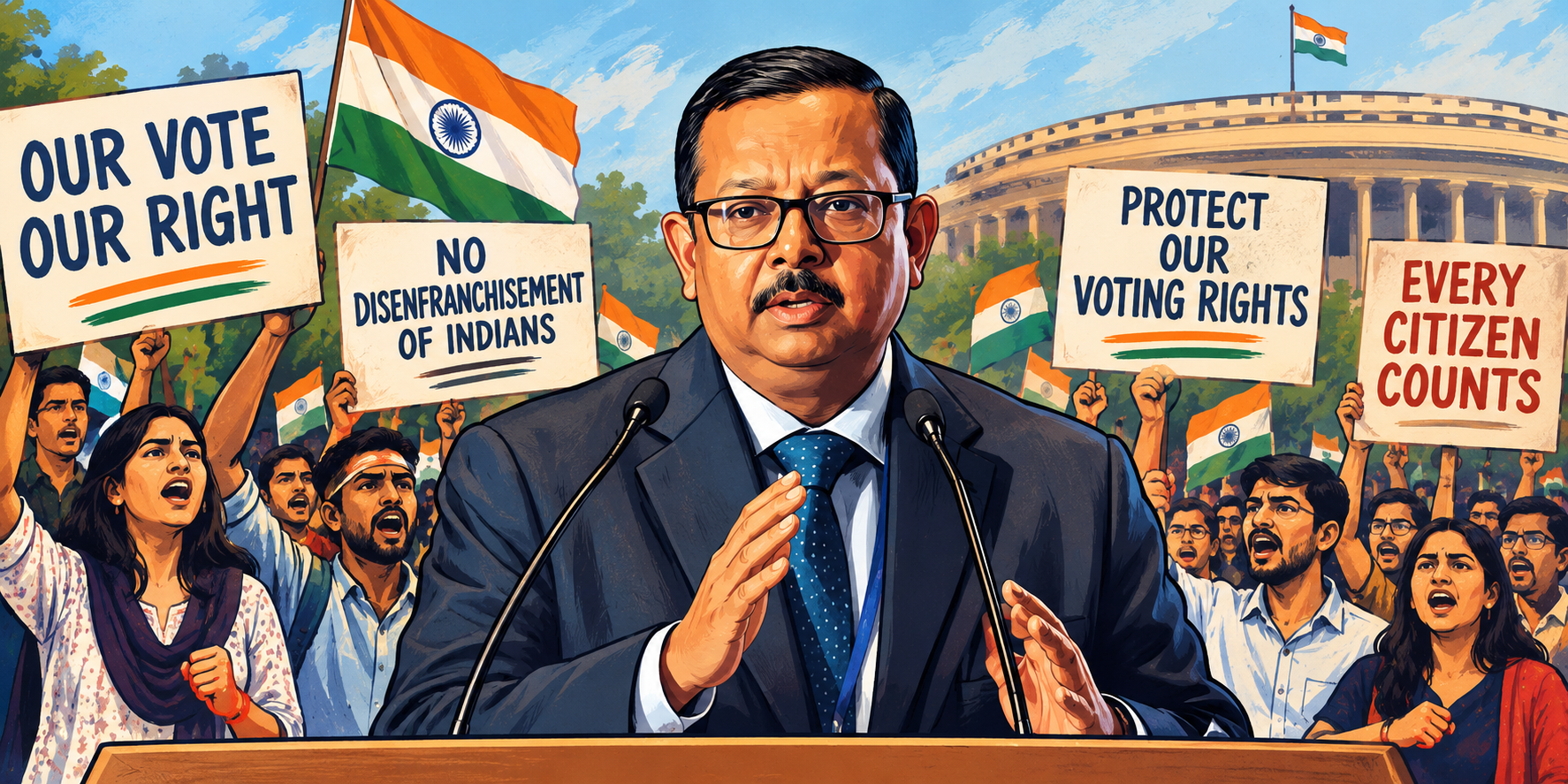
Recently, Justice Ujjal Bhuyan of the Supreme Court has said that any process that results in taking away the voting rights of a large number of Indian citizens would amount to “a negation of the constitutional order”, stressing that neither any authority nor any court can justify such disenfranchisement.
Justice Bhuyan made the remarks while delivering the valedictory address at the 19th NALSAR-Justice BR Sawhney Memorial Moot Court Competition at NALSAR University of Law in Hyderabad, where he previously served as Chancellor.
“The Indian Constitution does not provide for two classes of citizens: citizens with voting rights and citizens without voting rights,” Justice Bhuyan said.
He said that if any process ends up disenfranchising “millions and millions” of citizens and effectively turns them into second-class citizens by depriving them of voting rights, it would be inherently arbitrary and cannot be justified.
Justice Bhuyan said such a process would violate Article 14 of the Constitution, which guarantees equality before law, as well as Article 326, which provides for elections based on adult suffrage.
“I would go to the extent of saying that it is a negation of the constitutional order which we have adopted under the Constitution of India,” he said.
Justice Bhuyan did not refer to any particular authority or electoral exercise during his address. His remarks, however, come four months after the Supreme Court unanimously upheld the Election Commission of India's Special Intensive Revision (SIR) of electoral rolls.
The SIR exercise has recently faced criticism from Opposition parties, who have questioned the Election Commission’s autonomy and the manner in which the revision is being conducted.
Justice Bhuyan said the right to vote and the right of a citizen to be included in the electoral roll cannot be separated from the status of being an Indian citizen.
“From the persona of an Indian citizen, the right to vote or right to be included in the voters list cannot be detached. It will be like taking out the soul from the body,” he said.
The Supreme Court, while dealing with the SIR in May, had held that the exercise fell within the Election Commission’s constitutional mandate and that the measures adopted were neither excessive nor disproportionate. The Court also held that where the poll panel is not satisfied that a person fulfils the conditions for inclusion in the electoral roll, the matter can be referred to the competent authority for adjudication.
Justice Bhuyan said that, except in the case of a dead voter, a voter's name once included in the electoral roll should not be deleted without notice and an opportunity of hearing.
“And what is the worth of a citizen without her voting right?” he asked.
Linking the right to vote with India's freedom struggle, Justice Bhuyan said the right represented the freedom achieved by Indians after years of struggle and sacrifice.
“Article 326 cannot be tinkered with at all. No authority can do it; no court can condone it. No one is above the Constitution,” he said.
Justice Bhuyan also referred to jurist Nani Palkhivala's 1979 convocation address at the University of Madras, in which Palkhivala had stressed that every generation must defend freedom for it to survive.
Quoting former US Supreme Court Justice Felix Frankfurter, Justice Bhuyan said the highest office in a democracy is that of the citizen, adding that democracy remains a continuing pursuit rather than a final achievement.
He noted that while the Supreme Court has held that the right to vote is not a fundamental right, it has recognised voting as a constitutional right.
“Therefore, in my view, the right of an Indian citizen to cast his vote is central to the Basic Structure doctrine itself,” Justice Bhuyan said.
Describing universal adult franchise as the Constitution-makers' “act of faith” in the common man, he said that a billionaire and a rickshaw puller may occupy very different positions in society, but both have an equal vote in a democracy.
Website designed, developed and maintained by webexy